
Browse using the new Vinous website now. Launch →
Printed by, and for the sole use of . All rights reserved © 2015 Vinous Media
The Original Napa Valley Icon: Stag’s Leap Wine Cellars Cabernet Sauvignon S.L.V.
BY ANTONIO GALLONI | AUGUST 13, 2026
Fifty years ago, Stag’s Leap Wine Cellars’ 1973 Cabernet Sauvignon Stag's Leap Vineyards bested some of France’s best-known wines at an unassuming blind tasting. That tasting, chronicled as the Judgment of Paris, became a cultural phenomenon that changed the wine world. On the eve of the 50th anniversary of this momentous occasion, Vinous was thrilled to host a deep retrospective of the estate’s Cabernet Sauvignon S.L.V. going back to 1973.
London immediately came to mind when it came time to choose a location. As much as Napa Valley wines have progressed over the last several decades in terms of awareness, much work remains to be done, especially in markets outside the United States. I dream of a day when places like St. Helena, Howell Mountain and the Stags Leap District are presented on restaurant wine lists with the same reverence as Vosne-Romanée, Pauillac or Serralunga d’Alba. For these reasons, I very much wanted to present this vertical in London. Later, I learned this was the most comprehensive tasting ever done by Stag’s Leap Wine Cellars.
We were joined by Marchese Piero Antinori, Antinori CEO & Head Winemaker Renzo Cotarella and Estate Director Juan Muñoz-Oca, all of whom added invaluable insights. Guests traveled from all over the world to be part of this dinner, making for an unforgettable evening. I was especially thrilled for those lucky guests who walked away with empty bottles of some of the most memorable wines of the night. Those will be precious souvenirs for a very long time.
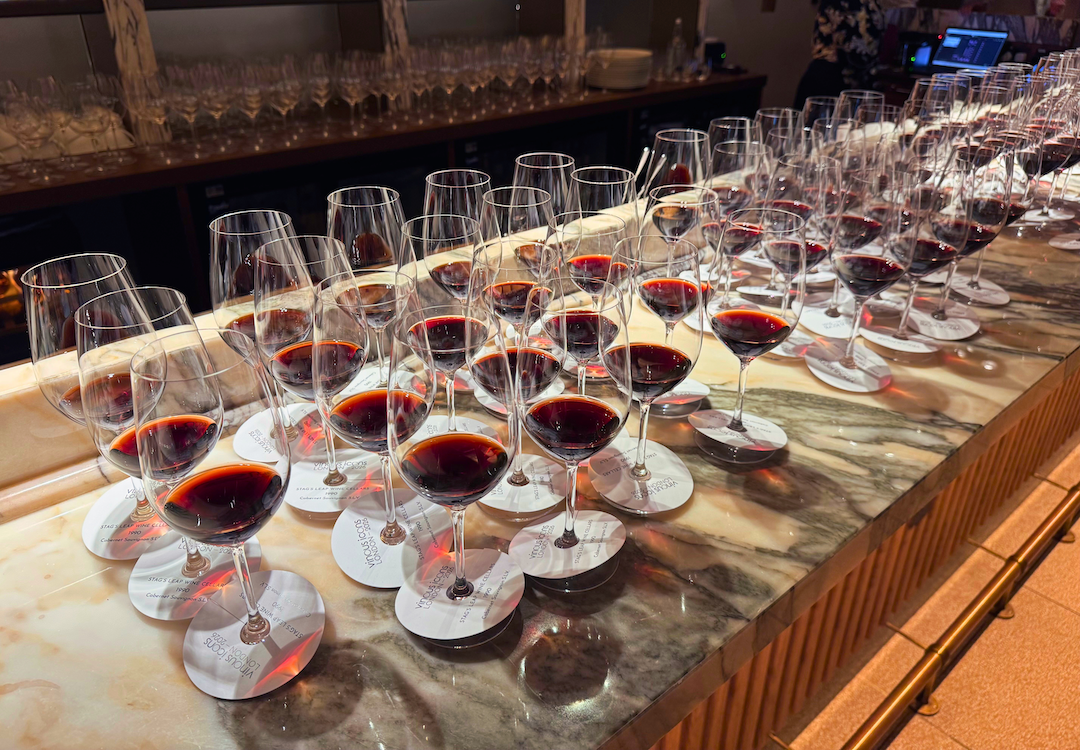
Preparing wines for service.
Stag’s Leap Wine Cellars: A Brief History
Warren Winiarski will be remembered as one of the most influential figures in the history of American wine. The son of Polish immigrants, Winiarski was born in Chicago in 1928. He studied humanities at St. John’s College in Annapolis, Maryland. There, he met his future wife, Barbara. Winiarski then pursued a graduate degree in political science at the University of Chicago. Those studies took Winiarski to Italy, where he devoted himself to works of the most influential political figures of the Renaissance while also becoming immersed in all aspects of Italian culture, language and, of course, wine. He later returned to the University of Chicago, where he took up a post as Lecturer in the Liberal Arts while completing work on master’s and doctorate degrees. A bottle of wine gifted to him was a turning point, as it connected Winiarski’s upbringing as a young boy watching his father make flower and fruit wines for home consumption with his experiences in Italy. All of this happened as the Winiarskis were contemplating a major life change. A few years later, the Winiarskis moved to Napa Valley with their young family.
Warren Winiarski spent two years working as an intern with Lee Stewart at Souverain before being hired as the first winemaker at Robert Mondavi Winery in 1966. Two years later, Winiarski decided to start his own winery and bought a property on Howell Mountain. He was intrigued by what he had heard about Nathan Fay’s experiments with irrigation and paid Fay a visit. The year was 1969. Winiarski tasted Fay’s 1968 Cabernet Sauvignon and knew instantly he had found the perfect place to make the wine he had conceived in his mind. As luck would have it, I had a chance to taste Nathan Fay’s 1968 Cabernet Sauvignon a few years ago. It was still exceptional. I can only imagine what it must have tasted like to a young Warren Winiarski in 1969!
Winiarski bought 44 acres of adjoining land from Fay and set out to develop what was then a prune orchard into a vineyard and winery. Winiarski founded Stag’s Leap Wine Cellars in 1970. In 1976, the 1973 Stag’s Leap Cabernet Sauvignon Stag's Leap Vineyards. won the famous Judgment of Paris tasting, vaulting Winiarski and Stag’s Leap Wine Cellars to global prominence. A decade later, Winiarski purchased Nathan Fay’s vineyard. In 1990, Winiarski bottled his first vineyard-designate Cabernet Sauvignon from that site and began using fruit from Fay in the Cabernet Sauvignon Cask 23, a barrel selection first produced in 1974 that had previously been made only with S.L.V. fruit.
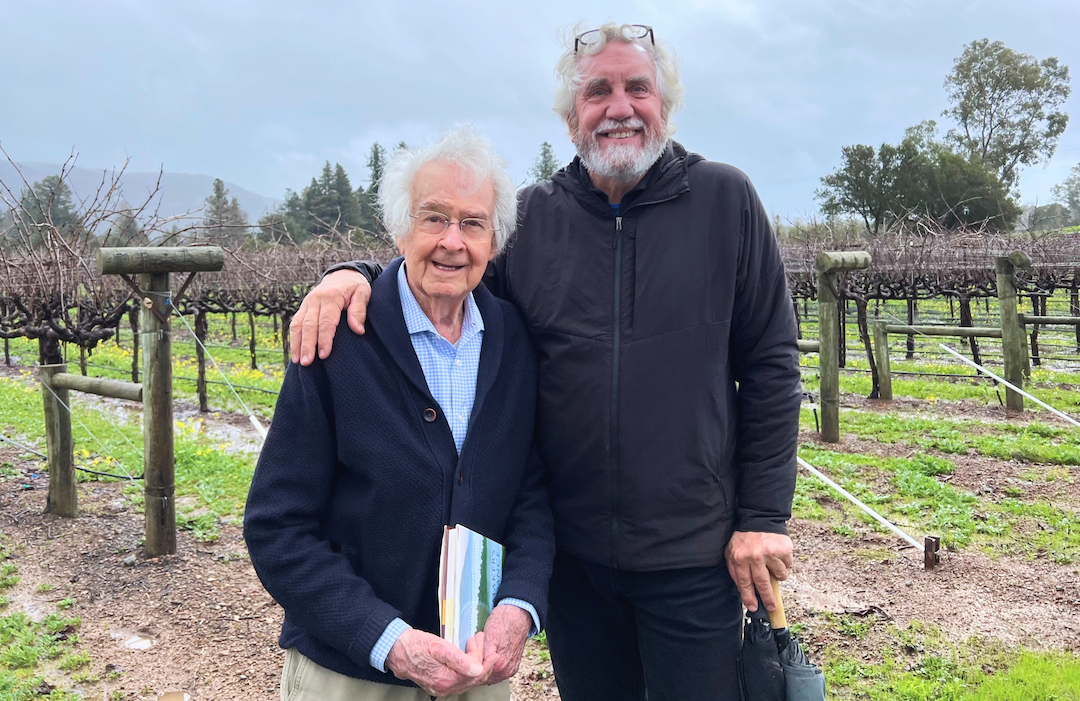
Warren Winiarski with John Kongsgaard, one of his protégés, at the Arcadia Vineyard in Coombsville.
Stag’s Leap Wine Cellars was a magnet for talent. André Tchelistcheff and John Williams were both pivotal figures in the winery’s early days. Michael Silacci, now Head Winemaker at Opus One, was winemaker for six years through 2001. Françoise Peschon, Andy Erickson, Paul Hobbs, John Kongsgaard and the late Dick Ward all spent time here.
In 2013, a bottle of the 1973 Cabernet Sauvignon Stag's Leap Vineyards became part of a permanent collection at the Smithsonian. Barbara and Warren Winiarski remained deeply involved in the Napa Valley community until their passings in 2021 and 2024, respectively. The Antinori family purchased Stag’s Leap Wine Cellars in 2023, but the relationship between the two families stretches back several decades. As early as 2007, Winiarski sought to guarantee continuity for his cherished estate. He wanted to sell to a family, not a company. Antinori was not in a financial position to buy the winery. Ultimately, Winiarski agreed to sell to a financial buyer, but only if Antinori had a minority position and the first option to purchase the remaining equity. By 2023, the conditions were in place for Antinori to assume full ownership. In 2025, Antinori acquired the Arcadia Vineyard in Coombsville from the Winiarski estate.
Video: Marchese Piero Antinori on the Stag’s Leap Wine Cellars legacy.
Personal Recollections
I had the pleasure of spending time with Warren Winiarski on multiple occasions before his passing in 2024. He remained deeply passionate and intellectually curious all the way through to his later years, displaying a rare sense of humility for someone who had achieved so much. Above all else, he had a real zest for life. I remember meeting Winiarski in Coombsville, at his Arcadia Vineyard (a core source for the Artemis Cabernet) with John Kongsgaard, while I was researching our Coombsville vineyard map. He was so precise, so meticulous, in every description. We then had lunch at nearby Bistro Don Giovanni. Winiarski ordered his meal in perfect Italian. He then pulled out a folder with all the Vinous Napa Valley maps and proceeded to grill me with questions. Most of our maps have small mistakes, some not so small, truth be told. I sat there praying he would not call me out on those. A year later, we launched the Coombsville map at the Culinary Institute of America at Copia in downtown Napa. Winiarski sat in the front row and asked questions of the panelists with all the enthusiasm of a first-year college student.
Aubert de Villaine looks back on the Judgment of Paris.
The Judgment of Paris
Two thousand twenty-six marks the 50th Anniversary of the Judgment of Paris. On that fateful day, a group of experts gathered in Paris for what was originally supposed to be a tasting of California wines, but organizers Steven Spurrier and Patricia Gallagher slipped in some French wines, too. Attendees were asked to take notes and submit their rankings at the end of the tasting. Stag’s Leap Wine Cellars’ 1973 Cabernet Sauvignon Stag's Leap Vineyards took the top spot, an incredible achievement for an unknown Napa Valley wine from a four-year-old vineyard. George Taber’s report on the tasting, published in Time Magazine, became the shot heard around the world.
The Judgment of Paris is widely considered a seminal moment, as it proved American wines could stand shoulder to shoulder with French wines. The California wines served in that tasting helped pave the way for the American wine industry as we know it today. The narrative around the Judgment of Paris often centers around its importance for American wine. But it was more than that.
In preparation for our event, I wanted to learn more about the Judgment of Paris. I visited twice with Aubert de Villaine, legendary former Co-Director of Domaine de la Romanée-Conti, one of the few judges that day who is still living. He shared that the tasting was a serious wake-up call for French producers. Jean-Philippe Delmas at Haut-Brion, which was also served at the Judgment of Paris. echoed that sentiment. In short, the Judgment of Paris had a profound impact on a very large portion of the fine wine industry as it existed at the time.
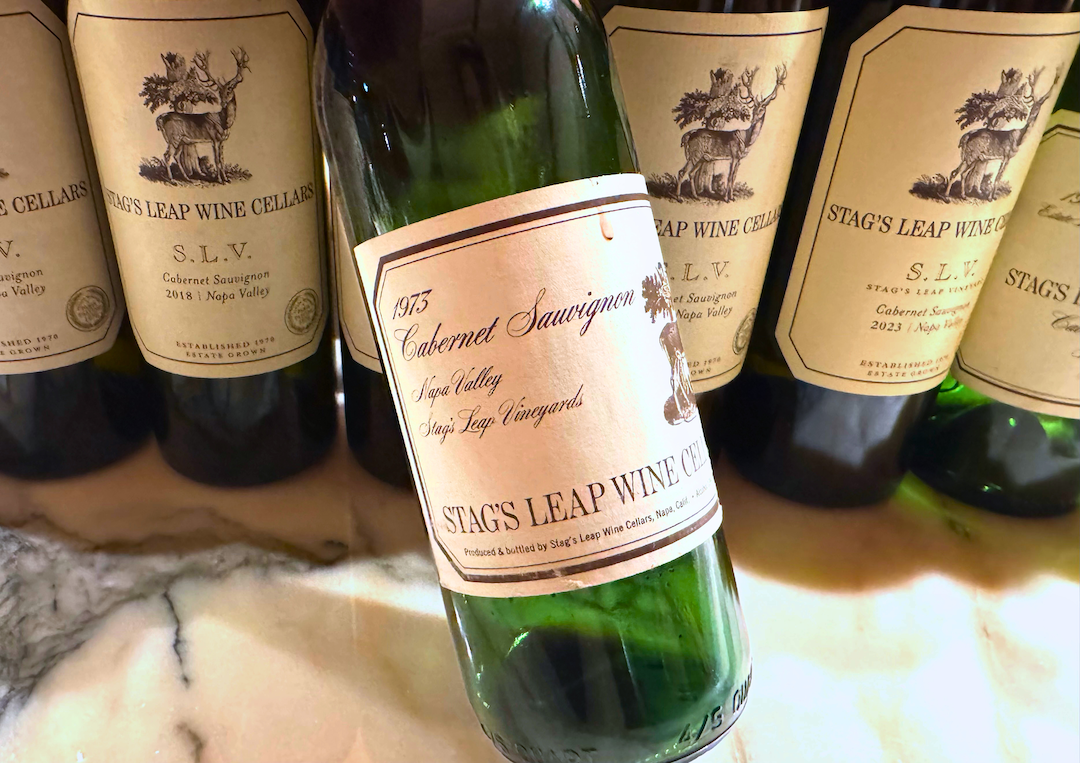
The epic 1973 Stag’s Leap Wine Cellars Cabernet Sauvignon Stag's Leap Vineyards.
S.L.V. – Stag’s Leap Vineyard
Stag’s Leap Vineyard runs across the eastern part of Napa Valley into the foothills of the Palisades Mountains. Young, rocky soils of volcanic origin yield wines with notable tannic clout and structure. Warren Winiarski planted his first vines here in 1970. There are currently approximately 55 acres under vine after a reclassification by soils led the back sections of Fay, where terrain is rocky, to be relabeled under S.L.V. Fay is about the same size as S.L.V. Nathan Fay planted Cabernet Sauvignon here in 1961. It was the first Cabernet Sauvignon in what later became the Stags Leap District AVA. Fay now includes a 12-acre parcel the winery acquired from the Fay family in 2021. Fay is defined by deeper, clay-rich alluvial soils. Winiarski often referred to S.L.V. as “fire” and Fay as “water.”
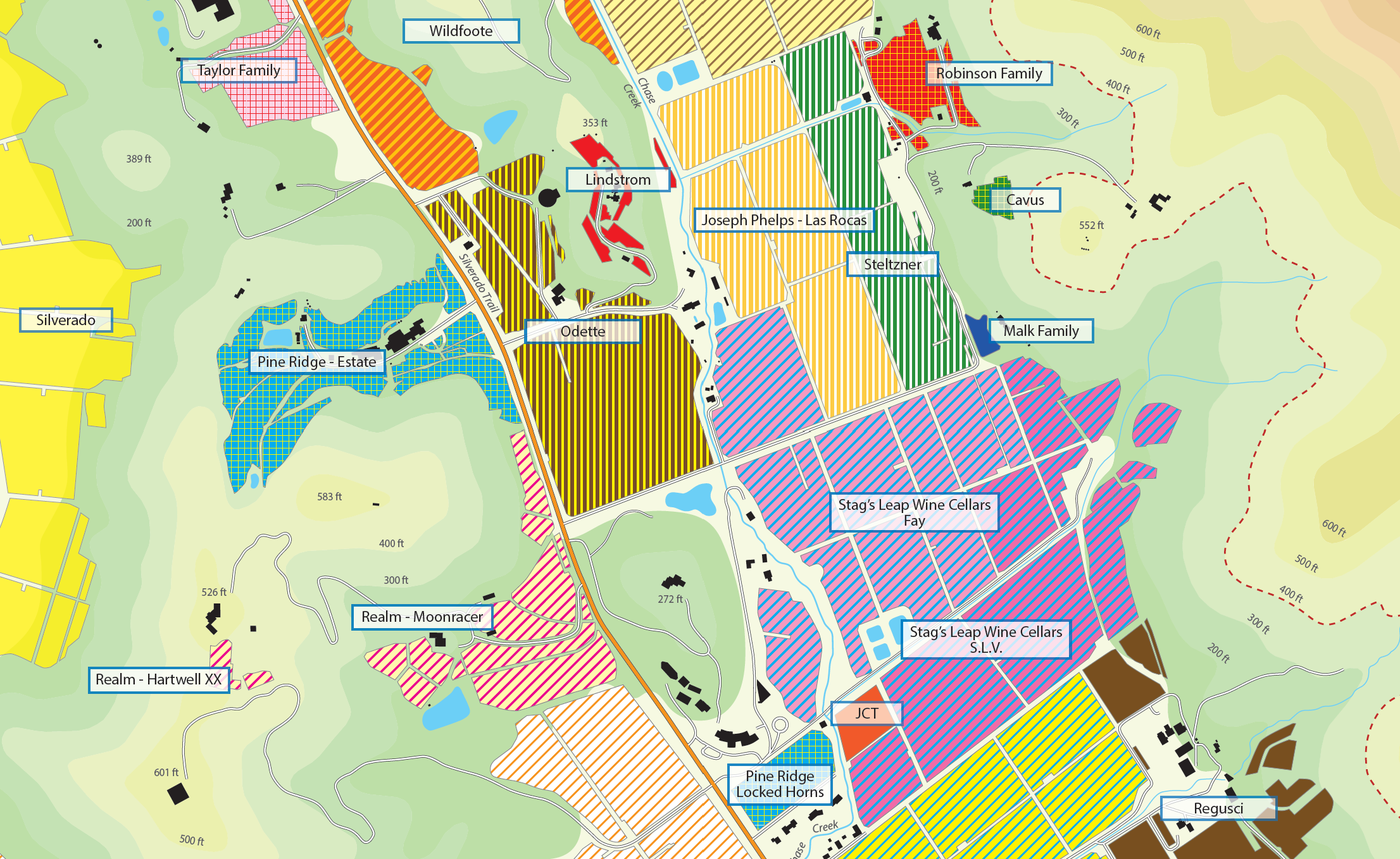
Stag’s Leap Wine Cellars’ S.L.V. and Fay Vineyards, as seen in the Vinous Map of Stags Leap, updated 2026, by Antonio Galloni and Alessandro Masnaghetti © 2016-2026 Vinous
The London Tasting at Cornus
Cornus is one of my favorite restaurants in London. Its location in posh Belgravia is perhaps a bit out of the way relative to the most central and high-end districts in London, but make no mistake about it, Cornus is more than worth a short trip. When it came time to select a location for this dinner, Cornus was at the top of my list. Executive Chef Gary Foulkes prepared a brilliant menu that had me thinking about my next visit during dinner.
I chose a wide range of vintages with the goal of offering guests a representative look at the last six decades at Stag’s Leap, while also trying to keep the number of wines reasonable. As is our custom, I organized the wines in thematic flights and in a specific order within those flights to best highlight the unique attributes of each vintage. Readers will notice the absence of vintages from the early 2000s. That was a period when Stag’s Leap Wine Cellars, like many estates in Napa Valley, struggled with Brettanomyces.
I tasted all the wines with Cornus’ Wine Director, Melania Battiston, one of London’s most respected sommeliers. We opened all the bottles in the late afternoon and double-decanted to remove sediment. I personally tasted each bottle, three per vintage. Any bottles that were less than perfect were set aside. I was very happy to see how well the older vintages had held up, as some were vintages I had not tasted in some time. Then again, that is the benefit of tasting bottles that have been impeccably stored for decades.
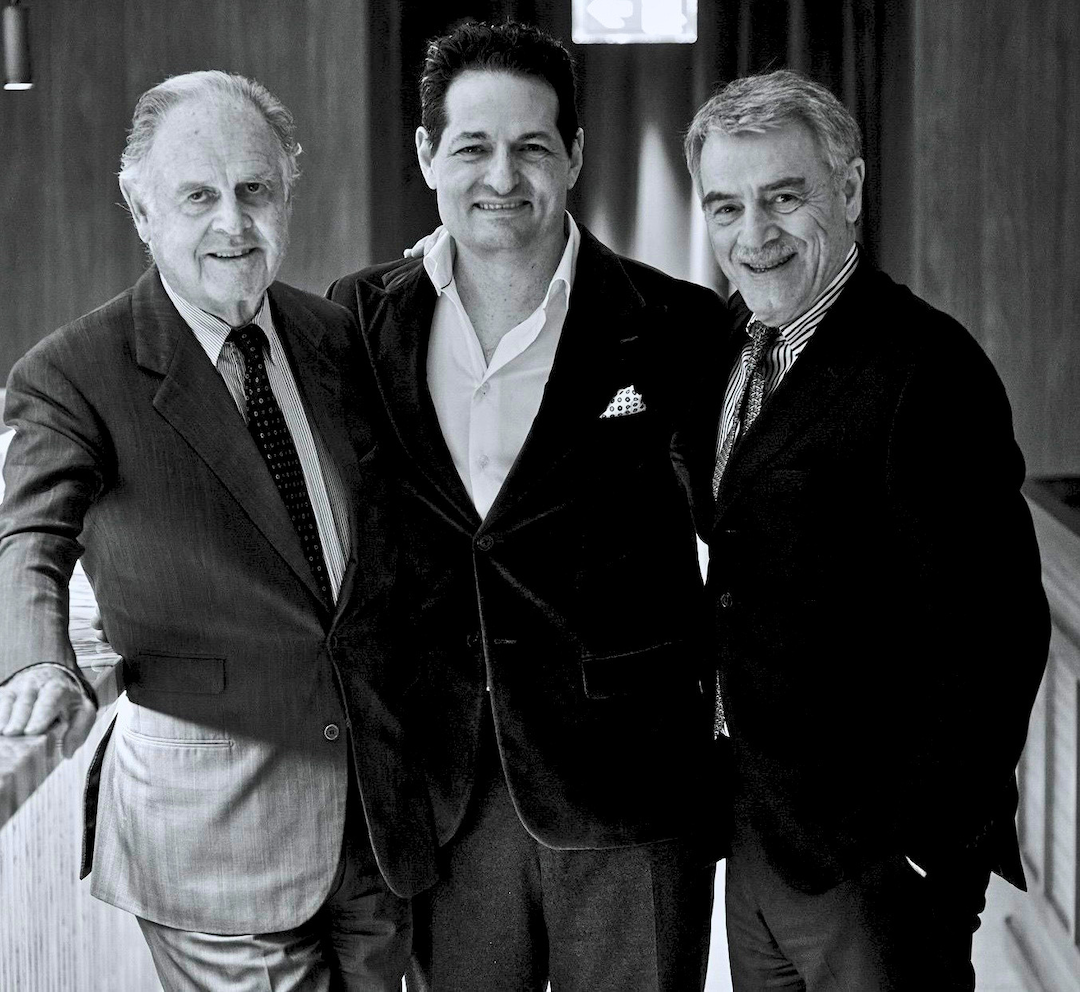
With Marchese Piero Antinori (left) and Antinori CEO and Head Winemaker Renzo Cotarella (right)
Passed Canapés
Jacquesson 2014 Avize Champ Caïn Grand Cru
Antinori - Castello della Sala 2019 Cervaro della Sala
Handpicked Devon Crab; Hass Avocado, Wasabi and Finger Lime
Warm Pressed Duck; Apple, Walnut and Italian Bitter Leaves
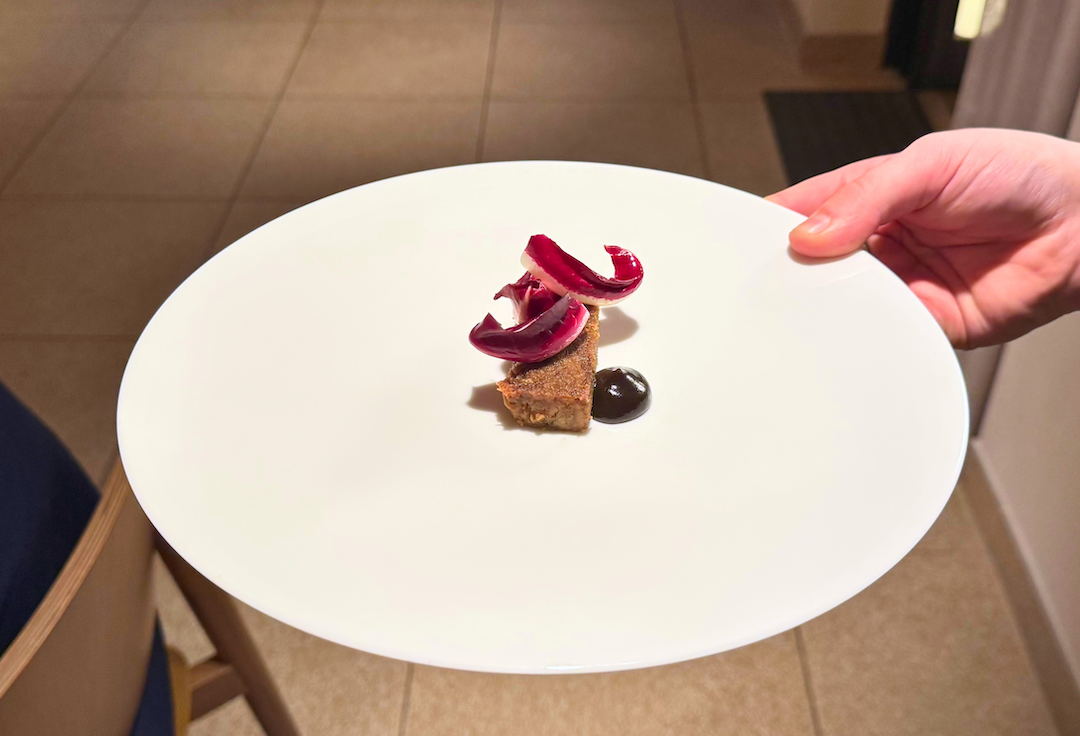
Warm Pressed Duck; Apple, Walnut and Italian Bitter Leaves.
An Introduction
Hand-Rolled Spaghetti; Parmesan and Pèppoli Olive Oil
2000, 2008, 2010 & 2013 Cabernet Sauvignon S.L.V.
It’s never easy to know where to start at a dinner like this, where all the vintages have been specifically selected for their strengths. The 2000 and 2008 are beautiful wines for drinking now. In this context, the 2010 comes across as shockingly opulent, especially compared to the wines of today. I find the 2013 underwhelming.
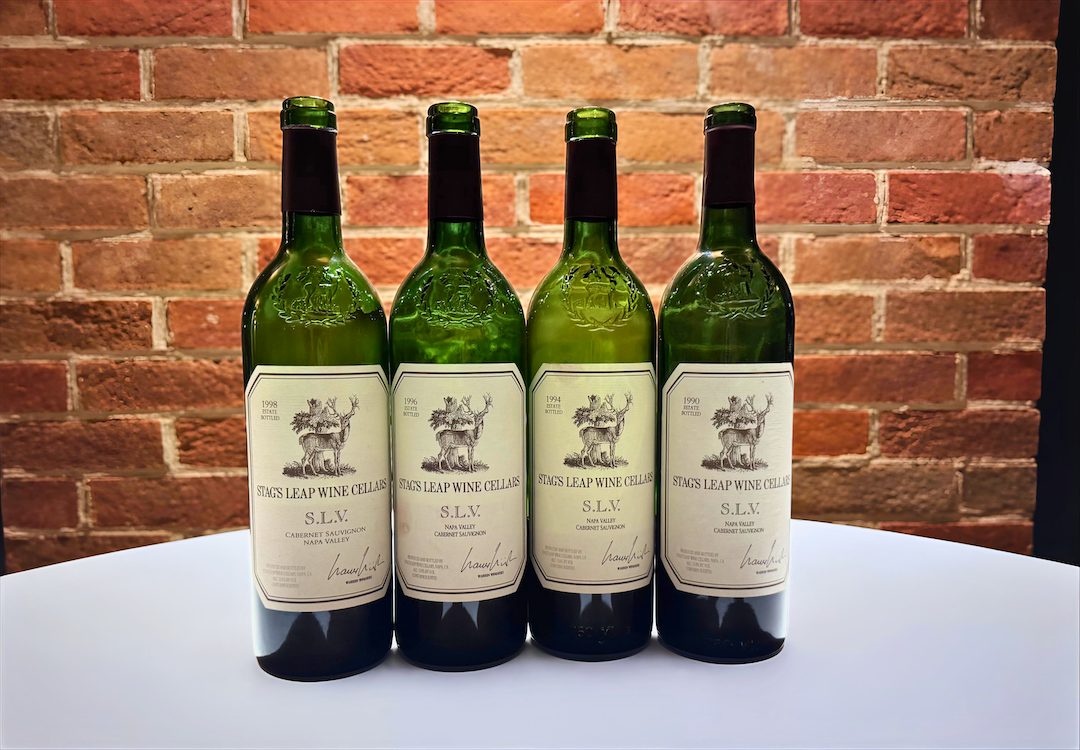
Four gorgeous wines from the 1990s.
The 1990s
Slow-Cooked Veal Cheek; Creamed Potato, Large Leaf Spinach and Hazelnut
1998, 1996, 1994 & 1990 Cabernet Sauvignon S.L.V.
This is one of the most surprising flights of the evening, perhaps because the wines were made and released at a time when attention in Napa Valley was shifting to some of the new players on the block. The 1998, from one of the most challenging vintages of the decade, is pristine. I also loved the 1994 in this flight; it’s a super-classic Cabernet Sauvignon from a justly renowned year.
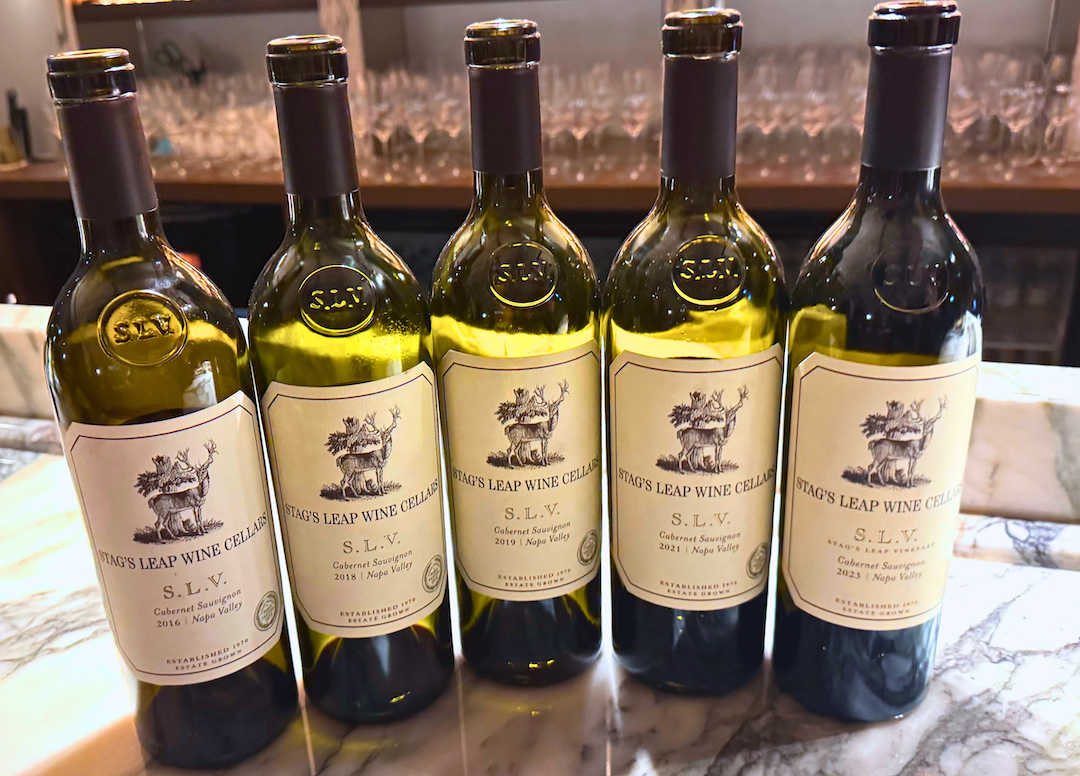
Modern-Day Classics
Chef’s Selection of Cheeses; Comté & Gouda
2016, 2018, 2019, 2021 & 2023 Cabernet Sauvignon S.L.V.
I chose to serve this flight in sequential ascending order to highlight evolutions in farming and winemaking under the leadership of Antinori Head Winemaker Renzo Cotarella and Winemaker Marcus Notaro. Specifically, the team has moved the wines in a direction that favors greater freshness than in the prior decade through picking earlier, gentler winemaking and more polished use of French oak. Those qualities are especially evident in the 2023, a wine from a cold, late-ripening year with a very bright future.
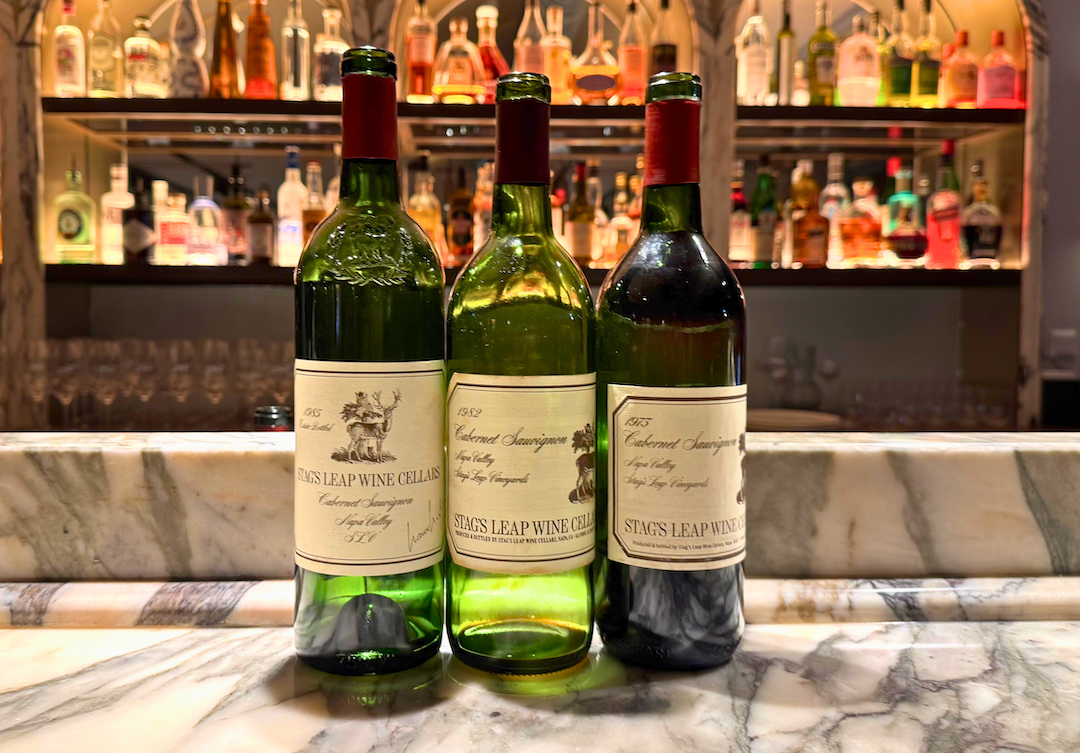
Our closing flight is truly memorable.
Raiding the Cellar
1985 Cabernet Sauvignon S.L.V., 1982 & 1973 Cabernet Sauvignon Stag's Leap Vineyards
The last flight more than lives up to the anticipation that has been building all evening. Yes, the 1973 is extraordinary. I can vouch for all three bottles. But before we get there, we enjoy the magnificent 1985. What a wine. The 1982 (also labeled as Stag's Leap Vineyards) is even better. It’s a reminder that all wines have their day. The 1982, made with vines that were a dozen years old at the time, is having a moment. It is the new 1973 for Stag’s Leap Wine Cellars. I would be thrilled to own it. The 1973 is, of course, the most famous wine made in Napa Valley over the last fifty years. It’s in spectacular shape. At the same time, the vines were just four years old at the time, and the wine is starting to lose some of its mid-palate depth. That’s not at all surprising, especially for a wine of its age, but it does serve as a reminder that no wine is immortal. For readers who still own the 1973, what are you waiting for? The wine will never be better than it is right now.
As the evening wound down, I had a chance to revisit many of the wines, including the 1973 and the 1982, which stole the show. Those wines told the story of a very special place capable of making extraordinary wines that stand the test of time. As is so often the case, though, my most vivid memories will always be of the great conversations that were shared on what was truly an unforgettable night.
© 2026, Vinous. No portion of this article may be copied, shared or redistributed without prior consent from Vinous. Doing so is not only a violation of our copyright but also threatens the survival of independent wine criticism.
You Might Also Enjoy
Napa Valley Soars: The 2023 & 2024 Cabernet Sauvignons, Antonio Galloni, November 2025
2015 Napa Valley Cabernet Sauvignon: In the Zone, Antonio Galloni, November 2025
Napa Valley’s 2022 & 2023 Cabernet Sauvignons, Antonio Galloni, December 2024
The 2021 Napa Valley Cabernets, Part One, Antonio Galloni, December 2023
Napa Valley: The Frantic 2020s & Stunning 2021s, Antonio Galloni, February 2023