
Browse using the new Vinous website now. Launch →
Printed by, and for the sole use of . All rights reserved © 2015 Vinous Media
Rocca di Montegrossi: Act Two
BY ANTONIO GALLONI | FEBRUARY 26, 2026
This recent vertical was a terrific opportunity to revisit a number of older wines, essentially picking up where my 2018 article, Rocca di Montegrossi: Chianti Classico Vigneto San Marcellino 1995–2013, left off a few years ago. From his first vintage in 1995, Marco Ricasoli-Firidolfi has crafted powerful yet elegant wines that capture the truest essence of this very special part of Chianti Classico.
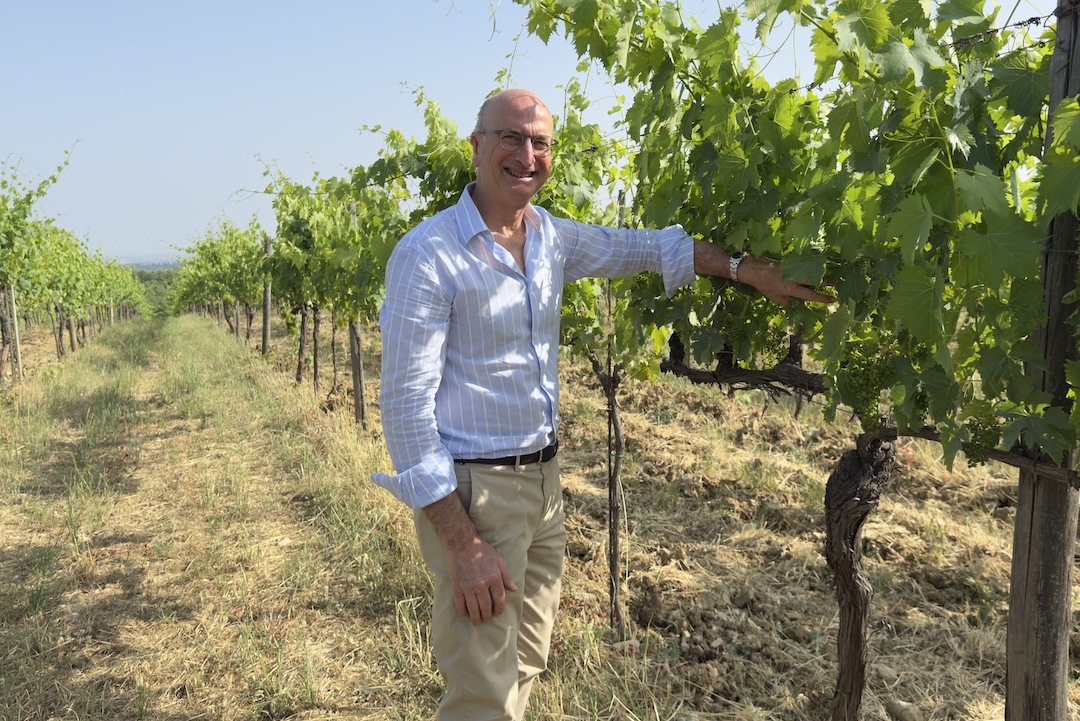
Marco Ricasoli-Firidolfi in one of the old-vine Sangiovese parcels in San Marcellino.
A Brief History
Rocca di Montegrossi is located in Gaiole’s Monti district, a strip of vineyards in the south of the commune that includes Brolio and San Giusto a Rentennano. Monti and the estates that surround it are quite different in character from the stretch of higher-elevation vineyards to the southwest that runs through Ama and San Sano, and the patchwork of sites that surrounds the town of Gaiole itself. Alberese soils here are high in calcium, which is one of the reasons the wines are intense in color and rich in texture.
The Ricasoli family’s history is a tapestry laced with numerous strands, speaking to the rich cultural legacy of Tuscany and Chianti Classico. Originally of Longobard origins, the Ricasolis trace their lineage back to at least the seventh century, making them one of the oldest families in Tuscany. Records show that the Ricasolis owned the Brolio castle as far back as 1141. In the twelfth and thirteenth centuries, the Ricasolis were feudal lords tasked with protecting Florence from the Republic of Siena during the Wars of the Guelphs and Ghibellines. The Ricasolis were also among the first families to recognize the potential of their land for agricultural purposes. In more contemporary times, and as it pertains to wine, the Ricasoli history starts in the 19th century. Bettino Ricasoli, known as the Iron Baron, was one of the creators of Chianti wine in the late 1800s and served twice as Prime Minister of Italy.
The modern-day history begins with Bettino Ricasoli's great-grandson (also named Bettino) and his brother, Alberto, along with their four sisters. In the 1960s, this generation of the Ricasoli family sold the “Barone Ricasoli” brand to the Seagram Company, but the Ricasolis retained ownership of the Castello di Brolio, its vineyards and the land. At the time, the family had an arrangement to sell grapes and bulk wine to the Barone Ricasoli label. Later, in 1993, Francesco Ricasoli (Bettino the second’s son) bought the family brand back from Seagram’s.
Frustrated by a lack of control in the operation, Alberto Ricasoli decided to leave the family winery. It was the mid-1960s, a time when Chianti Classico did not enjoy anywhere near the visibility it does today. Alberto and his wife, Elisabetta, moved to Castello di Cacchiano, where they planted vineyards for their new estate between 1965 and 1968. Sadly, Alberto passed away in 1972 before seeing the real fruits of his labor. A few years later, American wine broker Marc de Grazia, who was just getting started, sought to represent Cacchiano, but he was not able to reach an agreement to do so because the winery already had an exclusive arrangement with another importer. Elisabetta Ricasoli created Rocca di Montegrossi as a way of meeting this increased demand. She named her new label after the fortress on the site of the first Ricasoli settlement, which dates to 1530, and later dedicated the top wine to Geremia, the family patriarch. During this time, Rocca di Montegrossi was essentially a sister label to Castello di Cacchiano, as the wines for both labels were made from the same vineyards.
Alberto and Elisabetta had two sons, Giovanni and Marco, and a daughter, Claudia. In time, the two sons would have a falling out that ultimately led to Marco leaving the family winery to set up his own estate in 1994. He was just 24 at the time. Elisabetta gave Marco a small 7.5-hectare vineyard with which to start his new project and the Rocca di Montegrossi brand. That vineyard, San Marcellino, takes its name from the church located on the property. Marco also received help from his aunts, Francesca and Lisa Ricasoli, who had no direct heirs; they contributed vineyards as well as a winemaking facility that was later renovated with substantial investment.
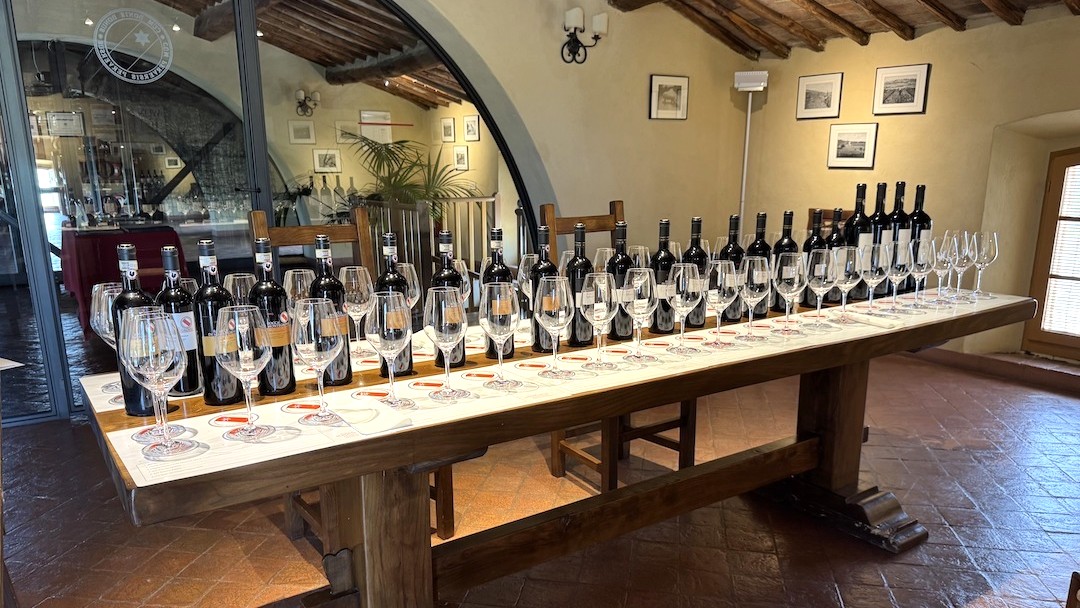
A stunning lineup of Chianti Classico Gran Selezione Vigneto San Marcellino, Geremia and Ridolfo at Rocca di Montegrossi.
In its early days, the estate made a Chianti Classico Vigneto San Marcellino that was mostly Sangiovese with a touch of Canaiolo. The Geremia was a 100% Sangiovese IGT in the mold of Le Pergole Torte, Flaccianello, Cepparello, Percarlo and other pure Sangioveses that were created during a time when Chianti Classico regulations required growers to blend in other grapes (thereby expressly forbidding 100% Sangiovese wines from being Chianti Classico). San Marcellino was first released as a Chianti Classico Riserva. Fed up with what he viewed as inconsistent quality in Riserva bottlings, Ricasoli withdrew from that designation with the 1999 vintage. Since 2010, San Marcellino has been a Gran Selezione, a relatively new tier in the qualitative hierarchy that was created for the finest estate Chianti Classicos.
The original San Marcellino vineyard was developed in the 1960s. Like many vineyards planted during this era, the focus was on quantity rather than quality, hence the desire to make two selections of Sangiovese. Ricasoli began converting the vineyards with an emphasis on quality. By 2006, the vineyards were all farmed organically. In the mid-1990s, Ricasoli planted Merlot and Cabernet Sauvignon. Once those vines were of sufficient age, they gave rise to the present-day Geremia, a blend of 70% Merlot and 30% Cabernet Sauvignon, starting with the 2001 vintage. The Chianti Classico Vigneto San Marcellino gradually became a pure Sangiovese starting in 1999 through 2006, when a dollop of Pugnitello was added to the blend.
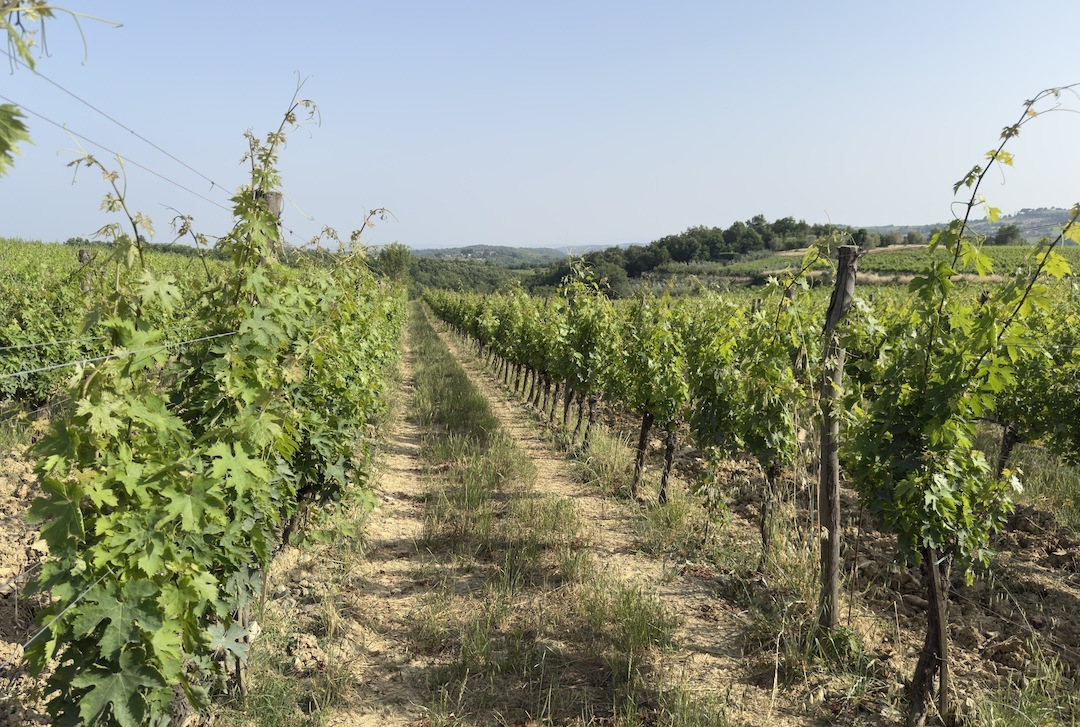
Cabernet Sauvignon in the Ridolfo Vineyard.
The flagships remain the Chianti Classico Gran Selezione Vigneto San Marcellino and the Geremia. With the 2016 vintage, Rocca di Montegrossi introduced Ridolfo, a Cabernet Sauvignon/Pugnitello blend that is sold only in large-format bottles. In just a few years, Ridolfo has established itself as one of the most distinctive wines in Tuscany. The rest of the range is equally impressive. Rocca di Montegrossi’s straight Chianti Classico is consistently among the best wines in its category. The Vin Santo, done in a rich, exotic style, is always compelling. Last but not least, the Rosato is a fine choice for the warmer summer months.
In the Cellar
Winemaking has not changed much over the years, although Ricasoli varies his approach quite a bit in response to the unique attributes of each vintage. Primary fermentation lasts 10 to 14 days. When conditions allow, alcoholic fermentation is followed by several weeks of maceration, which can extend total time on the skins to 30-40 days. Malolactic fermentation is done in French oak. In the early days, Rocca di Montegrossi relied mostly on barriques. Today, at least one-third of the wines are aged in larger 500-liter tonneaux. The wines spend anywhere from 24 to 27 months in barrel—on the long side for present-day Chianti Classico—followed by another two years or so in bottle before release. New oak is between 15% and 30%, and the barrels are medium toast.
I tasted all the wines in this article during a visit to the estate in June 2025. Some of this historical information is repeated from my previous report Rocca di Montegrossi: Chianti Classico Vigneto San Marcellino 1995–2013, which we published in 2018.
© 2026, Vinous. No portion of this article may be copied, shared or redistributed without prior consent from Vinous. Doing so is not only a violation of our copyright but also threatens the survival of independent wine criticism.
You Might Also Enjoy
Rocca di Montegrossi: Chianti Classico Vigneto San Marcellino 1995–2013, Antonio Galloni, August 2018
Chianti Classico: Riding Out the Storm, Antonio Galloni, July 2025
Chianti Classico: The Magnificent 2021s, Antonio Galloni, July 2024
Chianti Classico: The Brilliant 2021s & Variable 2020s, Antonio Galloni, August 2023
Chianti Classico & Neighbors: Looking at the 2020s and 2019s, Antonio Galloni, July 2022