
Browse using the new Vinous website now. Launch →
Printed by, and for the sole use of . All rights reserved © 2015 Vinous Media
It’s Rousseau’Clock: Grand Crus 1967-2019
BY NEALMARTIN | FEBRUARY 3, 2026
My existence on this planet overlaps with several things that have brightened my life…
Star Wars.
Late ‘80s raves.
ParkRun.
Murakami.
The Sopranos.
Elizabeth II.
My Bloody Valentine.
Vinyl/resurgence of vinyl.
Open-heart surgery.
Life without the internet
And…cue drumroll…
Affordable Rousseau.
I have fond memories of sashaying back to my ‘umble abode, opening the front door and declaring to those within earshot, usually my two cats Brian and Uma, that it was “Rousseau’Clock.” I would pop a cheeky Gevrey-Chambertin or Clos Saint-Jacques for the banal reason that I regarded it as Pinot Noir in excelsis. These were halcyon days when, if I had a couple of hours to kill before my train from Dijon, I would ring the Rousseau doorbell, and a ding-dong later, there was ‘umble old me being guided around the barrels by Charles Rousseau (who was wearing a jumper and jeans combo so tatty that it would probably be outlawed in contemporary Burgundy, where looks matter).
Those days are gone—nothing I, nor indeed Charles’s son, Eric, or granddaughter and current winemaker, Cyrielle Rousseau, can do about that. Burgundy’s ascension to a vinous mecca catapulted its most revered winemakers into an Elysium whereby the laws of supply and demand stoked a frenzied secondary market. At peak craziness, I recall a friend ruminating about selling his three cases of Chambertin for a sum that could pay off my mortgage. Even he was flabbergasted. Thirty-six bottles were worth the same as my semi-detached house.
This underlined how divorced the market had become from reality. The creators of that Chambertin could only look on in bafflement and altruistically maintain reasonable ex-cellar prices, rather than cashing in to buy a Porsche (and hiding it to maintain paysan credentials). As the bubble deflates, I suspect the Rousseaus are relieved. This market correction has done nothing to dent their reputation because, fundamentally, their wines have always been nectar to the taste buds.
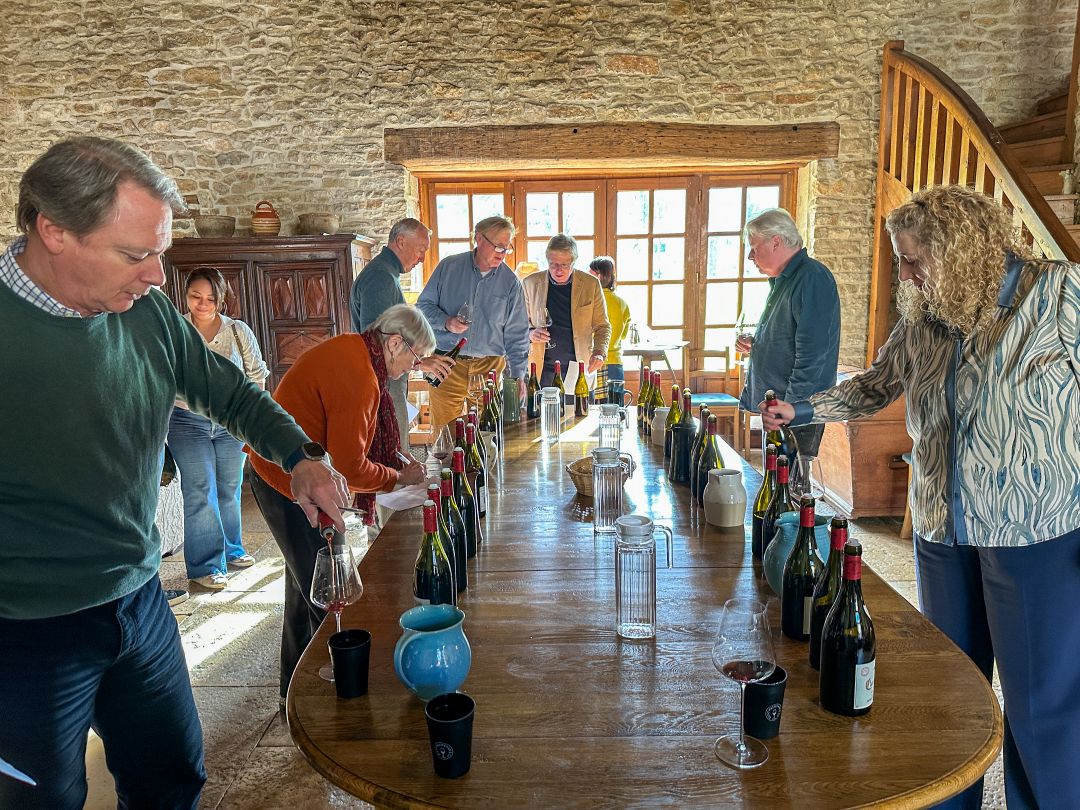
Though I continue to ring that same doorbell every year, nowadays my pockets are not deep enough to guzzle Rousseau with such nonchalance. I am thankful for munificent friends who share bottles and uphold the raison d’être that Rousseau is for drinking.
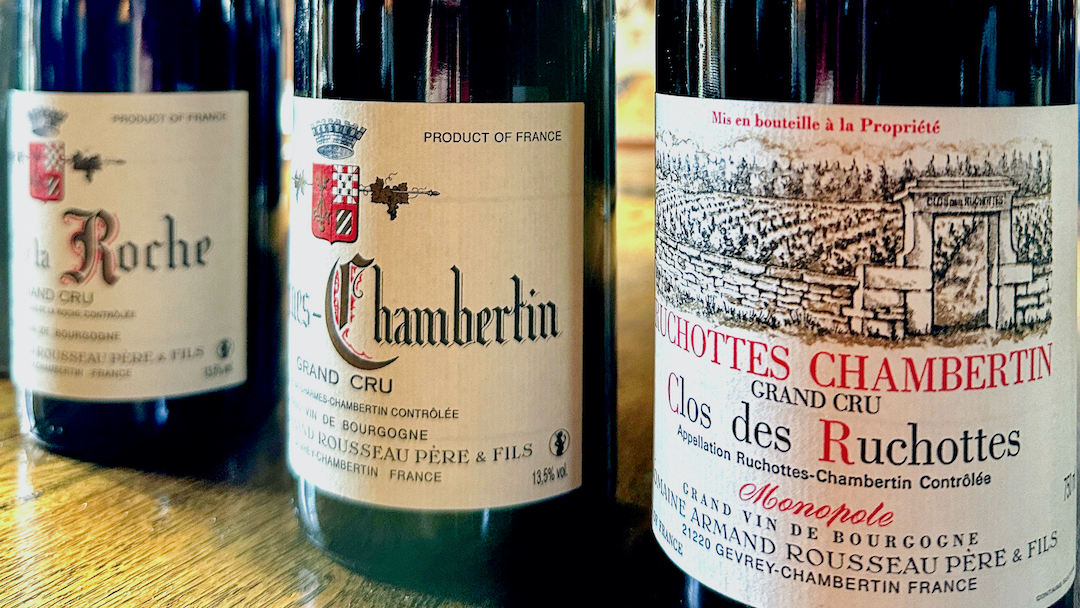
This article stems from a walk-around tasting last November at the home of Russell Hone and the late, much-missed Becky Wassermann, in Bouilland. The bottles had been cellared by a Burgundy lover who has spent a lifetime buying Rousseau and whose generosity knows no bounds. Thirty-two bottles were lined up on a single table, themed around three Grand Crus: Ruchottes-Chambertin, Charmes-Chambertin and Clos de la Roche. I have included additional notes from other lunches and dinners, including several from La Paulée, which immediately followed this smorgasbord. Yes, it was one of those frenetic days where one extraordinary bottle followed another.
For in-depth background on Rousseau’s history, holdings and viticulture, I refer readers to the Chambertin vertical from 2022, but this is a brief overview.
Vineyards
Rousseau’s holding in Ruchottes-Chambertin consists of the 1.06-hectare monopole in the lieu-dit that Clos des Ruchottes bought from merchant Thomas Bassot in 1977, the same transaction whereby Georges Mugneret and Michel Bonnefond took over the remainder of the Grand Cru since Rousseau had to split the cost (read more here). Bonnefond leased his part to Domaine Roumier. Among the vineyard’s eight current owners, Rousseau presides over the largest holding by some margin. Located in the upper sector on white oolite soils where the mother-rock occasionally rips the surface, Rousseau’s holdings are relatively protected from the cooling influence of air running down the Combe de Lavaux. Young vines have been replanted since 2003 to complement and eventually replace the older vines. In Charmes-Chambertin, Rousseau owns three parcels that comprise 1.47 hectares: 0.86 hectares in Mazoyères-Chambertin and 0.61 hectares in Charmes-Chambertin itself. The Clos de la Roche holdings are also divided into two plots totalling 1.48 hectares, one in the lieu-dit of Les Fremières purchased in the 1920s, and the other acquired in 1975 in the namesake lieu-dit of Clos de la Roche.
Eric Rousseau was present at this tasting. Though I have visited the estate countless times, I admit that we have never become well acquainted, save for the occasional bonjour. He seems cut from the same cloth as his father, down to earth and self-effacing, indifferent to the hoopla that surrounds his family name, refreshingly devoid of airs and graces. He is apparently no longer directly involved in the running of the domaine.
Eric Rousseau deserves credit for taking the wines to a higher level, especially in terms of viticulture—debudding hard early in the season and lowering yields that were occasionally too high under his father. He also ceased the liberal use of potassium to fertilize the soils, which marred some of the wines in the 1970s and 1980s. Rousseau introduced ploughing in 2000 and ceased the use of insecticides, though non-organic treatments are applied when there is no alternative. Sorting is undertaken in the vines during harvest rather than using a table de tri at the winery reception, and practically all the bunches are destemmed. While the Chambertin and Clos-de-Bèze are raised in 100% new oak from the François Frères cooperage, plus a little from the Rousseau cooperage (possibly a distant branch of the family), the other Grand Crus are predominantly raised in one-year-old oak.
I met Cyrielle Rousseau in the first year she joined her father. Personality-wise, she seems similar to her forebears, diffident upon first acquaintance and uninterested in the fuss and exultation that surrounds the domaine. She always seems so sanguine, no matter what is going on beyond the domaine’s walls. Cyrielle Rousseau is devoted to the vines and terroir…and her beloved dogs.
The Wines
My main takeaway from this retrospective was Rousseau’s consistency. A high base level of quality underpins the domaine’s reputation as a trustworthy address beyond compare. No domaine is infallible, but after drinking these wines for over a quarter-century, I can attest that their hit rate is second to none. It was easy to see the signature traits across all the wines presented here: red rather than black fruit (even in the hotter growing seasons), transparency, fineness of tannins, brightness, length and typicité. Their sheer drinkability, a virtue too often overlooked, is almost unmatched in Burgundy. There is nothing manipulated or concocted. Underlying all of these wines is a moral duty to translate the vagaries of each season, be it the opulence of 2009 or the structure of 2010.
Two vintages that stood out were 2012, the first vintage in which Cyrielle Rousseau joined her father, and 2017—both challenging, cool years. The latter punched well above expectations, and I might have my beady eye on any of those if you see them for sale. The only vintage that I felt did not pass muster was 2008, a troubled season for red Burgundy. The 2008s were the only wines that lacked stuffing and the level of fruit that would have rendered their finishes less austere.
In terms of comparing each cuvée, the Ruchottes-Chambertin Clos des Ruchottes showed its mettle, revealing more complexity than both the Charmes-Chambertin and Clos de la Roche. The limestone terroir imparts a magical sense of mineralité that can be thrilling in the glass. This spellbinding quality was no surprise since I was privileged to attend a similar vertical several years ago that stretched back to the debut vintage. You will find some notes from that occasion in this report, as I am unlikely to ever encounter those wines again.
Final Thoughts
It is physically impossible for me to drink Rousseau without smiling—a Pavlovian response. To taste over 30 in one sitting does not happen often, even for a spoiled palate like mine, so you can imagine the grin plastered on my face. This tasting confirmed Rousseau as a producer par excellence. The wines deliver in the only place that matters: the glass. Blessed with comparatively large holdings, the domaine has more flexibility to deselect barrels that do not pass muster, something few others can afford to do. The modus operandi has always been simplicity. Rather than experimenting with WineGlobes or ceramics, Rousseau adheres to the traditional practices that have served them so well for many years. Why change something that does not need fixing?
Rousseau was once seen as a triumvirate of Chambertin, Clos-de-Bèze and Clos Saint-Jacques. This tasting proved how the other Grand Crus can reach similar heights and enrapture the senses with just as much style. Sure, I miss those days when I could drink Rousseau without considering the cost, but in my mind, it’s always Rousseau’Clock.
© 2026, Vinous. No portion of this article may be copied, shared or redistributed without prior consent from Vinous. Doing so is not only a violation of our copyright but also threatens the survival of independent wine criticism.
You Might Also Enjoy
Burgundy 2024: One Battle After Another, Neal Martin, January 2026
The Wine Was Chambertin: Rousseau 1919-2017, Neal Martin, June 2022
Cellar Favorite: 1996 Domaine Armand Rousseau Chambertin Grand Cru, Neal Martin, March 2021
Mugneret-Gibourg: Ruchottes-Chambertin 1945-2014, Neal Martin, June 2018
Domaine Armand Rousseau: Chambertin 1988-2002, Antonio Galloni, August 2017