
Browse using the new Vinous website now. Launch →
Printed by, and for the sole use of . All rights reserved © 2015 Vinous Media
Monteraponi Trebbiano: A Whiter Shade of Chianti Classico
BY ANTONIO GALLONI | SEPTEMBER 23, 2026
Monteraponi is one of the recent success stories of Chianti Classico. Most of the attention naturally focuses on the reds, but the Trebbiano is just as compelling. This recent retrospective back to 2011 provided a fascinating opportunity to check in on older vintages and track the evolution of one of the world’s most distinctive whites.
A Little Historical Background
Visitors to Monteraponi will find a typical Tuscan borgo, a self-contained hamlet that dates to Medieval times. The sprawling property spans 200 hectares, of which only 12.5 are under vine. A collection of small parcels is nestled into the rugged terrain at high elevations that are increasingly valuable in today’s world.
Proprietor Michele Braganti describes himself as the black sheep in a family whose main business activity is the production of fine silver in Florence. “My father bought the property in 1974, which was abandoned at the time, to make a little wine for fun,” Braganti explained. “I finished my studies in economics in 1998. Let’s just say I didn’t do too well. My mother sent me here as punishment. First, I sold fruit, and then in 2003, we started making our own wines.” Braganti takes much of his inspiration from Burgundy. Not surprisingly, his wines often have a striking sense of transparency in both colors.
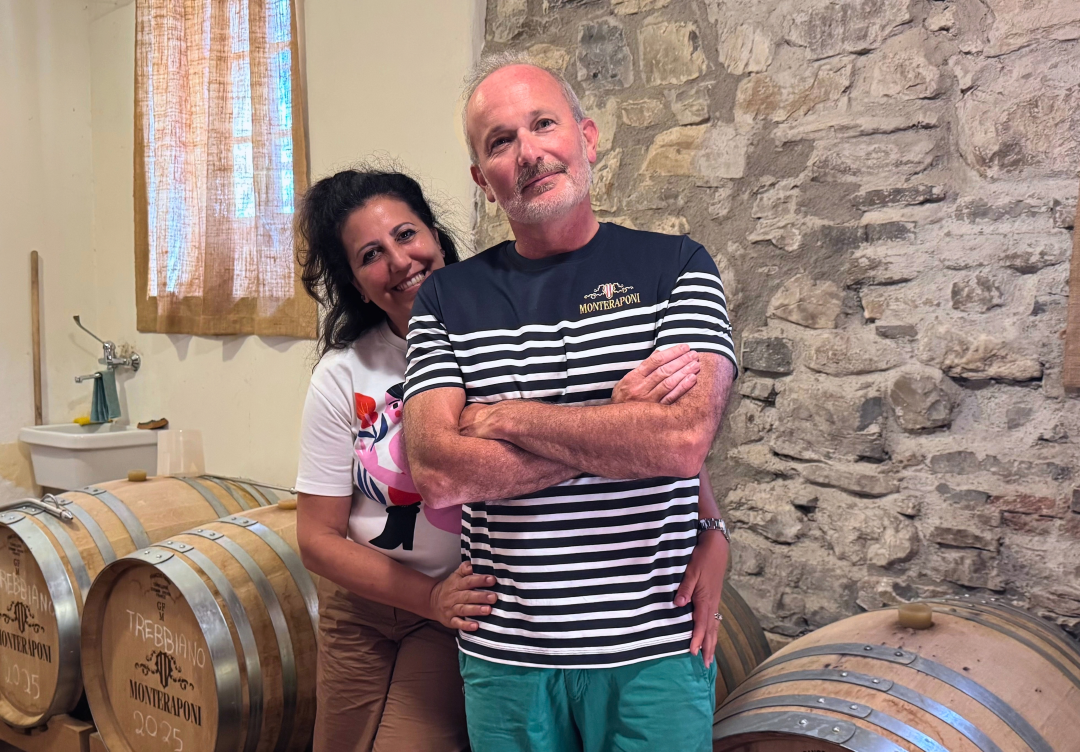
Alessandra Deiana and Michele Braganti in their cramped cellars at Monteraponi.
Diving into Trebbiano
“We’ve always had a few rows of Trebbiano in all our vineyards,” Braganti explained. Up until 2005, Braganti used Trebbiano in his Chianti Classico. In 2006, regulations changed and excluded the use of white grapes. “I made a little Vin Santo in 2006 and 2008, but skipped 2007 as birds ate the entire crop. In 2010, I decided to experiment with a pure Trebbiano. Back in Medieval times, Trebbiano was more highly regarded than Sangiovese because of its use in Vin Santo and its link to the church.”
The first two vintages, 2009 and 2010, did not turn out as expected. “I threw them out; the wines were undrinkable,” Braganti continued. “My father, Antonio, was incensed. ‘What are we doing here, making wine to throw it away?’” However, those early vintages provided quite a bit of learning. “Two thousand twenty-one is the first vintage that was drinkable,” Braganti added with his usual mix of sarcasm and dry humor.
The Monteraponi Trebbiano is unique among the top wines in the range in that it is not a single-vineyard wine, but is made from fruit across several estate vineyards. The 2011 was fermented and aged entirely in cement with no skin contact but with very ripe grapes. Trebbiano was harvested after Sangiovese, resulting in a fairly high alcohol level of 13.5%. With the 2012 vintage, Braganti shifted to picking Trebbiano before moving on to Sangiovese. The 2014 Trebbiano is the first wine made in the style that has carried through to today. Trebbiano is vinified in cement with about 20% whole bunches, where it spends six days on the skins before being pressed to used French oak barrels for aging.
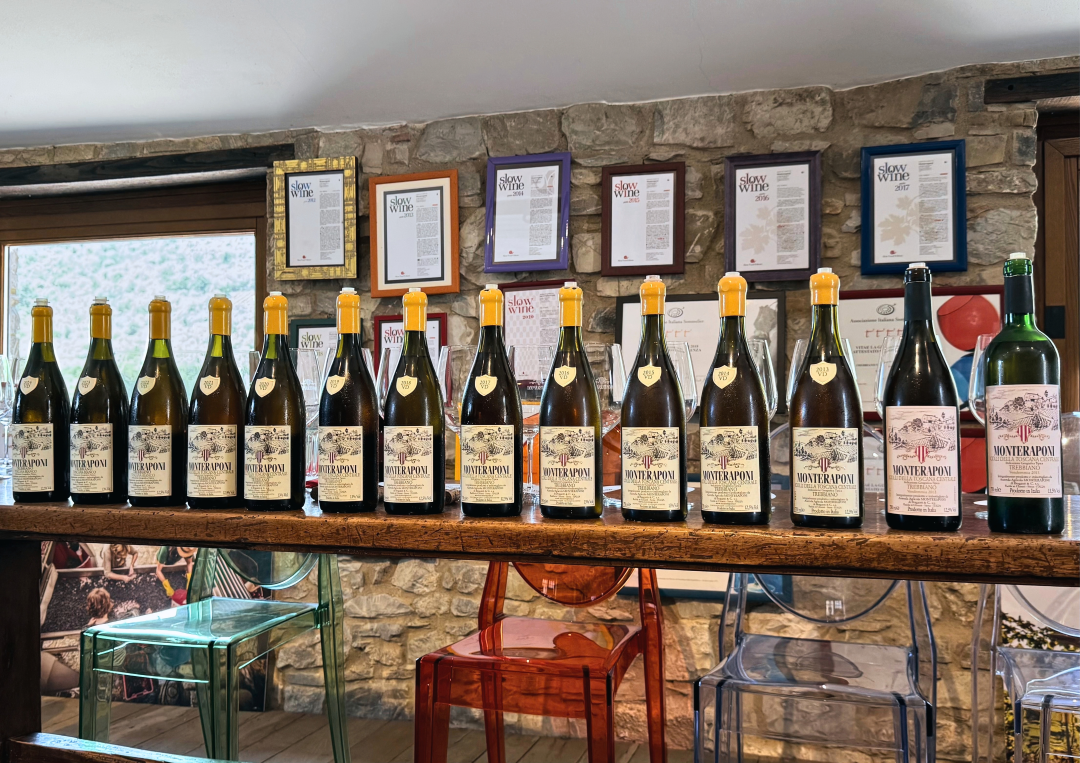
A stunning lineup of Trebbiano back to 2011.
My biggest takeaway from this tasting is how well the Trebbiano ages. There’s a great deal of discussion in Italy these days about Trebbiano and its various biotypes. While plant material is certainly important, vine age, site character and a producer’s ambition are likely even more determinant of quality. Readers who can find the Monteraponi Trebbiano should not hesitate.
© 2026, Vinous. No portion of this article may be copied, shared or redistributed without prior consent from Vinous. Doing so is not only a violation of our copyright but also threatens the survival of independent wine criticism.
You Might Also Enjoy
Chianti Classico: Looking Up, Antonio Galloni, August 2026
Chianti Classico: Riding Out the Storm, Antonio Galloni, July 2025
Chianti Classico: The Magnificent 2021s, Antonio Galloni, July 2024
Chianti Classico: The Brilliant 2021s & Variable 2020s, Antonio Galloni, August 2023
Chianti Classico & Neighbors: Looking at the 2020s and 2019s, Antonio Galloni, July 2022
- 2026
- Joseph Phelps Insignia 1974-2025: Past, Present and Future (Oct 2026)
- Cellar Favorite: 2017 & 2018 Soldera – Case Basse Toscana Sangiovese (Aug 2026)
- Chianti Classico: Looking Up (Aug 2026)
- Vatan Sancerre Clos La Néore: 2005-2022 (Aug 2026)
- The Original Napa Valley Icon: Stag’s Leap Wine Cellars Cabernet Sauvignon S.L.V. (Aug 2026)
- Mvemve Raats MR de Compostella: 2014-2022 (Aug 2026)
- Tuscany’s Maremma: Scenes from the Coast (Jul 2026)
- Dom Pérignon Rosé Through the Decades at Vinous Icons (Jul 2026)
- Cellar Favorite: 1983 Marchesi Antinori Tignanello (Jul 2026)
- A Century of…Sixes: 1846-2016 (Jul 2026)
- Remembering Franco Bernabei (Jul 2026)
- Cellar Favorite: 2016 Fontodi Flaccianello della Pieve (Jul 2026)
- Steenwold Returns! South Africa’s 2016s (Jul 2026)
- Beyond Category: Twelve Vintages of Hors Catégorie (Jun 2026)
- Salon Cuvée S 1996-2013 at Vinous Icons (Jun 2026)
- Learn from the Best: Méo-Camuzet 1991-2013 (May 2026)
- Henschke Mount Edelstone 1956-2024: A Rare Gem Comes of Age (May 2026)
- Sassicaia from Magnum at Vinous Icons: Italy (May 2026)
- Vino Nobile di Montepulciano: Credit Where Credit is Due (May 2026)
- Tuscany’s Quintessential Underdogs (Apr 2026)
- Southwold: 2016 Bordeaux, Ten Years On (Apr 2026)
- Castillo Ygay 1959–2016: A Legacy in Present Tense (Apr 2026)
- Fusion Over Force: The Sadie Family Columella 2001-2020 (Apr 2026)
- Vasse Felix Tom Cullity 2013-2022 (Mar 2026)
- Two Sides of the Same Coin: 2023 and 2024 Rosso di Montalcino (Mar 2026)
- Rocca di Montegrossi: Act Two (Feb 2026)
- Curse of the Fours: Bouchard Père 1861-2014 (Mar 2026)
- The Landmark Vintage: 2006 Brunello di Montalcino Retrospective (Feb 2026)
- Salt of the Earth: Voliero Brunello di Montalcino 2006-2021 (Feb 2026)
- It’s Rousseau’Clock: Grand Crus 1967-2019 (Feb 2026)
- Vinous Table: La Trompette, London, UK (Jan 2026)
- 2025
- Philip Togni Cabernet Sauvignon Estate: 1983-2014 (Dec 2025)
- Châteauneuf-du-Pape 2005: The Grand Backbone Vintage (Dec 2025)
- Cavallotto: Raiding the Cellar (Dec 2025)
- Giacomo Conterno: Seven Decades of Barolo Riserva Monfortino (Dec 2025)
- Piedmont Icons Dinner (Dec 2025)
- Massolino Barolo Riserva Vigna Rionda Vertical Tasting & Lunch at La Festa del Barolo (Dec 2025)
- Giuseppe Mascarello & Figlio: Barolo Monprivato and Riserva Cà d’Morissio in Magnum (Dec 2025)
- Battle Royale! Bordeaux 1961, 1982, 1990 & 1995 (Dec 2025)
- Te Mata Coleraine: 1982-2023 (Nov 2025)
- The Exquisite 2021 Brunellos (Nov 2025)
- El Molino: The Essence of Napa Valley Classicism (Nov 2025)
- 2015 Napa Valley Cabernet Sauvignon: In the Zone (Nov 2025)
- Littorai: The First Thirty Years (Jul 2025)
- Cellar Favorite: Castell’in Villa Library Releases (Jul 2025)
- Chianti Classico: Riding Out the Storm (Jul 2025)
- 2025 Tuscany Preview (Feb 2025)
- One Night in Taipei: Domaine de la Romanée-Conti Richebourg 1995-2017 (Jun 2025)
- Grape Expectations: Burgundy 1978 Retrospective (Apr 2025)
- Pinball Number Count: Bouchard Père 1923-2013 (Apr 2025)
- The Murakami Wine: Royal Tokaji Essencia 1993-2017 (Mar 2025)
- Unearthing Tuscan Gems: Carmignano, Montecucco and Beyond (Mar 2025)
- Vino Nobile di Montepulciano: An Unstoppable Force (Feb 2025)
- 2014 Napa Valley Cabernet Sauvignon: A Dark Horse Emerges (Jan 2025)
- A Vintage of Transcendence: 2004 Brunello di Montalcino Retrospective (Jan 2025)
- 2024
- New Releases from the Tuscan Maremma (Dec 2024)
- Dunn: Cabernet Sauvignon Howell Mountain 1985-2014 (Dec 2024)
- A Tale of Two Extremes: The 2020 Brunellos and 2019 Riservas (Nov 2024)
- Morlet Family Vineyards: Cabernet Sauvignon Mon Chevalier 2007-2019 (Oct 2024)
- The Misunderstood Margaux: Marquis de Terme 1947-2021 (Oct 2024)
- Cellar Favorite: Castello dei Rampolla: Library Releases (Oct 2024)
- Conti Costanti: Montalcino’s Most Historic Estate (Oct 2024)
- Kumeu River: The Kiwi Dream (Sep 2024)
- The Magic of 2022 Rosso di Montalcino (Sep 2024)
- Tiberio's Fonte Canale: Redefining Trebbiano d'Abruzzo (Aug 2024)
- Memories Elide: Vieux Château Certan 1923-2020 (Jul 2024)
- The Minnow: Sigalas Rabaud 1975-2019 (Jul 2024)
- Chianti Classico: The Magnificent 2021s (Jul 2024)
- Rockeries in Living Rooms: 1988 vs. 1989 Bordeaux (Jul 2024)
- Once Upon a Time – Soldera Retrospective: 1977-2017 (Jun 2024)
- Archive Away: Mature Burgundies 1919-2019 (Jun 2024)
- It’s All in the Name: Domaine Pierre Vincent (Jun 2024)
- Ironing Out The Kinks: Jim Barry The Armagh 1985-2021 (Jun 2024)
- Cellar Favorite: Castello di Ama - Looking Back at the 2006s (May 2024)
- 2012 & 2013 Napa Valley: Too Close to Call (May 2024)
- Oldies But Goldies: Bouchard Père 1892-2012 (Apr 2024)
- Past Becomes Now: Lafite-Rothschild 1874-1982 (Apr 2024)
- An Exploration of Time: Gruaud Larose 1831-2018 (Mar 2024)
- Borgo del Tiglio Rosso Riserva: The Road Less Traveled (Mar 2024)
- Test of Endurance: Bordeaux 2014 Ten Years On (Mar 2024)
- Merci, Monsieur Amiot: Clos des Lambrays 1923-2021 (Mar 2024)
- Carmignano, Montecucco and Tuscany’s Unrivaled Diversity (Mar 2024)
- Come On Aline: Château Coutet 1943-2017 (Feb 2024)
- 2024 Tuscany Preview (Feb 2024)
- Survive Us All: Latour 1858-2018 (Feb 2024)
- 2013 Brunello di Montalcino: The Throwback Vintage (Feb 2024)
- Flirting with Perfection - Giaconda Chardonnay 2011-2021 (Jan 2024)
- Ulysse Collin Rosé de Saignée Les Maillons Vertical (Jan 2024)
- 2023
- Buckle Your Seatbelts: 2019 Brunello and 2021 Rosso di Montalcino (Dec 2023)
- Roederer Cristal Full Circle: 1993-2015 (Dec 2023)
- White-on-White: Porseleinberg 2010-2020 (Nov 2023)
- Ten Years On: Burgundy 2013 (Oct 2023)
- Vino Nobile di Montepulciano: Making Wine in The New Normal (Oct 2023)
- Making History: 21 Vintages of Leonetti’s Red Wine Reserve (Oct 2023)
- Margaux Focus 3: Château Margaux (Sep 2023)
- Margaux Focus 2: Château Palmer (Aug 2023)
- Chianti Classico: The Brilliant 2021s & Variable 2020s (Aug 2023)
- Cellar Favorite: San Giusto a Rentennano Chianti Classico: 2001-1990 (Aug 2023)
- Margaux Focus 1: Château Durfort-Vivens (Aug 2023)
- Bruno Giacosa Dinner at Legacy Records (Aug 2023)
- Exploring New Releases from Coastal Tuscany (Aug 2023)
- Passing the Baton: Lynch-Bages 1945-2018 (Jul 2023)
- Bartolo Mascarello 1955 to…from Magnum (Jul 2023)
- Going Back to My Roots: Putting Liber Pater In Context (Jun 2023)
- Vinous Table: Osteria Le Logge, Siena, Italy (Jun 2023)
- Half-Century - Not Out: Kanonkop 1973-2015 (Jun 2023)
- Moving On: Lafon-Rochet 1955-2017 (Jun 2023)
- Burgundy Focus 4: Ponsot’s Clos de la Roche & Morey Monts Luisants 1934-2019 (May 2023)
- Burgundy Focus 3: Mugnier’s Chambolle-Musigny Les Amoureuses 1er Cru 2007-1980 (May 2023)
- Burgundy Focus 2: Domaine Comte Armand Pommard Clos des Epeneaux 1er Cru 1945-2001 (Apr 2023)
- Henschke’s Hill of Grace - The Garden of Eden (Apr 2023)
- Burgundy Focus 1: Duroché’s Clos de Bèze Grand Cru 1988-2020 (Apr 2023)
- The 2001 Napa Valley Cabernet Sauvignon: Stepping Back in Time (Apr 2023)
- Castello di Monsanto Chianti Classico Riserva Il Poggio 1962-2017 (Apr 2023)
- Domaine de la Romanée-Conti 2020 & The New Burgundy (Mar 2023)
- Lower Your Sails (Or Breeches): Beychevelle 1929-2019 (Mar 2023)
- Not Classed, but Classy: Haut-Bergeron 1961-2019 (Mar 2023)
- Keller Excellence (Mar 2023)
- Money Well Spent: Domaine de L’Arlot: 1959-2019 (Mar 2023)
- 2020 Tuscany Preview (Feb 2023)
- Touring Tuscany: Carmignano, Montecucco and Beyond (Feb 2023)
- Terroir and Determination: Vino Nobile di Montepulciano (Feb 2023)
- The Pendulum Swings: 2012 Brunello di Montalcino (Jan 2023)
- 2022
- 2018 Brunello di Montalcino: The Rubik’s Cube Vintage (Dec 2022)
- Clonakilla Shiraz Viognier 1994-2021 (Nov 2022)
- Domaine Georges Roumier Part 2: Chambolle-Musigny Les Cras 1er Cru (Nov 2022)
- Domaine Georges Roumier Part 1: 1988s Examined (Nov 2022)
- Bending Rules: Les Carmes Haut-Brion 1955-2019 (Oct 2022)
- Decoding Emidio Pepe: 13 Vintages of Montepulciano d’Abruzzo Vecchie Vigne (Oct 2022)
- The Rise of Rosso di Montalcino (Oct 2022)
- Dive In: Cantenac Brown 1978-2018 (Oct 2022)
- Léoville-Poyferré 1936-2018 (Sep 2022)
- The Power and the Passion: Wynns John Riddoch 1982-2019 (Sep 2022)
- Memories Tumble Out: Pichon Baron 1937-1990 (Aug 2022)
- Relive the Nightmare! 2008 Red & White Burgundy (Aug 2022)
- Magic and Madness: Climens 1912-2020 (Aug 2022)
- Viñedo Chadwick: 21 Years of Cabernet Sauvignon from Puente Alto (Aug 2022)
- Bring Out Your “Dead”: Pichon-Lalande 1957-2013 (Aug 2022)
- Back In Black: Kanonkop Black Label Pinotage 2006-2019 (Aug 2022)
- A Quarter of a Century in Chile: A Vertical Tasting of Seña (Aug 2022)
- Scaling Heights: Duroché’s Lavaut Saint-Jacques 1969-2019 (Jul 2022)
- Domaine Leroy: A Voyage Across the 2019s (Jul 2022)
- Where the Heart Is: Ducru-Beaucaillou 1934-2018 (Jul 2022)
- Chianti Classico & Neighbors: Looking at the 2020s and 2019s (Jul 2022)
- Book Excerpt from Alessandro Masnaghetti’s Chianti Classico: The Complete Atlas of the UGA Vineyards (Jul 2022)
- Cellar Favorite: San Giusto a Rentennano Chianti Classico 2002-2010 (Jul 2022)
- Tuscany: New Releases from the Coast (Jul 2022)
- Bols Blue to Bordeaux: Barde-Haut, Clos l’Église & Poesia (Jun 2022)
- The Wine Was Chambertin: Rousseau 1919-2017 (Jun 2022)
- Fronsac Royalty: Château de La Dauphine 2001-2018 (Jun 2022)
- The 2011 Napa Valley Cabernet Sauvignons at Age Ten (May 2022)
- This Is Not Just Another Winery: Haut-Bailly 1964-2018 (Apr 2022)
- Unrivalled/ Unequalled: Yquem 1921–2019 (Apr 2022)
- From the Vault: Realm 2005-2018 (Mar 2022)
- Pages in the Photo Album: Vieux Château Certan 1928-2013 (Mar 2022)
- VHR, Vine Hill Ranch Cabernet Sauvignon 2008-2019 (Mar 2022)
- 2019 Tuscany Preview (Mar 2022)
- Branas Grand Poujeaux 2002-2019 (Feb 2022)
- Domaine Hubert Lignier Clos de la Roche 1974-2010 (Feb 2021)
- The Pros and Cons of Rosso di Montalcino and Beyond (Jan 2022)
- Pierre, Denis & Jean-Jacques: Doisy-Daëne & L’Extravagance 1942-2013 (Jan 2022)
- Looking Back to Look Forward: Back Vintage Brunello (Jan 2022)
- 2021
- Montepulciano, Carmignano and Montecucco: New Releases (Dec 2021)
- Jekyll and Hyde: 2017 Brunello di Montalcino and 2016 Riservas (Dec 2021)
- A Janus with Soul: Figeac 1943–2016 (Dec 2021)
- Cellar Favorite: 2012 Pian dell'Orino Rosso di Montalcino (Nov 2021)
- Against all Odds: Vie di Romans Sauvignon Blanc Vieris (Oct 2021)
- Cellar Favorite: 1969 Castello di Monsanto Chianti Classico Riserva Il Poggio (Oct 2021)
- Chianti Classico and Beyond – 2018 & 2019 (Sep 2021)
- Mission Complete: La Mission Haut-Brion 1928–2011 (Sep 2021)
- Left Bank on the Right: Jean Faure 2007–2018 (Sep 2021)
- So Chic, So Listrac: Fourcas Hosten (Jul 2021)
- Seven Australian Cabernets from 2015 (Jun 2021)
- His Father’s Son: Grand Mayne 1955-2011 (May 2021)
- Cellar Favorite: 2015 Soldera Sangiovese (May 2021)
- Cellar Favorite: 2011 Cupano Brunello di Montalcino (Apr 2021)
- Marking Milestones with Moulin Touchais (Apr 2021)
- Cellar Favorite: 2004 Poggio Il Castellare Brunello di Montalcino (Apr 2021)
- 2005 Bordeaux: Here and Now (Apr 2021)
- Vino Nobile & Carmignano: Italy’s Forgotten Noble Reds (Apr 2021)
- Tuscany Odds & Ends (Apr 2021)
- In the Sweet Spot: 2001 Brunello di Montalcino (Mar 2021)
- 1971 x 50 (Feb 2021)
- 2018 Tuscany Preview (Feb 2021)
- Conterno Monfortino Magnum Vertical: 1970-2014 (Feb 2021)
- Cellar Favorite: 2006 Castello di Monsanto Chianti Classico Riserva Il Poggio (Feb 2021)
- Choose Wisely: Château Sérilhan 2008–2017 (Jan 2021)
- The Power of Three: New Vintage Rosso di Montalcino (Jan 2021)
- New Releases from the Tuscan Coast (Jan 2021)
- 2020
- Lagrange 1959-2015 (Dec 2020)
- Domaine A. Clape Cornas: 2012–1987 (Dec 2020)
- 2016 Brunello di Montalcino: Radiance Personified (Nov 2020)
- The Year of Jazz & Wine: 1959 (Nov 2020)
- Cellar Favorite: 2006 Monsanto Chianti Classico Riserva (Nov 2020)
- Joseph Drouhin “Monty and Moose” (Oct 2020)
- Saturday Morning: Larcis Ducasse 1945-2017 (Oct 2020)
- Antinori Solaia From Magnum: 1978-2016 (Sep 2020)
- Chianti Classico: More Than Meets The Eye (Sep 2020)
- Taupenot-Merme: Mazoyères-Chambertin 2002-2017 (Aug 2020)
- Southwold: 2016 Bordeaux Blind (Aug 2020)
- The Grand Vin of the North: San Leonardo (Jul 2020)
- Cellar Favorite: Soldera: A Look at the 2013 & 2014 (Jul 2020)
- The Most and Least Important of Things: Petrus 1897–2011 (Jul 2020)
- 2017 Domaine de la Romanée-Conti: A Day’s Work (Jul 2020)
- Delivering Where It Counts: Meyney 1971–2017 (Jul 2020)
- Vintage Retrospective: The 2001 Napa Valley Cabernets (Jun 2020)
- Cellar Favorite: 1997 Col d’Orcia Brunello di Montalcino (Jun 2020)
- Château Siran 1918-2008 (Jun 2020)
- Vintage Retrospective: The 2010 Napa Valley Cabernets (May 2020)
- Hopes and Dreams: Canon Chaigneau 1998-2019 (May 2020)
- Six Decades of Pavie-Macquin: 1928-2018 (May 2020)
- No Relation: Clos Saint-Martin 1964-2017 (Apr 2020)
- Cellar Favorite: 1999 Podere La Vigna Brunello di Montalcino (Apr 2020)
- 2015 Brunello: The Vintage We Have Been Waiting For? (Apr 2020)
- Montalcino: The Great 2015 Brunellos & More (Apr 2020)
- Domaine Dujac Clos Saint-Denis 1970-2004 (Mar 2020)
- Tuscany New Releases, Part 1 (Mar 2020)
- Roses de Jeanne La Bolorée Retrospective (Mar 2020)
- Cellar Favorite: 1990 Soldera – Case Basse Brunello di Montalcino (Feb 2020)
- Refusing to Follow the Script: Jean-Marie Guffens (Feb 2020)
- Resurrecting the Mystery: Clos Joliette (Jan 2020)
- Gulfi Nero d’Avola Nerosanloré: 2001-2015 (Jan 2020)
- DeLille Cellars Chaleur Blanc: 1995-2016 (Jan 2020)
- Masseto Retrospective at the Country Music Hall of Fame (Jan 2020)
- 2019
- Domaine des Comtes Lafon Meursault Perrières 1984-2014 (Dec 2019)
- Mount Eden Pinot Noir: 1984-2016 (Dec 2019)
- San Giusto a Rentennano La Ricolma: A Complete Retrospective (Dec 2019)
- Cristal in Magnum: It’s Another World (Dec 2019)
- Dauvissat Chablis Les Clos: 1983-2015 (Nov 2019)
- Grosjean Petite Arvine: 1997-2016 (Dec 2019)
- Marquis d’Angerville’s Volnay Clos des Ducs: 1920-2017 (Oct 2019)
- A Century - Not Out: Talbot 1919-2010 (Oct 2019)
- Mugneret-Gibourg’s Clos Vougeot 1984 - 2015 (Oct 2019)
- Spotlight on Rosso di Montalcino (Oct 2019)
- Domaine Leflaive Chevalier-Montrachet: 1981-2012 (Sep 2019)
- Cellar Favorite: 2009 Le Macchiole Paleo Rosso (Sep 2019)
- Larkmead’s Solari Cabernet and LMV Salon: 2001-2015 (Aug 2019)
- 2016 Chianti Classico – A Modern Day Benchmark (Aug 2019)
- Raveneau Chablis Montée de Tonnerre: 1985-2015 (Aug 2019)
- Drink Your Idols: Roumier’s Musigny 1976-2008 (Aug 2019)
- The 2009 Napa Valley Cabernets at Age 10 (Jul 2019)
- Precious Clay: L’Eglise-Clinet 1929–2015 (Jul 2019)
- "G" Acte 1 to 8 (Jul 2019)
- Paul Hobbs’ Cabernet Beckstoffer To Kalon: 1999-2016 (Jul 2019)
- Kapcsándy Roberta’s Reserve and Grand Vin (Jun 2019)
- Two Cape Crusaders: Alheit & Mullineux (Jun 2019)
- Finding Filhot: Filhot 1935-2015 (May 2019)
- Domaine Trapet Chambertin: 1949-2012 (May 2019)
- Chateau Montelena Cabernet Estate: 1977-2010 (May 2019)
- Vintage Retrospective: The 1999 Napa Valley Cabernets (May 2019)
- Lail Vineyards J. Daniel Cuvée: 1997-2016 (May 2019)
- Fermented Grape Juice: Romanée-Conti 1953-2005 (Apr 2019)
- The Margaux Paragon: Rauzan-Ségla 1900-2015 (Apr 2019)
- Beaulieu’s Georges de Latour Private Reserve: 1965–2016 (Apr 2019)
- Remembering Gianfranco Soldera (Apr 2019)
- Domaine des Lambrays’ Clos des Lambrays 1966-2012 (Apr 2019)
- 2014 Brunello di Montalcino and 2013 Riservas (March 2019)
- Central Tuscany: Maremma, Montepulciano and Beyond (Mar 2019)
- Joseph Roty’s Charmes-Chambertin Très Vieilles Vignes (Feb 2019)
- Chianti Classico 2015 & 2016: Right Place, Right Time (Feb 2019)
- Vertical Tasting of Louis Jadot’s Corton Pougets (Feb 2019)
- Looking The Part: Pichon-Baron 1953 – 2015 (Jan 2019)
- Château de la Tour Clos-Vougeot Vieilles Vignes 1985-2016 (Jun 2019)
- Long Distance Runner: Brane-Cantenac 1924-2015 (Jan 2019)
- 2018
- Ceretto Barbaresco Asili: 1974-2014 (Dec 2018)
- Port Is For Life: Symington Vintage & Tawny Ports (Dec 2018)
- Eternal Leroy: 1937-2010 (Oct 2018)
- Golden Oldies & Goodies: The Ageworthiness of Verdicchio (Oct 2018)
- Albert Mann Gewurztraminer Furstentum: 1993-2015 (Oct 2018)
- Vinous Table: Osteria Le Logge, Siena, Italy (Oct 2018)
- Picture This: Domaine Henri Gouges 1945 – 2016 (Oct 2018)
- Le Potazzine Brunello di Montalcino 2001 – 2013 (Oct 2018)
- Malvirà Roero Arneis Vigna Renesio: 2007 – 2015 (Oct 2018)
- Fairest of Them All: Cos d’Estournel 1928 – 2015 (Oct 2018)
- Sharing Alike: Petrus 1947 - 2015 (Sep 2018)
- Priceless: Roumier Bonnes-Mares 1945 - 2015 (Sep 2018)
- Les Crêtes Fumin: 1994 - 2015 (Sep 2018)
- Double Vertical of Ridge's Geyserville and Lytton Springs (Aug 2018)
- Rocca di Montegrossi: Vigneto San Marcellino 1995–2013 (Aug 2018)
- Aiming High: Haut-Condissas 1997–2015 (Aug 2018)
- Cellar Favorite: 1998 Fontodi Chianti Classico (Aug 2018)
- Dunn Cabernet Sauvignon Howell Mountain: 1979–2014 (Aug 2018)
- The Marital Margaux: d’Issan 1945-2015 (Jul 2018)
- Vintage Retrospective: 1991 Napa Cabernet Sauvignon (Jul 2018)
- Looking Back To Go Forward: Lafite-Rothschild 1868 – 2015 (Jul 2018)
- In Excelsis: Château Latour 1887 – 2010 (Jul 2018)
- Cellar Favorites: Laville Haut-Brion (Jul 2018)
- Bordeaux In Excelsis (Jun 2018)
- Williams Selyem: Pinot Noir Allen Vineyard 1987–2016 (Jun 2018)
- Mugneret-Gibourg: Ruchottes-Chambertin 1945 – 2014 (Jun 2018)
- Last Man Standing: Bel-Air Marquis d’Aligre (May 2018)
- Ten Wines That Changed My Life (May 2018)
- A Century of Bordeaux: The Eights (May 2018)
- Turley Zinfandel Hayne Vineyard: 1993 – 2015 (May 2018)
- Purple Reign: La Conseillante 1966-2015 (May 2018)
- Vintage Retrospective: The 2008 Napa Valley Cabernets (May 2018)
- Bucci Verdicchio dei Castelli di Jesi Classico Riserva Villa Bucci (May 2018)
- Mother & Child: La Lagune 1962 – 2015 (Apr 2018)
- O’Shaughnessy Cabernet Sauvignon Estate Howell Mountain: 2000–2015 (Apr 2018)
- Life Is Funny Like That: 1999 & 2015 DRC (Apr 2018)
- Crocker & Starr Cabernet Sauvignon Stone Place: 1999 – 2015 (Apr 2018)
- A Beautiful Stay: Beau-Séjour Bécot 1970-2015 (Apr 2018)
- Tuscany New Releases: Maremma, Montepulciano & More (Apr 2018)
- Vineyard 29 Estate Cabernet Sauvignon Retrospective (Apr 2018)
- Brunello di Montalcino: Sleek '13s, Surprising '12 Riservas (Apr 2018)
- The Magic of d’Auvenay: 1989 – 2011 (Mar 2018)
- The Glorious 1999 Red Burgundies (Mar 2018)
- The Magician’s Fool: 1950s Bordeaux (Feb 2018)
- 2008 Bordeaux: A Day In A Life (Feb 2018)
- Nals-Margreid: Pinot Bianco Sirmian 1986 – 2016 (Jan 2018)
- Chianti Classico: The Stellar 2015s and Surprising 2014s (Jan 2018)
- 2017
- Miani Ribolla Gialla Pettarin: 2000 – 2015 (Dec 2017)
- Dom Pérignon in Three Acts (Nov 2017)
- Castello di Ama L’Apparita Retrospective 1988-2013 (Nov 2017)
- BOND: A Complete Retrospective (Nov 2017)
- Cellar Favorite: 2007 Antinori Tignanello (Nov 2017)
- Pichon Longueville Comtesse de Lalande 1921-2016 (Oct 2017)
- Ronco del Gelso Pinot Grigio Sot lis Rivis 2006 – 2015 (Oct 2017)
- 1996 Piedmont: The Proof is in the Pudding (Oct 2017)
- Louis Sipp: Riesling Kirchberg de Ribeauvillé 1971 – 2014 (Oct 2017)
- Tasca d’Almerita’s Rosso del Conte: 1979 – 2012 (Oct 2017)
- Cayuse Vineyards’ Syrah Bionic Frog: 2000 – 2014 (Oct 2017)
- Harlan Estate Vertical at The Naples Winter Wine Festival (Sep 2017)
- Prà Soave Classico Monte Grande: 1998 - 2015 (Sep 2017)
- Feudo Montoni’s Nero d’Avola Lagnusa and Vrucara: A Definitive Tasting of Two Great Italian Reds (Sep 2017)
- Vintage Retrospective: The 1997 Napa Valley Cabernets (Sep 2017)
- Next of Kyn – The First Seven Years: 2007-2013 (Aug 2017)
- Domaine Armand Rousseau: Chambertin 1988 - 2002 (Aug 2017)
- Cellar Favorite: 1990 Col D’Orcia Brunello di Montalcino Riserva (Jun 2017)
- Eight Decades of Cappellano Barolo: 1935-2011 (May 2017)
- Vintage Retrospective: The 2007 Napa Valley Cabernets (May 2017)
- Bryant’s Cabernet Sauvignon: 1994-2014 (May 2017)
- Arietta – A Complete Retrospective: 1996-2015 (May 2017)
- Domaine Lignier: Clos de la Roche 1978-2014 (May 2017)
- Seavey Cabernet Sauvignon: A Complete Retrospective (Apr 2017)
- Colgin Syrah IX Estate: A Complete Retrospective (Apr 2017)
- The 2001 Red Burgundies at Age 15 (Apr 2017)
- Tramin Pinot Grigio Unterebner: 2002-2015 (Mar 2017)
- Bruno Giacosa: Barbaresco Santo Stefano 1964-2007 (Mar 2017)
- Brunello di Montalcino: The 2012 Brunellos & 2011 Riservas (Mar 2017)
- Ovid: The First Nine Years 2005-2013 (Feb 2017)
- Manni Nössing Sylvaner: 2008-2015 (Feb 2017)
- Cantina Terlano Pinot Bianco Vorberg: 1959-2014 (Jan 2017)
- Ornellaia & Masseto: 1995-2010 From Magnum (Jan 2017)
- Miani’s Friulano Filip and Buri: 1991-2014 (Jan 2017)
- Cellar Favorite: 1995 Castello di Ama Merlot L’Apparita (Jan 2017)
- 2016
- Donnafugata's Mille e Una Notte: 1995-2011 (Dec 2016)
- Vinous Acquires Delectable & Banquet Apps (Dec 2016)
- Elena Fucci Aglianico del Vulture Titolo: 2000-2014 (Dec 2016)
- Central Tuscany – Maremma, Montepulciano, Carmignano and Beyond (Nov 2016)
- Bartolo Mascarello Retrospective: 1958-2010 (Nov 2016)
- Benito Ferrara Greco di Tufo Vigna Cicogna: 2008-2015 (Nov 2016)
- Norman Hardie Chardonnay Vertical: 2006-2014 (Nov 2016)
- Weinbach Riesling Schlossberg Cuvée Ste. Catherine: 1990-2011 (Nov 2016)
- Vinous Event: Soldera Vertical in London (Oct 2016)
- Soldera Redux: 1981-2006 (Oct 2016)
- Looking Back at the 2005 & 2004 Brunellos (Oct 2016)
- Vertical Tasting of the Nicolás Catena Zapata 1997-2012 (Oct 2016)
- 2014 Chianti Classico: Better Late Than Never (Oct 2016)
- Trimbach: Riesling Clos Ste. Hune 1966-2010 (Oct 2016)
- J. F. Coche-Dury & Domaine de la Romanée-Conti (Sep 2016)
- A Tuscan Icon – Petrolo Galatrona: 1998-2012 (Sep 2016)
- Tawse Chardonnay Quarry Road: 2006-2013 (Aug 2016)
- Argiolas Turriga – Looking Back at an Italian Icon: 2012-1988 (Aug 2016)
- Vertical Tasting of Shafer’s Cabernet Sauvignon Hillside Select (Jul 2016)
- 2005 Barolo: A Dark Horse Emerges (Jul 2016)
- Ridge Monte Bello Revisited: 1968 – 2012 (Jul 2016)
- Vertical Tasting of Spottswoode Cabernet Sauvignon (Jun 2016)
- Horizontal Tasting of Napa Valley’s 1995 Cabernets (Jun 2016)
- Domaine Rousseau Chambertin-Clos de Bèze and Chambertin (Jun 2016)
- A Look Back at the 2004 & 2005 Barbarescos (Jun 2016)
- Champagnes Salon & Delamotte 1959-2007 (Jun 2016)
- Zind-Humbrecht’s Pinot Gris Clos Saint Urbain Rangen de Thann 1983-2013 (Jun 2016)
- Vertical Tasting of Hundred Acre Kayli Morgan Vineyard Cabernet Sauvignon (Jun 2016)
- Vintage Retrospective: 2005 Napa Valley Cabernet Sauvignon (May 2016)
- Vietti Barolo Rocche: A Historical Retrospective 1961-2011 (May 2016)
- Vertical Tastings of Mondavi’s Cabernet Sauvignon Reserve and I Block To Kalon Vineyard Fumé Blanc (May 2016)
- Salvioni: Brunello di Montalcino 1985-2011 (May 2016)
- Vertical Tasting of Domaine Dirler-Cadé’s Sylvaner (May 2016)
- Mouton Rothschild: 2003-2015 (May 2016)
- Vertical Tasting of Kongsgaard Syrah (May 2016)
- Vertical Tasting of Phelps Insignia (Apr 2016)
- Barberani’s Orvieto Classico Superiore Luigi e Giovanna (Apr 2016)
- Colgin Retrospective at the Villa d’Este Wine Symposium (Apr 2016)
- Domaine du Comte Liger-Belair: La Romanée 1865 – 2014 (Mar 2016)
- Vino Nobile, Carmignano and Tuscany Odds & Ends (Mar 2016)
- Tuscany’s Mysterious Self-Making Vin Santo (Mar 2016)
- 2011 Brunello di Montalcino: Terroir Matters (Feb 2016)
- The Glorious 2002 Red Burgundies (Feb 2016)
- Vinous in London – April 26 & 27, 2016 (Feb 2016)
- Montevertine: Le Pergole Torte 1980-2012 (Jan 2016)
- 2015
- 2004 Barolo: The Cream Rises to The Top (May 2015)
- 2005 Tuscany – Ten Years Later (Dec 2015)
- Vinous Event: 2010 Brunello di Montalcino (Dec 2015)
- Vinous Table: Veuve Clicquot Retrospective at Marea, New York (Nov 2015)
- Historic Piedmont: A Trip Back In Time (Nov 2015)
- 2005 Bordeaux with Tanzer & Galloni (Nov 2015)
- Domaine de la Romanée-Conti Montrachet 1982-2012 (Nov 2015)
- Dom Pérignon: 2002-2006 (Oct 2015)
- Castello dei Rampolla: Sammarco 1981-2011 (Oct 2015)
- On the Tuscan Coast: New Releases (Oct 2015)
- Calera Pinot Noir Jensen Vineyard – A Journey Through Time 1978-2013 (Sep 2015)
- Chianti Classico 2013 & 2012: The Luck of the Draw (Sep 2015)
- Ridge Monte Bello: Past, Present and Future (Jul 2015)
- Beringer’s Private Reserve Cabernet Sauvignon: One of Napa Valley’s First Cult Wines (Jul 2015)
- Forman: Four Decades of Cabernet Sauvignon 1985-2012 (Jul 2015)
- Horizontal Tasting of Napa Valley’s 1994 Cabernets (Jul 2015)
- Horizontal Tasting of Napa Valley’s 2004 Cabernets (Jun 2015)
- Pride – Reserve Cabernet Sauvignon Vertical Tasting (Jun 2015)
- Vinous Event: 2010 Napa Valley at the NoMad Rooftop (Jun 2015)
- Cellar Favorite: 1988 Montevertine Le Pergole Torte (Jun 2015)
- Blankiet: Proprietary Red 1999-2012 (May 2015)
- Roederer Cristal Rosé: A Journey Through Time 1976-2007 (May 2015)
- Vertical Tasting of Turley's Petite Syrah Hayne Vineyard (May 2015)
- Dom Pérignon: A Rosé Retrospective: 1962-2004 (May 2015)
- Colgin Cabernet Sauvignon Tychson Hill – A Complete Retrospective: 2000-2012 (Apr 2015)
- Sean Thackrey’s Orion: A Complete Retrospective (Apr 2015)
- A Half Century of Clos des Goisses: 1952-2004 (Mar 2015)
- Canalicchio di Sopra: Brunello di Montalcino 1970-2008 (Mar 2015)
- Biondi-Santi: The Epic Vintages 1955-1975 (Mar 2015)
- Domaine de la Romanée-Conti: Romanée-Conti and Montrachet (Feb 2015)
- Cellar Favorite: 2006 Tenuta dell’Ornellaia Masseto (Feb 2015)
- 2010 Brunello di Montalcino: A Promise Fulfilled (Feb 2015)
- Cellar Favorite: 1965 Col d'Orcia Brunello di Montalcino (Feb 2015)
- Germany: Ten Years After - 2004 Pinot Noir (Feb 2015)
- Germany: Ten Years After – 2004 Dry Riesling (Jan 2015)
- Noël Verset Cornas 1985-2006 (Jan 2015)
- Brovia – Barolo Rocche di Castiglione: 1982-2010 (Jan 2015)
- Soldera – Case Basse: Brunello di Montalcino 1981-2006 (Jan 2015)
- Vertical Tasting of Sadie Family Wines Columella (Jan 2015)
- Le Miracle de Haut-Brion (Dec 2014)
- Germany Grand Cru Riesling: 2004-2013 (Dec 2014)
- 2014
- Six Decades of Mayacamas Cabernet Sauvignon: 1967-2012 (Jun 2014)
- Epic Dunn: Cabernet Sauvignon Howell Mountain 1979-1999 (Feb 2014)
- 2012 Rosso di Montalcino (Dec 2014)
- Tuscany Part 2: Bolgheri, the Tuscan Coast and More Super-Tuscans (Dec 2014)
- Gaja: Sorì San Lorenzo 1971-2011 (Nov 2014)
- Cellar Favorite: Six Epic Monfortinos (Oct 2014)
- 1996 Champagne – For The Ages (Oct 2014)
- Val d’Orcia, Montepulciano, Carmignano and the Undiscovered Tuscany (Oct 2014)
- Exploring the Tuscan Coast (Sep 2014)
- Cellar Favorite: Domaine de la Romanée-Conti Montrachet 1988-2004 (Sep 2014)
- Chianti Classico and Beyond – New Releases (Sep 2014)
- Tuscany Part 1: Chianti, Vino Nobile and Supertuscans (Sep 2014)
- 1999 Barolo: Brilliance, Intensity and Class (Aug 2014)
- Soldera: Brunello di Montalcino 1979-2006 (Aug 2014)
- Checking in on the 1999 Barbarescos (Aug 2014)
- Domaine de la Romanée-Conti: Focus on Grands-Échézeaux and Richebourg (Jul 2014)
- 1964 Leroy: Simply Timeless (Jul 2014)
- Taittinger Comtes de Champagne Rosé 1985-2006 (Jul 2014)
- Brunello di Montalcino 2009 and 2008 Riserva (Jul 2014)
- 2003 Barolo: Ten Years Later (Jun 2014)
- Dalla Valle Maya: A Complete Retrospective 1988-2012 (June 2014)
- Four Decades of Champagne Salon and Delamotte: 1970-2004 (May 2014)
- 2009 Brunello di Montalcino: The Day of Reckoning (May 2014)
- 2010 Red Burgundy: Essays in Terroir (May 2014)
- Giacomo Conterno Barolo Riserva Monfortino 1970-2006 from Magnum (May 2014)
- A Look Back at the 2008 Barolos (May 2014)
- Vertical Tasting of Mastroberardino's Taurasi Riserva (May 2014)
- Vertical Tasting of Il Marroneto Brunello di Montalcino (May 2014)
- Vinous Table: Chave Hermitage Vertical at Ristorante Morini, New York (May 2014)
- Le Macchiole: Paleo Rosso 1992-2012 (Apr 2014)
- Giacomo Conterno: Barbera d’Alba Cascina Francia 2000-2010 (Mar 2014)
- Vertical Tasting of Chateau Branaire-Ducru (Mar 2014)
- Vertical Tasting of Chateau Pavie Macquin (Mar 2014)
- Fontodi: Chianti Classico Riserva Vigna del Sorbo 1985-2010 (Feb 2014)
- 2013
- Piedmont’s Glorious 1989 and 1990 Vintages Revisited (Feb 2010)
- Mastroberardino – Defining the Greatness of Taurasi: 1928-2006 (Dec 2013)
- Antinori Solaia – A Complete Retrospective 1978-2010 (Dec 2013)
- Castello dei Rampolla d’Alceo – A Complete Retrospective 1996-2011 (Dec 2013)
- Isole e Olena: Cabernet Sauvignon Collezione De Marchi 1986-2010 (Dec 2013)
- Borgo del Tiglio – A Study in Whites: 1982-2011 (Nov 2013)
- Vertical Tasting of Col d'Orcia's Brunello di Montalcino Poggio al Vento Riserva (Oct 2013)
- Focus on Rosso di Montalcino (Oct 2013)
- 2008 Brunello di Montalcino: A Consumer's Vintage (Sep 2013)
- 2006 Brunello di Montalcino Revisited (Sep 2013)
- Vertical Tasting of Zind-Humbrecht's Riesling Brand and Riesling Rangen (Sep 2013)
- Vertical Tasting of Trimbach's Riesling Frederic Emile (Sep 2013)
- In a Tuscan State of Mind (Aug 2013)
- Isole e Olena Cepparello: The Heart and Soul of Sangiovese (Aug 2013)
- San Giusto a Rentennano Percarlo: The Essence of Gaiole Sangiovese (Aug 2013)
- Castello di Ama – Chianti Classico Bellavista: 1982-2007 (Aug 2013)
- Fontodi – Flaccianello and the Path to Greatness: 1981-2009 (Aug 2013)
- Montevertine Le Pergole Torte: A Sangiovese Icon (Aug 2013)
- Vinous Table: Villa Bordoni, Greve in Chianti, Italy (Aug 2013)
- Castellare I Sodi di San Niccolò: A Complete Retrospective 1979 – 2007 (Jul 2013)
- Castell’in Villa – An Icon Revisited: 1971-2007 (Jul 2013)
- Felsina – Chianti Classico Riserva Rancia: A Complete Retrospective 1983-2011 (Jul 2013)
- Brunello di Montalcino 2008 and 2007 Riserva (Jul 2013)
- Castello di Ama: L’Apparita Retrospective 1985-2009 (Jun 2013)
- Opus One – Past, Present and Future: 1979-2012 (Jun 2013)
- Kracher: A Brief Essay 2003-2010 (Jun 2013)
- Zenato Amarone – A Journey Across Three Decades (Jun 2013)
- Jadot: Corton-Charlemagne 1973-1996 (Jun 2013)
- Gems From The Cellar at Montevertine (Apr 2013)
- Vertical Tasting of Chateau Gruaud Larose (Apr 2013)
- Vertical Tasting of Domaine de Chevalier Rouge (Apr 2013)
- Vertical Tasting of Domaine Meo-Camuzet's Vosne-Romanee aux Brulees (Mar 2013)
- Vertical Tasting of Colgin Cellars' IX Estate Syrah Napa Valley (Mar 2013)
- Vertical Tasting of Castello di Monsanto's Chianti Classico Il Poggio Riserva (Feb 2013)
- Vertical Tasting of Castello di Ama's Chianti Classico Vigneto Bellavista (Feb 2013)
- 2012
- 1978 Piemonte Retrospective at Eleven Madison Park (Nov 2012)
- Tuscany Part 2: The Tuscan Coast, More Supertuscans et al (Sep 2012)
- Vertical Tasting of Corison Winery's Cabernet Sauvignon Napa Valley (Sep 2012)
- Tuscany Part 1: Chianti, Vino Nobile and Supertuscans (Jul 2012)
- Brunello di Montalcino 2007 and 2006 Riserva (Jul 2012)
- Staring Into The Heart of Sangiovese (Jun 2012)
- Tuscany 2009 and 2010: A World of Opposites (Jun 2012)
- The 2002 Burgundies at Eleven Madison Park (May 2012)
- Col d’Orcia: Brunello di Montalcino Riserva Poggio al Vento 1982-2006 (May 2012)
- 1982 Bordeaux at Age 30 (May 2012)
- Piedmont Report: Checking in on the 2001 Baroli (Apr 2012)
- Brunello di Montalcino 2007: A Worthy Successor to 2006 (Apr 2012)
- Vertical Tasting of Château Magdelaine (Mar 2012)
- Vertical Tasting of Château Trotanoy (Mar 2012)
- Masseto Vertical at A Voce Columbus (Mar 2012)
- Vinous Table: Ristorante di Poggio Antico, Montalcino, Italy (Feb 2012)
- Vertical Tasting of Chateau Lynch-Bages (Jan 2012)
- Vertical Tasting of Chateau du Tertre (Jan 2012)
- 2011
- Vertical Tasting of Chateau Cheval Blanc (Oct 2011)
- Focus on Tuscany: The 2009s and 2008s (Aug 2011)
- Vietti: Barolo Riserva Villero – A Complete Retrospective 1982-2004 (Aug 2011)
- Krug: Clos du Mesnil 1979-1998 (Jul 2011)
- 2006 Brunello di Montalcino (Jul 2011)
- Checking in on Piedmont’s 2000 Vintage (Jun 2011)
- Vertical Tasting of Arietta Red Wine H Block Hudson Vineyards Napa Valley (Jun 2011)
- Vertical Tasting of Il Poggione's Brunello di Montalcino (May 2011)
- 2006 Brunello: The Emperor’s New Clothes or Historic Vintage? (May 2011)
- Le Pupille: A Complete Retrospective 1987-2007 (May 2011)
- Tenuta dell’Ornellaia: Masseto – A Complete Retrospective 1986-2008 (Apr 2011)
- Le Macchiole Messorio 1994-2006: A Study in Greatness (Feb 2011)
- 2010
- Bruno Giacosa Dinner at Bar Boulud, New York (Oct 2010)
- In a Tuscan State of Mind (Oct 2010)
- Focus on the Tuscan Coast (Sep 2010)
- The Noble Wines of Southern Italy (Aug 2010)
- Chianti, Vino Nobile and Super-Tuscans (Jul 2010)
- Vinous Table: Dom Pérignon and Giacosa Verticals, Del Posto, New York (Jun 2010)
- Miani Redux – Calvari: 1995-2008 and a Preview of the 2009s (Jun 2010)
- Allegrini Amarone: 1982 – 2004 (Apr 2010)
- New Releases from Montalcino (Apr 2010)
- Tasca d’Almerita Rosso del Conte: 1979-2006 (Mar 2010)
- Roberto Voerzio – Past, Present and Future: 1988-2008 (Mar 2010)
- Vinous Table: 1964 Dom Pérignon, Giacosa's 1989s & 1990s, Del Posto, New York (Jan 2010)
- 2009
- Lupicaia: An Emerging Tuscan Thoroughbred (Dec 2009)
- Ornellaia: A Major Retrospective 1985-2006 (Dec 2009)
- The Wines of Fausto Maculan: 1985-2007 (Oct 2009)
- A Survey of Michet: Giuseppe Mascarello Barolo 1967-2001 (Sep 2009)
- Vinous Table: Solociccia, Firenze, Italy (Aug 2009)
- Tuscany 2006 and 2007: A New Golden Age (Aug 2009)
- The Essence of Merlot: Miani 1994-2006 (Aug 2009)
- 2004 Brunello di Montalcino (Jul 2009)
- 2004 Brunello di Montalcino: A Vintage Full of Surprises (Jun 2009)
- Elio Altare: A Retrospective of Larigi 1985-2008 (May 2009)
- Gems from Tuscany’s Spectacular 2006 Vintage (Jan 2009)
- The 1996 Champagnes Revisited (Jan 2009)
- A Survey of Cristal: 1979-2002 (Jan 2009)
- 2008
- Antinori: Tignanello and Solaia Revisited (Nov 2008)
- Valdicava: Brunello di Montalcino 1988-2004 (Nov 2008)
- Soldera: Brunello di Montalcino 1977-2000 (Jul 2008)
- Poggio Scalette: Il Carbonaione 1992-2007 (Jul 2008)
- 2003 Brunello di Montalcino (Jul 2008)
- Tuscany: The Best of 2005 and 2006 (Jun 2008)
- Thirty Years of Vietti: Barolo Rocche 1974-2004 (May 2008)
- Montalcino: The Good, the Bad and the Ugly (Apr 2008)
- Soldera Brunellos and 1979 Champagnes at Alto, New York (Apr 2008)
- Il Poggione: Brunello di Montalcino 1967-2001 (Apr 2008)
- 2007
- Granbussia Through the Decades: 1974-2001 (Nov 2007)
- Brunello di Montalcino: The 2001 Riservas (Oct 2007)
- Massolino: A Journey Through Vigna Rionda 1982 - 2001 (Oct 2007)
- Cavallotto: The Re-Emergence of One of Barolo’s Historic Estates (Aug 2007)
- Ian D'Agata on Chianti, Carmignano and Montepulciano (Jul 2007)
- Central Tuscany 2003 and 2004: A Tale of Two Vintages (June 2007)
- Podere Il Carnasciale: Il Caberlot 1988-2004 (May 2007)
- Tenuta di Trinoro: Tenuta di Trinoro 1997-2005 (Apr 2007)
- Tenuta dell’Ornellaia: Ornellaia and Masseto 1997-2004 (Mar 2007)
- Exploring Maremma’s 2003 and 2004 Vintages (Feb 2007)
- 2006
- Giuseppe Mascarello Revisited: 1967 - 2001 (Oct 2006)
- The Wines of López de Heredia: 1954–1998 (Oct 2006)
- The Wines of Emidio Pepe: 1964 – 2001 (Oct 2006)
- New Releases from the Tuscan Coast (Sep 2006)
- 2001 Brunello Vintage (Aug 2006)
- 2001 Brunello di Montalcino (Jul 2006)
- Barolo 1999: The Forgotten Vintage (May 2006)
- Elio Altare Revisited: 1970 – 1991 (May 2006)
- Vintage Retrospective: The 1978 Barolos and Barbarescos (Jan 2006)
- 2005
- Produttori del Barbaresco: The 1999 Riservas (Apr 2005)
- 2004
- 1999 Brunello di Montalcino (Sep 2004)
- 2003
- Focus on Brunello di Montalcino (Sep 2003)
- New Wines from the Tuscan Coast (Jul 2003)
- 2002
- 1987 California Cabernets (Sep 2002)
- 1982 Bordeaux, 20 Years On (Jul 2002)
- 1997 Brunello di Montalcino (Jul 2002)
- 1999 and 1998 Chianti (Jan 2002)
- 2000
- Two Vertical Tastings (Sep 2000)
- Daniel Thomases on Tuscany (Jul 2000)
- 1999
- Five Vertical Tastings (Jul 1999)
- 1998
- Brunello di Montalcino and Other Red Wines of Tuscany... (Jul 1998)
- Five California Verticals (Jul 1998)