
Browse using the new Vinous website now. Launch →
Printed by, and for the sole use of . All rights reserved © 2015 Vinous Media
Fusion Over Force: The Sadie Family Columella 2001-2020
BY NEAL MARTIN | APRIL 9, 2026
Winemaker, entrepreneur, surfer, husband, sage, nerd, dude, workaholic, intellectual, talisman, father, reluctant messiah…
Take your pick. However you see Eben Sadie, there is a strong argument for dividing the evolution of South African wine into before and after the touch-and-go debut of the 2000 Columella. Sadie later became an instigator of the Swartland Revolution, a touchstone and vanguard for legions of winemakers who followed in his footsteps—literally, in some cases. Reverence infers that he did everything right, but Sadie has always been his own strongest critic. A single sentence of his can contain self-confidence and self-doubt. He is constantly learning and revising his approach, not just fine-tuning it, but, at predetermined junctures, overhauling it altogether. Such volte-faces are few and far between in modern-day viticulture. The risks are too high. You might lose your audience, but you must trust that they will come with you on your journey. In this instance, they certainly did.
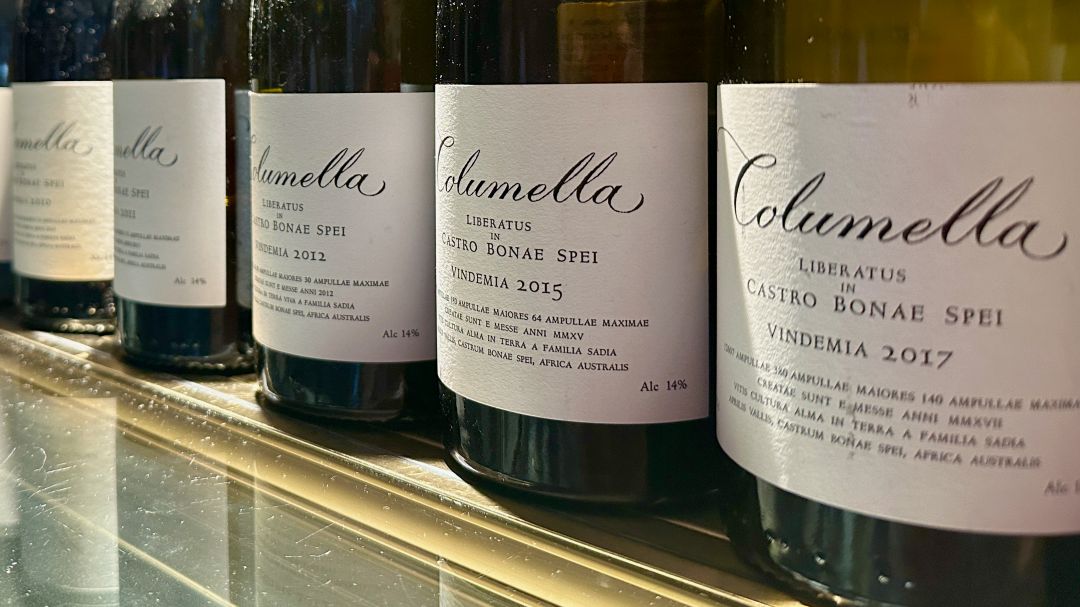
The catalyst for this article was a vertical of Columella in Hong Kong that traversed two distinctive eras of Sadie’s winemaking. With help from Sadie and a handful of friends, I will lay out the background of The Sadie Family Wines, from its humble origins to its present-day eminence. I’ll delve into the philosophy and modus operandi applied both in the vineyard and winery, the significant changes in approach over the years and what might lie ahead.
The Early Years
Following the abolition of apartheid, Fairview had become one of South Africa’s most well-known and successful wineries. In 1995, Charles Back II took over running it from his father. During his formative years working at the Pederberg co-op, Back developed a penchant for Swartland-sourced Mediterranean varieties that had a propensity to ripen easily. That led him to set up a new venture in this sparsely populated backwater that was more associated with wheat than wine. All he needed was a young winemaker to run it…
“I grew up in Vredenburg, in the coastal part of the Swartland,” Sadie told me. “At school I loved maths, science and biology, but agriculture was the subject I loved more than anything. I initially wanted to become a marine biologist as I have an intense love for the ocean, but during my compulsory military service, I decided to study agriculture instead. That decision led me to Stellenbosch.”
Sadie studied at Elsenberg Agricultural Training Institute, alongside Boekenhoutskloof’s Mark Kent. On his recent visit to London, Kent told me that Sadie was the youngest of ten students in a “Cellar Technology” class and how, three days after graduation, they toured the Mosel and France together. Kent described Sadie as his “passe partout,” his porter through the winelands of France. “Sadie was always a great storyteller, always super fun,” Kent wrote, “especially when loaded with Olof Bergh, his brandy of choice.”
“Viticulture quickly captured my attention,” Sadie continued. “Once introduced to great wines and their taste, it was essentially game over. I became fascinated by global wines and regions from Armenia to Canada, Patagonia to New Zealand and everywhere in between. I became, and remain, a true wine nerd.”
After graduating from Elsenberg in 1994 and a three-year stint at the Romansrivier co-op, Sadie took up a postgraduate position at Back’s new winery in 1998, where he worked three vintages. “I was fortunate to take a position at the newly formed Spice Route Wine Company, a private Swartland startup seeded by Charles Back and his partners at the time. During my years there, I had the privilege of working with grapes from many regions and quickly began to understand the differences in terroir, climate and viticultural dynamics.”
Spice Route was a commercial enterprise in a competitive market. There’s nothing wrong with that, even if the mantra was not necessarily the pursuit of ultimate quality. Nevertheless, the experience provided a fundamental understanding of wine regions, not to mention that Sadie was able to make few barrels for himself. He understood that, to create wines that realised Swartland’s full potential, he must go it alone. Armed with contacts that could supply Rhône varieties, what Sadie lacked was money. A serendipitous meeting with English merchant Roy Richards, who was scouting around the region looking for alternatives to South African Bordeaux blends, provided the kick-start.
“Louise Hofmeyr of Welgemeend Estate in Klapmuts tipped me off about this young chap using Rhône varieties up in the Swartland,” Richards recalled. “So we jumped in her pickup truck and drove up to meet him. I don’t remember there being tarmac roads at the time, just dirt tracks. This was probably in the late autumn of 2000. We found Eben in a garden shed with just a handful of barrels. As soon as I tasted them, I experienced a sense of excitement. This was what I was looking for. I asked to buy the wine, and his response was bitterly disappointing. ‘I am sorry,’ he said, ‘but I can’t sell it to you.’ ‘Why ever not?’ I asked. ‘Because I am selling it in bulk. I haven’t got the money to buy bottles and corks. Sorry man.’ I reached into my briefcase, fished out a compliment slip and wrote out a promissory note for Eben to take to his bank—I don’t remember for how much. I told him he could borrow against it temporarily. I promised him that, once back in England, I would transfer the necessary funds. What I tasted was the 2000 Columella, a little firm in tannin but gloriously idiosyncratic. And yes, there was something charismatic and evangelical about its author: hunger and self-belief, the boldness of youth unsullied by cynicism.”
My own juvenile sense of humour revels in the notion that Sadie baptised his creation Columella after the cartilage between the nostrils. I did ask. But no. The name comes from the Roman soldier-turned-farmer, Lucius Junius Moderatus Columella, who wrote extensively about agriculture in his 12-volume, De re rustica, in the first century BC. “He never got any acknowledgment for his work, nor did his later successor, Palladius,” explained Sadie, referencing the name of his white wine that debuted two years later.
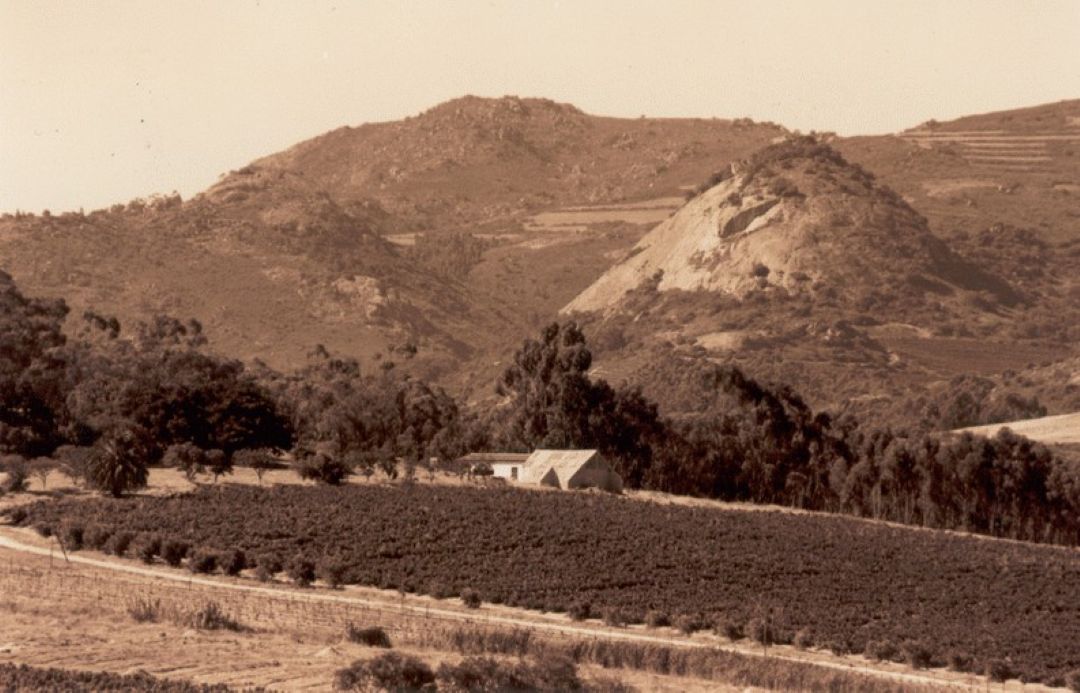
Eben Sadie’s winery in his formative years. The buildings look so small against Swartland’s mountainous backdrop.
More Than the Sum of Its Parts
Sadie produced around 5,000 bottles of the maiden Columella, a blend of 90% Syrah and 10% Mourvèdre. (I have read other figures in wine literature, but this is straight from the horse’s mouth.) Columella never states the blend on the label. It is a blend of sites, ergo it has more in common with Bordeaux than Burgundy. Sadie’s friend, winemaker Ian Naudé, explained that at that time, they were treated as black sheep because blends were regarded as “the lowest of the low.” Indeed, to this day, Columella is anomalous in being a multi-site blend rather than one of the Cape’s many single-site cuvées. Sadie confirmed that the vineyards have remained 90% consistent over the past decade, with only minor additions.
“I firmly believe that regional wines should consistently represent the highest expression of a place and conditions of the vintage,” he opined. “The modern wine world increasingly treats regional or village wines as a ‘downgrade,’ while single-vineyard or monopole wines are positioned as premium products. This makes commercial sense. Monopoles are easier to defend conceptually, easier to explain to a consumer, and easier to price at higher levels due to inherent scarcity. But how does terroir really work? From a purely logical perspective, there is no way that over time, the effort of a single vineyard can consistently outperform the combined effort of ten top-quality monopoles year after year. Ultimately, the latter will be far more representative of an appellation or village.”
“Our landscape is vast and fragmented across South Africa’s largest appellation [990,000 hectares], which stretches from the Atlantic coast to the mountains of Piketberg, Riebeek, Paardeberg and the foothills of the Witzenberg range. Within the soils alone, there is enormous variability, something clearly illustrated in the work of researchers such as [famed geologist] Françoise Vannier in Burgundy. Swartland has an incredibly diverse array of some of the best soils—slate, granite, clay, greywacke, limestone, sandstone, alluvial plains and more—all that you could want. It is a remarkably complex and dynamic region. It’s not rocket science to see that this is a vinous hotspot. The combination of soils, climate, largely unirrigated vines, naturally lower yields and a range of elevations from about 20 meters to over 1,000 meters above sea level creates a uniquely complete package. Quite frankly, if you cannot make world-class wine here, you might want to consider a career change.”
“Our reality is fundamentally different from Burgundy. They work with four varieties. We work with 38. There is a strong oceanic influence near the coast and a pronounced altitude effect inland. Day/night temperature differentials are minimal near the ocean but are extreme further inland. To put it simply, the only honest way to attempt bottling a wine that truly represents Swartland is to farm across all these conditions and bring the fruit together. Anything else captures only a fragment.”
Sadie and Columella brought Swartland to the attention of consumers and winemakers who had hitherto ignored or traduced the region, sparking interest among international wine writers, including Vinous’ own Stephen Tanzer. Sadie’s first vintages predate my maiden visit to South Africa, though I remember how they caused a stir at various dinners. Here was a wine with a distinctly artisan approach in a market awash with established major brands and their heavy-handed takes on Bordeaux varieties or Pinotage. Swartland put South Africa on the global stage and encouraged like-minded winemakers to relocate, including Sadie’s present neighbour, Adi Badenhorst, as well as Chris and Andrea Mullineux. Together, this cohort pooled their resources to incept the Swartland Revolution, a showcase for new South African wine infused with youthful hedonism. To quote the Stone Roses: “The past was yours, but the future is mine.”
Sadie was the talisman at its epicentre, but his unbounded curiosity and desire to extend his education beyond the geographically remote Cape led him to undertake two harvests in different hemispheres every year. For 15 years, Sadie had a joint project with Dominik Huber in Priorat called Terroir al Límit, but the workload was immense. Sadie finally relinquished his role in 2010 in order to dedicate himself to Swartland, not to mention his family of two sons, a daughter and his very patient wife, Magriet.
From Humble Beginnings
In those early years, Sadie worked out of a rudimentary winery that he himself described as a “shack” on the Lammershoek estate. The first vintages of Columella came from contracted fruit for which Sadie oversaw the viticulture. In 2006, he bought his first parcel within Lammershoek. It was the start of a long-term, piecemeal process to convert Columella and Palladius into cuvées made from his own holdings. He made a significant purchase of another 20 hectares in a joint investment with Badenhorst, from an adjacent property with what he described as “a remarkable collection of old-vine vineyards.”
I remember touring his new acquisition in his bakkie (i.e., 4x4). His excitement was tangible as he effused about the prospects of how these vines would contribute to his wines. Most recently, Sadie added another conjoining seven-hectare parcel. With a sense of mission complete, he renamed the 44-hectare farm Rotsvas, which translates to “rock solid.” It includes 20 hectares under vine, interpolated with natural green corridors to maintain ecodiversity.
“We farm roughly half of our fruit on our own property,” Sadie explained. “In addition, we work with 14 other properties under long-term lease agreements in which we rent the land but conduct all viticultural work ourselves. Our permanent team currently consists of 38 people. We farm 51 hectares in total, which, due to very low yields, results in approximately 100,000 bottles per year.”
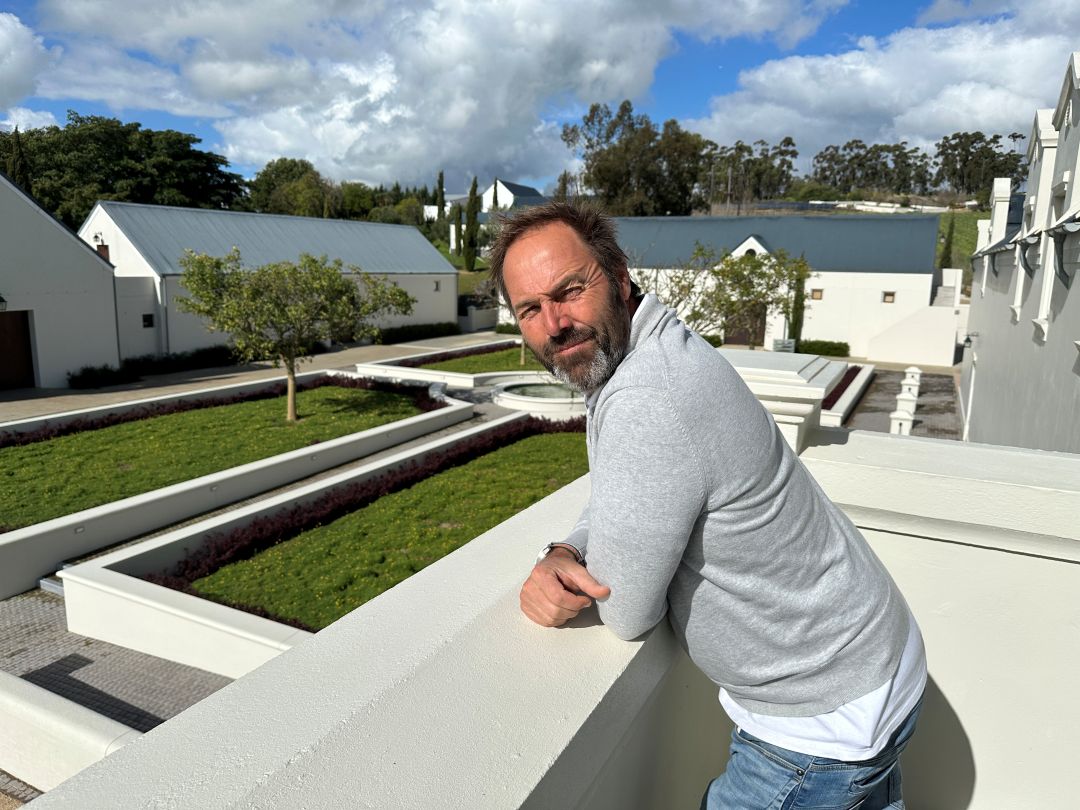
Sadie on the balcony of his recently completed winery, tasting room and outbuildings. The architecture reflects South Africa’s heritage, grand in design but functional throughout.
As detailed in my recent South Africa reports, Sadie oversaw the construction of a substantial winery that he planned and executed down to the minutest detail. When I inspected the foundations a couple of years ago, with the smell of wet cement in the air, Sadie seemed to have laid every brick, hammered every nail. Sadie has always been a workaholic. Not a control freak, but a man who pores over every detail, rolls up his sleeves and does things himself. That he installed a state-of-the-art kitchen not to open a restaurant for tourists but simply to feed his team properly is indicative of Sadie’s regard for those under his aegis. I remember him stopping to speak to a team of young vineyard workers pruning vines. Though the conversation was entirely in Afrikaans, I could still discern the mutual affection.
Until recently, Sadie employed Paul Jordaan as Head Winemaker, which freed up time to get Sadie out of the cellar and into the open air. He is truly happiest in the vines, clichéd as that phrase has become. He has always spoken with wisdom beyond his years, thanks to a lifetime of visiting wine regions and tasting wines from around the world. The rows of empty bottles and esteemed labels that regimentally decorate his shelves testify to his expertise. Sadie is a fascinating interlocutor. I always wish we had longer to chew the fat. He enunciates words in a measured manner, as if he had reflected on your question hours before you asked it. He tends to speak candidly, practically and philosophically about issues pertaining to the Cape and beyond, punctuating his insights with the wry humour common in these parts.
When not in the vines, Sadie is most content on the ocean. “Surfing is an important counterbalance for me as it is all-consuming,” he told me. “I simply love it.” To celebrate his half-century birthday, Sadie surfed the famous Cloudbreak wave off the island of Tavuara in Fiji. “The wave is an absolute marvel and certainly produced the biggest barrels I have ever surfed.” (So, he hasn’t completely given up on barrels!) “It is damn scary too. The shallow and sharp reef is a stark reminder that we are living at the mercy of far greater forces.”
Could he not just go for a Nando’s with his mates?
A Change in M.O.
Nobody would refute Sadie’s enormous impact on South African wine. However, this was not a case where a winemaker sets out their stall at the beginning of their career and is hidebound to the same principles until they put down their pipette. He undertakes a wholesale review of his practises every ten years and stress tests new techniques before their implementation.
“Until 2009, we finalised our blends by tasting through individual components—14 vineyards for Columella and 24 vineyard sites for Palladius—and then assembling the final wine at the blending table,” Sadie explains. “Over time, I realised that this approach is flawed from the outset. A wine should not be an imagined reality of a place, nor the result of philosophical ideology. It should reflect the truth. At the blending table, too many external pressures come into play: journalistic considerations, financial pressures around volume, personal ego, ambition and consumer expectations. Before the blending process even begins, the wine is already compromised. Any aspiration to truthfully represent Swartland terroir is lost.”
“Since 2010, everything we harvest from the designated Columella and Palladius sites is used in totality. If a site suffers from poor flowering, sunburn or reduced yields, then that is simply what the wine becomes. This approach offers a far more honest reflection of terroir and the climatic conditions of a given vintage. Ultimately, we value truthful representation of site and season over perceived perfection. It requires some nerve and confidence, which can only be achieved through solid viticulture. That is the cornerstone of every aspect of our work.”
This revised approach is diametric to Sadie’s erstwhile policy of deselecting plots or parcels, which ineluctably shapes a wine according to the winemaker’s vision and predilection. It reinvented Columella as a faithful translation of land and season via fruit and resulting wine. Sadie’s ethos is similar to that of Cheval Blanc in terms of representing the whole of a vineyard. Crucially, significant changes in winemaking have caused Columella’s style to evolve over time, as I describe in my attendant tasting notes.
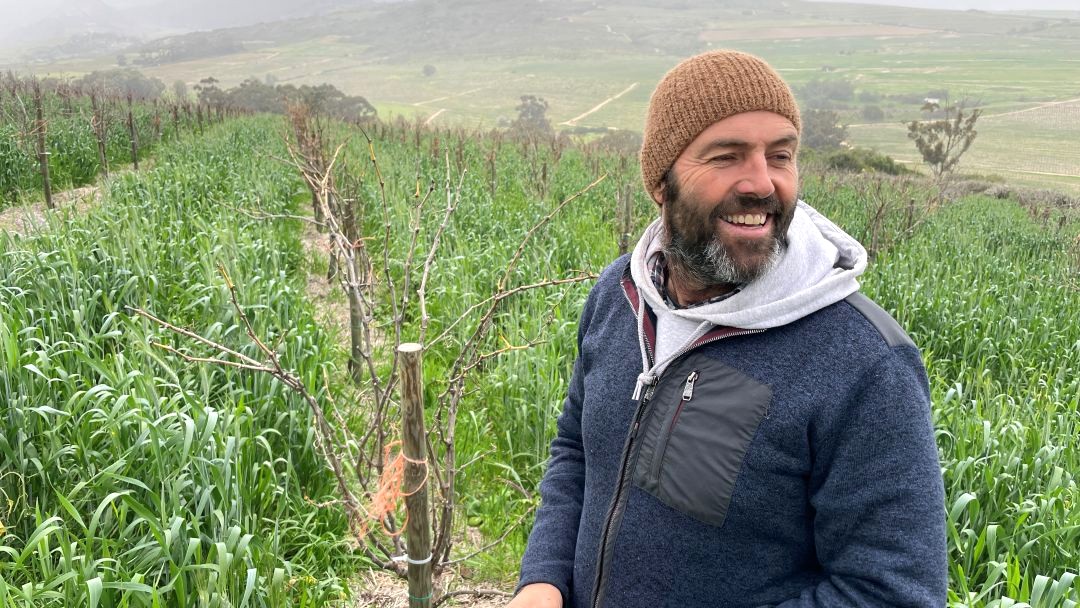
Sadie in the vines in August 2022, or rather, cover crops in the South African winter.
Until 2009, Columella was primarily Syrah and Mourvèdre, fully destemmed. It underwent pigeage and higher extraction before maturation in around 30% new oak. You could argue that it borrowed heavily from the modus operandi commonplace in the Cape. My reaction to those wines back in 2011, when I wrote in my South Africa report apropos Sadie: “My only criticism is that older vintages have been rather brawny and alcoholic…”
“Certainly, post-2009, we hit an entirely new direction in the cellar,” Sadie explains. “First, we started to open up the varietal range beyond Syrah and Mourvèdre. The parcels for Columella grew from four to eleven with the inclusion of Grenache for texture and grip, Carignan for acidity and direction, Cinsault for brightness and Tinta Barocca for darker fruit and diverse/expanded tannins. In recent years, we have added around 4% of Pinotage for more depth.”
“The primary concern was that Syrah would be susceptible to climate change. To this end, we started using around 30% whole cluster. [Limiting whole bunch protects pH levels since potassium-rich stems can lower acidity.] We stopped punchdowns and only do one ‘bucket-over’ per day, focusing on fusion rather than force. For the last 15 years, we have also worked with serious cover crops, using mulch and a vine density program to improve soil moisture control. Canopy management of the goblet systems has been completely reworked, and crop levels are now balanced. All the above reduced the Columella’s alcohol levels to between 13.3% and 13.6% in recent years.”
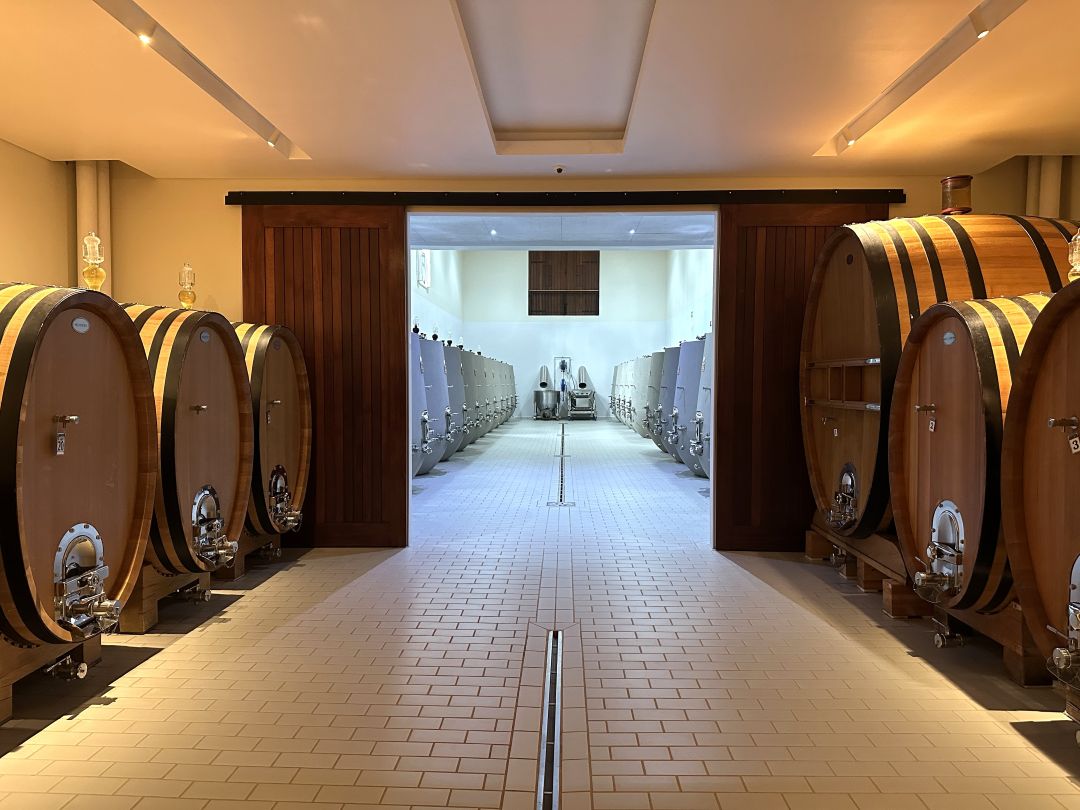
The new winery as of my last visit in August 2025.
The Wines
I suspect that my scores for the first decade of Columella will raise eyebrows. I understand that. This is one of South Africa’s icons, one that was garlanded with adulatory reviews at the time. However, tasting them chronologically, it was patently obvious that there are two very different styles of Columella. Had I sat on the fence and scored consistently, littered compliments equally between eras, that would leave a mixed message. Retasting the first decade of Columella, I felt as if I was tasting a great wine compromised by an ill-fitting winemaking approach, as if the namesake Roman soldier was marching with heavy body armour. Enrobed in oak, the terroir, secondary aromas and flavours feel masked. This approach resulted in a generic Syrah blend that comes across as predictable. Frankly, with one or two exceptions, vintages from that era have not repaid bottle age by evolving into something less primary and more profound. Of course, new oak and traditional barrels were in vogue at the time and doubtlessly helped Columella win an international audience.
To Sadie’s credit, he implemented the radical changes described earlier. This vertical exposed the stylistic limitations of earlier vintages. The seasoning of other Rhône varieties, the moderation of oak influence, the addition of whole bunch and changes in the vineyard are all concomitant to a different and, in my view, superior wine that is far more engrossing, endowed with more character and nuance. That must be reflected in my scores, just as someone who appreciates oakier wines might rue this change in style!
Moreover, I feel that the post-2010 Columella wines are closer to what Sadie envisaged. His is an empirical process of continually making, tasting and revising. When I discuss each new vintage with Sadie, he often confesses what he sees as their shortcomings. By the same token, he will express contentment when he feels a vintage approaches the epitome of his vision. The most recent vintage in the vertical was the 2017, given that the Columella does require bottle age. I sacrificed one bottle of the 2018 from my own cellar and purchased a 2020 from Hedonism in London to complete the story. In my opinion, the best Columella wines are post-2020, where they touch the level of the world’s finest Syrahs and Sadie matches exponents such as Jean-Paul Jamet or Jean-Louis Chave.
There is a twist in the tale.
We could not undertake the Columella vertical without whetting our palates with a few whites from Sadie’s Old Vine Series of single-site cuvées. These deserve a standalone article of their own. I recall tasting the first commercial releases in a café in Riebeek-Kasteel with Sadie and Chris Mullineux, back in 2011. Together with Rosa Kruger, they had located parcels of ancient vines to make several white and red cuvées, baptised with names in Afrikaans. Though initially difficult to sell, these wines have since become highly coveted. They are frequently profound expressions of terroir, albeit with reasonable prices that would embarrass much of Burgundy. We tasted four whites from three cuvées—the Skerpioen, Mev. Kirsten and T Voetpad—and they made a huge impression on a Hong Kong audience, most of whom were unacquainted with these wines.
Final Thoughts
Columella was crucial to South Africa’s coming of age and remains one of its most coveted wines. At the same time, it reflects the learning process of its creator. Practice makes perfect. Only by getting grit under your fingernails, only by making, can you assess and improve. Hypothetical exploration is not an option for winemakers furrowing their own path—there is only experiential learning. Jamie Goode once quoted Sadie as saying, “What I have learned from the first ten years is much more important than what I have actually done in the first ten years.”
That sentence is this tasting in a nutshell.
Today, the Columella is far closer to what Sadie envisaged than ever before, an articulation of Swartland in its kaleidoscopic glory.
Sadie and I exchanged messages as this article took form. I always received a thought-provoking answer that often prompted more follow-up questions. One of his last messages read: “I decided at age 26 to pursue fine wine; not money nor fame, but to produce the wine that speaks of this place and its people.”
You hear sentiments like this all the time, and some feel disingenuous. In this case, it is unequivocally true. You cannot ignore the unbreakable bond between this winemaker and his region.
“Swartland is also home, the place where I wanted to get married and raise a family,” he wrote, “where we have hopefully made a positive impact on the community beyond wine and financial gain.”
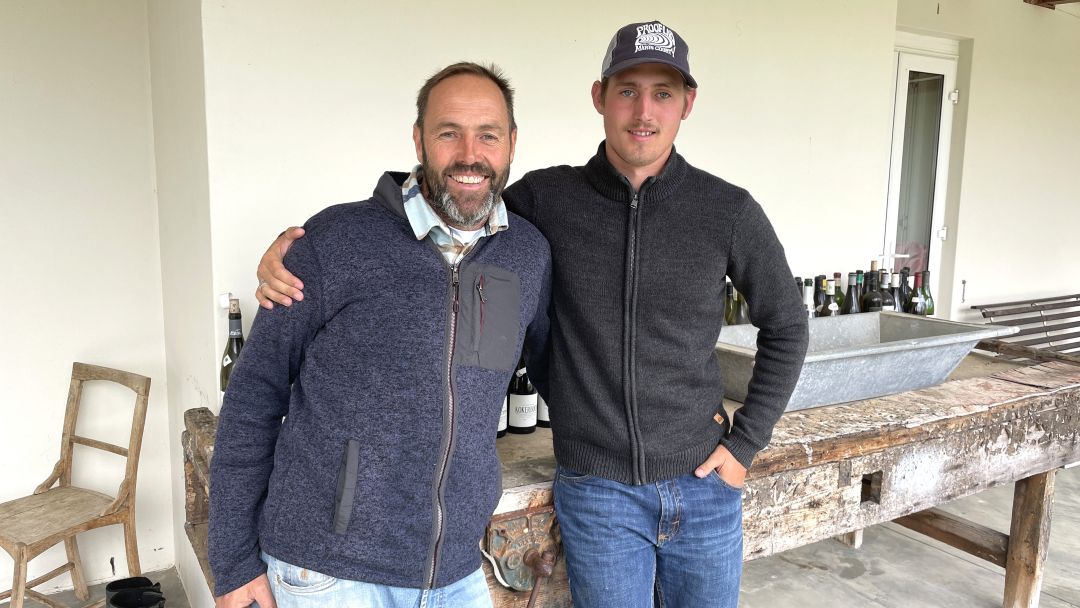
Eben Sadie and his son, Markus, in the new vat room in August 2023.
What about the future? Sadie told me that he is developing new vineyards in response to global warming, with a plan to incorporate them into both Columella and Palladius in 15 to 20 years, possibly sooner. In the meantime, the fruit is sold off. Sadie has always planned for the long term. He often mentions handing over the reins to the next generation, and his son, Markus, now takes a bigger role.
Passing on the baton is the easy part.
Letting go? That’s much harder.
Whatever the future holds, Columella is an emblem of Sadie’s—and indeed, South Africa’s—restlessness, which undergirds the pursuit of quality. You do not achieve greatness by standing still, but by thinking and rethinking, trying and maybe failing ‘til you succeed.
Winemaker, entrepreneur, surfer, husband, sage, nerd, dude, workaholic, intellectual, talisman, father, reluctant messiah?
All of these and more.
© 2026, Vinous. No portion of this article may be copied, shared or redistributed without prior consent from Vinous. Doing so is not only a violation of our copyright but also threatens the survival of independent wine criticism.
You Might Also Enjoy
Day by Day: South Africa in 2025, Neal Martin, October 2025
Steenwold! South Africa: Ten Years On, Neal Martin, July 2025
South Africa: Where Are We Now?, Neal Martin, September 2024
White-on-White: Porseleinberg 2010-2020, Neal Martin, November 2023
The A to Z of South Africa, Neal Martin, November 2023