
Browse using the new Vinous website now. Launch →
Printed by, and for the sole use of . All rights reserved © 2015 Vinous Media
Giuseppe Mascarello & Figlio: Barolo Monprivato and Riserva Cà d’Morissio in Magnum
BY ANTONIO GALLONI | DECEMBER 15, 2025
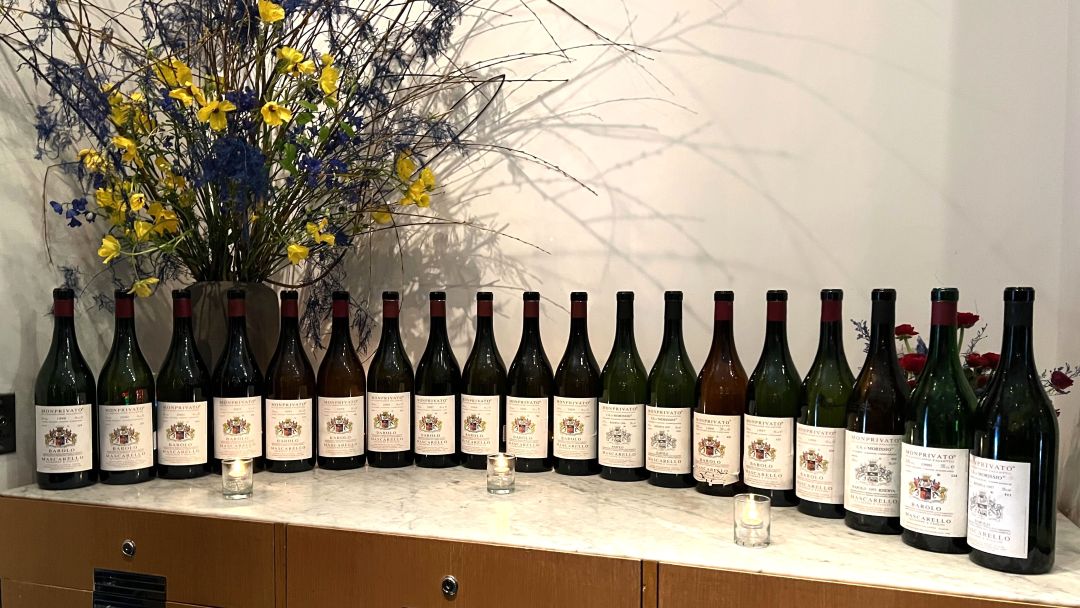
Giuseppe Mascarello & Figlio is one of Piedmont’s most historic estates. This rare vertical tasting of Mascarello’s iconic Barolo Monprivato and Barolo Riserva Cà d’Morissio, all from magnum, provided an extraordinary opportunity to trace the evolution of the wines across three decades that include many of the estate’s most legendary vintages.
I hope readers will indulge my tardiness in publishing these reviews, which date from the 2022 Festa del Barolo. The sheer number of new wines that need to be reviewed on a timely basis is overwhelming and leaves precious little time for reporting on retrospectives. This article is the first in a series that will put a big dent in my archive of tasting notes on older Piedmont wines. “Better late than never,” the saying goes. I think that applies to these notes, especially for wines in magnum format. Suffice it to say, I have never been to a tasting like this one.
A Personal Journey
I started following Giuseppe Mascarello & Figlio sometime in the mid-1990s. Unfortunately, I don’t remember how I first learned about the estate and their wines, but I was totally mesmerized by Mauro Mascarello’s mystical, old-school persona. The wines were widely available in Boston, where I lived at the time. I often ordered the 1990 Barolos in restaurants, as they were so well priced, and the quality was exceptional. For daily drinking, I often chose the Barbera d’Alba Codana, which I loved back then for its stunning quality and accessible price.
By the time I was in business school a few years later, my wine of choice was the 1996 Barolo Monprivato. It cost $50 a bottle, a lot more than what my friends were spending for their beverage of choice, but not so much for a world-class bottle. The 1996 sat on retailers’ shelves for years. Not months, years. These were the days when you could go to a shop, buy a wine, then come back days, weeks or even months later and buy more. Things are a little different now.
When it came time to plan the 2022 Festa del Barolo, I had a strong pull to revisit the Mascarello Barolos, wines that had played such an important role in my early appreciation of Barolo and Piedmont. All the wines for this dinner at The Modern were acquired from a single large collection of magnums, all purchased on release. I chose the wines with the intent of showcasing a mix of benchmark vintages and under-the-radar years. I stopped at 2008, as I felt that quality had dipped in subsequent years, although things seem to be back on track these days. The wines were arranged in thematic flights, as is our custom.
A Brief History
The Mascarello family’s history dates to at least the 1800s, when they farmed vineyards for Giulia Falletti di Barolo, the French-born aristocrat and philanthropist who is credited with bringing the French winemaking techniques to Italy that transformed Barolo from a sweet wine to a dry wine. Family patriarch Giuseppe Mascarello (1830-1902) acquired the family’s first vineyard, a parcel in Pianpolvere, in 1881. His son, Maurizio (Morissio), bought the estate’s core holding in Monprivato in 1904. Nestled in the middle of the Barolo appellation, in the heart of Castiglione Falletto, Monprivato is a stunning vineyard capable of yielding wines of supreme elegance that can also age effortlessly for decades.
Mauro Mascarello and the Birth of Barolo Monprivato
Mauro Mascarello worked with his father for years before taking over most of the day-to-day management of the family estate in 1967. In 1970, after years of trying, a young and rebellious Mauro Mascarello finally convinced his father, Giuseppe (Gepin, 1897–1983), to let him make a single-vineyard Barolo from the family’s Monprivato vineyard. It was a radical departure from the past. Up until then, the Mascarellos had made a single Barolo blended from several different vineyards, as was the custom at the time. Indeed, readers fortunate enough to have tasted wines like the 1961, 1964 and 1967 Barolo know just how special those wines are, even today. But the young Mauro Mascarello wanted to follow the emerging fashion of vineyard-designated Barolos that had started in the early 1960s. Before embarking on the new project, Gepin told Mauro that if he was going to make a single-vineyard Barolo from Monprivato, he should at least use the best part of the vineyard. These were blocks planted with the rare Michet clone, which Mauro’s grandfather, Maurizio, had first planted in the 1920s, and that Gepin later expanded in the 1960s through a massale selection.
In his first vintage, Mauro Mascarello fashioned an epic Barolo Monprivato that would plant the seed for a Riserva many years later. Readers who have tasted the 1970 Barolo Monprivato know what an extraordinary wine it is. A remarkable string of vintages followed. The 1971, 1978, 1982 and 1985 are all early reference points. The style was and remains rigorously traditional: long fermentations and lengthy aging in cask. During this time, the estate had a small but loyal following. In 1979, Mauro Mascarello bought back a portion of the family vineyards from his uncle, Natale, the first of a series of transactions that led to Mascarello’s total of six hectares in Monprivato, a near-monopole.
Along the way, Mauro Mascarello decided he wanted to create a Riserva from Monprivato, a wine he would bottle only in the best years. In the early 1980s, Mauro Mascarello began his own project to select and then propagate the best material from Gepin’s plants. That led to a major replanting of Michet in 1988 and then the first Riserva Cà d’Morissio from these new blocks. Mauro Mascarello dedicated his new Riserva to his grandfather, Morissio.
Hard as it may seem to believe today, the winery fell into a state of near oblivion during the 1980s and 1990s, as the more lush, extroverted wines of the modern school became increasingly popular. The wines did not suffer, though. Many of the vintages of the late-1990s and 2000s were superb.
Appreciation for the Mascarello Barolos increased starting in the mid-2000s, as consumers and the press began to tire of modern wines. Like all historic estates in Piedmont, Mascarello rode the extraordinary surge of popularity Piedmont wines have enjoyed since. But not everything has been easy. Quality dipped with the 2009 vintage and several subsequent inconsistent vintages before rebounding in a big way with the 2020, a wine I hope signals a permanent return to form.
Reception
Chef’s Seasonal Selection of Passed Canapés
Vinous Champagne Bar
Dinner Menu
Monprivato Here & Now
Citrus Cured Hamachi with Avocado and Cherry Belle Radish
Barolo Monprivato 1998, 2000, 2001 & 2003
The 2003 steals the show in this first flight. No one in the room expects it to be so vibrant and fresh, but it is.
Under the Radar Vintages
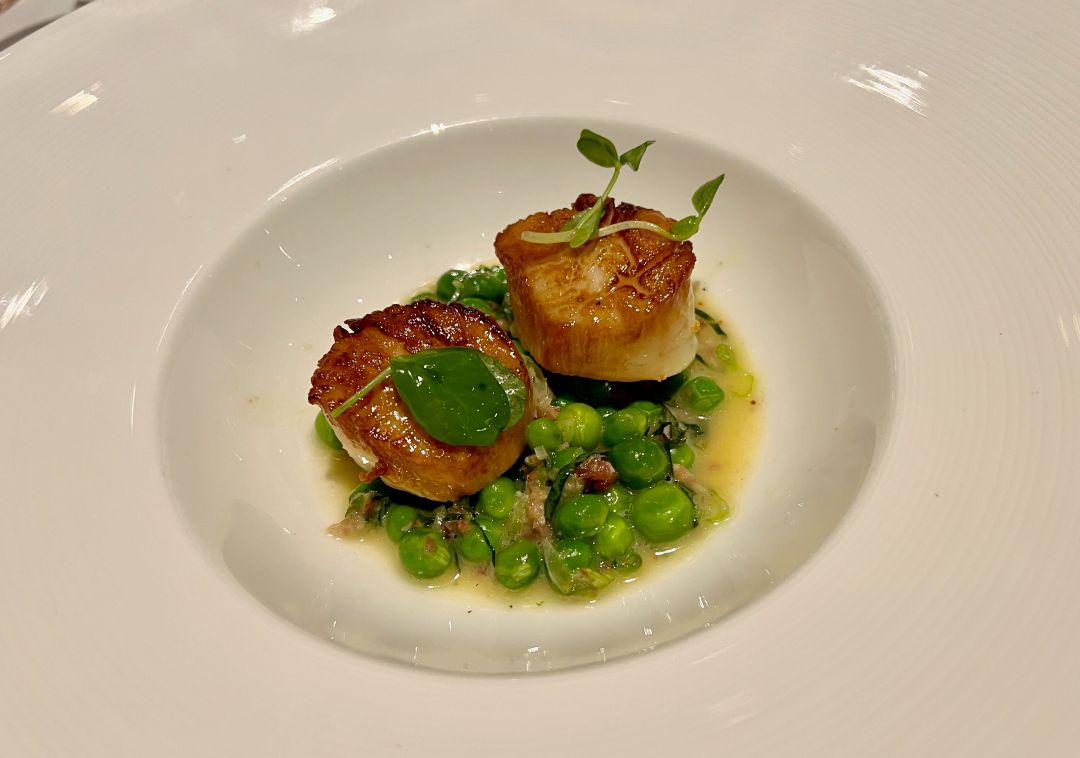
Seared Scallops with English Peas and Bacon
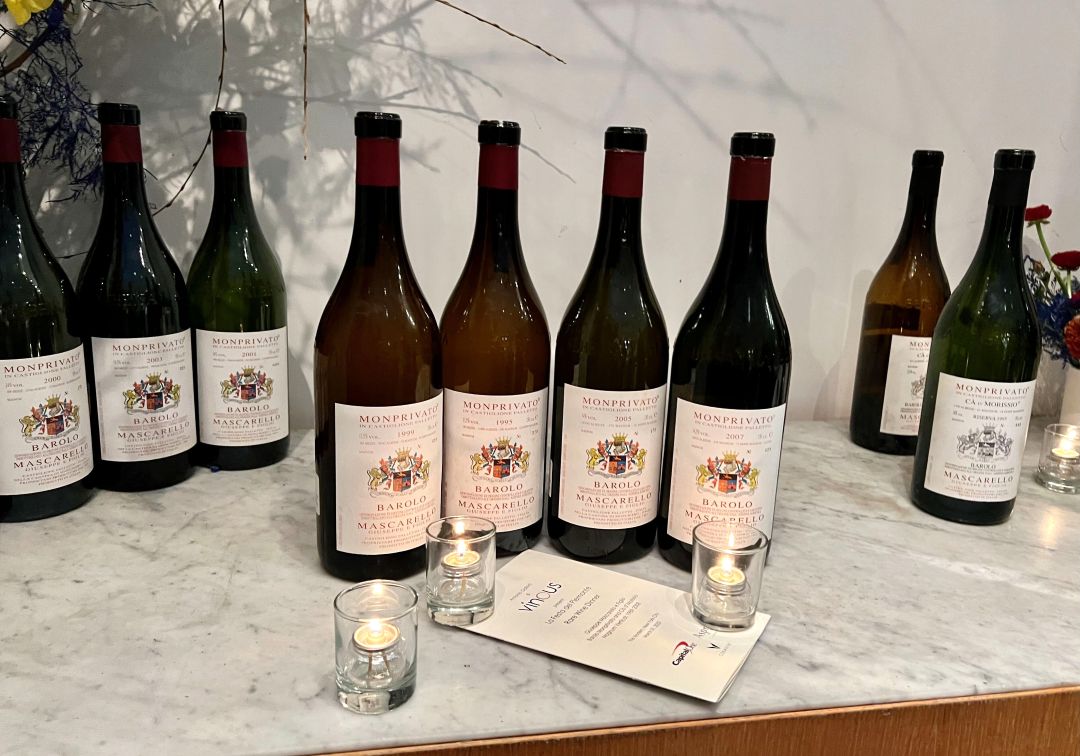
Barolo Monprivato 1995, 1999, 2005 & 2007
This flight features two vintages in which there is no Cà
d’Morissio, 1999 and 2005, both of which are stellar. The 1995 is surprisingly
outstanding, while the 2007 is its usual opulent self.
Great Vintages of the 2000s
Gruyere Ravioli with Chives and Broccolini
Barolo Monprivato 2004, 2006 & 2008
It’s hard to go wrong with three superb vintages from the 2000s. The 2004 and 2008 are both wines from cool, late-ripening years, while the 2006 emerges from a warmer growing season. All are superb.
Cà d’Morissio – The Early Days
Dry Aged Duck with Caramelized Endive and Rhubarb
Barolo Riserva Monprivato Cà d’Morissio 1993, 1995 & 1996
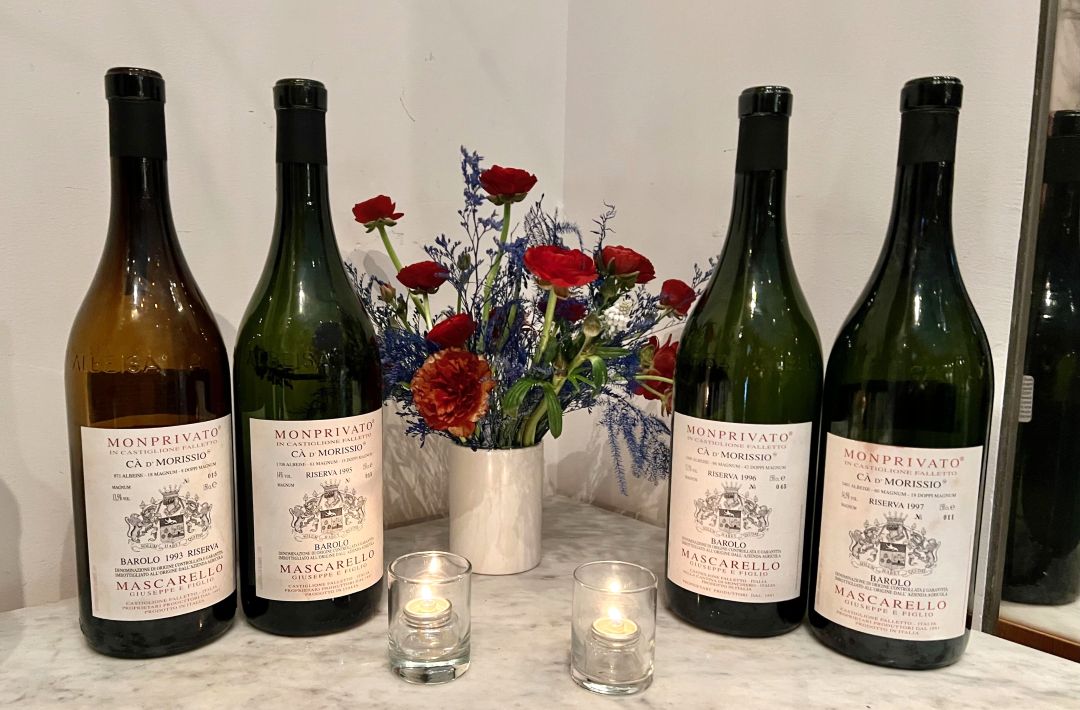
What a treat it is to taste the first three vintages of the
Barolo Riserva Cà d’Morissio, a wine that has gone on to become one of the most
coveted bottles in Piedmont. The 1993 shows a work in progress, but by 1995
Mascarello is in full swing.
Shades of Monprivato
Caramelized Apple Tarte Tatin with Granny Smith Apples
Barolo Monprivato 1997, 1996, 1990 & 1989
Our final flight features two iconic pairings. Nineteen ninety is a seminal vintage for Barolo. It is one of the first vintages that helped make Barolo popular in the United States because the wines were so open. Classicists have always preferred 1989, however. I count myself in that camp. Much the same applies to 1997 and 1996, with 1997 garnering more public acclaim and 1996 a darling of Piedmont lovers. At this level, though, it’s hard to go wrong with any of these wines. Especially from magnum.
The 1997 Barolo Riserva Cà d’Morissio is a last-minute addition that brings the evening to a rousing finish.
© 2025, Vinous. No portion of this article may be copied, shared or redistributed without prior consent from Vinous. Doing so is not only a violation of our copyright but also threatens the survival of independent wine criticism.
You Might Also Enjoy
2021 Barolo Part Two: Restless Energy, Antonio Galloni, September 2025
2021 Barolo: Changing Times, Changing Wines, Antonio Galloni, January 2025
Cellar Favorite: 1989 Giuseppe Mascarello & Figlio Barolo Monprivato, Antonio Galloni, September 2017
Piedmont’s Glorious 1989 and 1990 Vintages Revisited, Antonio Galloni, February 2010
A Survey of Michet: Giuseppe Mascarello Barolo 1967-2001, Antonio Galloni, September 2009