
Browse using the new Vinous website now. Launch →
Printed by, and for the sole use of . All rights reserved © 2015 Vinous Media
3-7 Devonshire Road
Chiswick, London
W4 2EU
Tel: 0208 747 1836
BY NEAL MARTIN | JANUARY 30, 2026
The Food:
Heirloom tomatoes with crushed green olives, smoked paprika aioli, basil and wild rocket
Tuna sashimi with yuzu and white soy, avocado, toasted sesame, coriander, ginger and chili
Black truffle linguini
Rump of veal with butternut squash purée, sweetcorn, girolles, fondant potato and roasting juices
Chocolate, peanut and salted caramel delice with milk ice cream
The Wines:
| 1986 Taittinger Comtes de Champagne | 91 |
| 1988 Montevertine Le Pergole Torte | 90 |
| 1988 Soldera – Case Basse Montevertine Brunello di Montalcino | 96 |
| 1990 Soldera – Case Basse Brunello di Montalcino Riserva | 99 |
| 1997 Soldera – Case Basse Brunello di Montalcino Riserva | 96 |
| 2001 Soldera – Case Basse Brunello di Montalcino Riserva | 93? |
| 2006 Soldera – Case Basse Brunello di Montalcino Riserva | 97 |
| 2013 Soldera – Case Basse Toscana Sangiovese | 95 |
| 2004 Dal Forno Passito Rosso Vigna Seré | 98 |
| 1999 Thierry Allemand Cornas Reynard | 96 |
| 1999 Domaine A. Clape Cornas | 97 |
| 1999 Domaine Noël Verset Cornas | 91? |
| 1995 Domaine Jean-Paul, Corinne & Loïc Jamet Côte-Rôtie | 94 |
| 1999 Domaine Jean-Paul, Corinne & Loïc Jamet Côte-Rôtie | 95 |
| 1999 Domaine Jean-Paul, Corinne & Loïc Jamet Côte-Rôtie Côte Brune | 97 |
| 1999 Château de Fonsalette Côtes du Rhône | 93 |
| 1998 Domaine Henri Bonneau Châteauneuf-du-Pape Réserve de Célestins | 88 |
| 1999 Domaine Henri Bonneau Châteauneuf-du-Pape Réserve de Célestins | 95 |
| 1985 E. Guigal Côte-Rôtie La Mouline | 96 |
| 1990 E. Guigal Côte-Rôtie La Turque | 94 |
| 1990 Domaine Noël Verset Cornas | 91? |
| 1990 Domaine A. Clape Cornas | 95 |
| 1942 Maison Chapoutier Hermitage Blanc | 87 |
You could define a bona fide great restaurant as one where tingles of excitement run down your spine no matter many times you enter its doors. La Trompette is essentially my second home, given the innumerable times I have visited. In fact, I wrote it up for one of my first-ever Vinous Tables. Seven years, countless wines and one new chef later, I recently returned for two splendid evenings: a Soldera dinner and a Rhône dinner. Chef Rob Weston untied his apron after 16 years of service, though when I rack my memory, I think I only saw him once. Greg Wellman, who worked at restaurateur Nigel Platts-Martin’s sister restaurants, The Square and Chez Bruce, has stepping into Weston's shoes.
In my opinion, the standard at La Trompette under Wellman is as good as it was under his predecessor. Prices have increased in recent months, but show me somewhere in London where they have not. Wellman’s execution of the dishes is impressive. The ingredients consistently shine, and dishes lean towards the more decadent side. That said, the à la carte menu makes it easy to choose lighter options. Like the aforementioned Chez Bruce, La Trompette deftly combines a local bistro ambiance with upmarket cuisine, offering a chance to “escape” central London in just a few stops of the tube or a taxi ride.
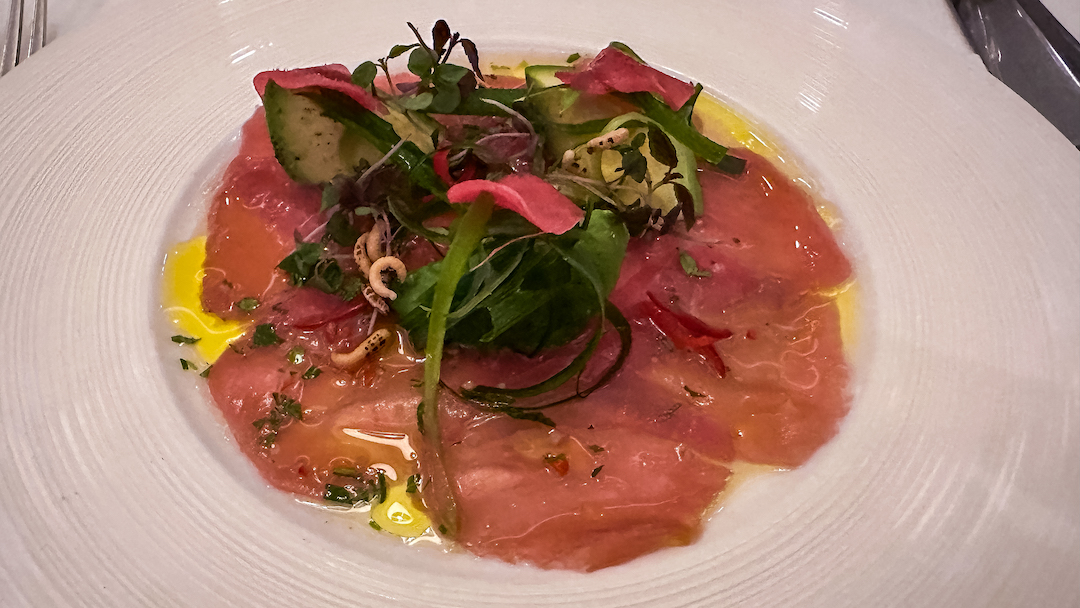
Tuna sashimi with yuzu and white soy, avocado, toasted sesame, coriander, ginger and chili.
I choose a different starter at each dinner. At the Soldera dinner, the heirloom tomatoes with crushed green olives, smoked paprika aioli, basil and wild rocket just shine on the plate, the seasoning perfect so as not to overpower the bright flavors of the tomatoes. For the second dinner, I opt for the tuna sashimi with yuzu and white soy, avocado, toasted sesame, coriander, ginger and chili. It is divine. The slithers of finely cut tuna have a melt-in-the-mouth texture, while the avocado lends sweetness.
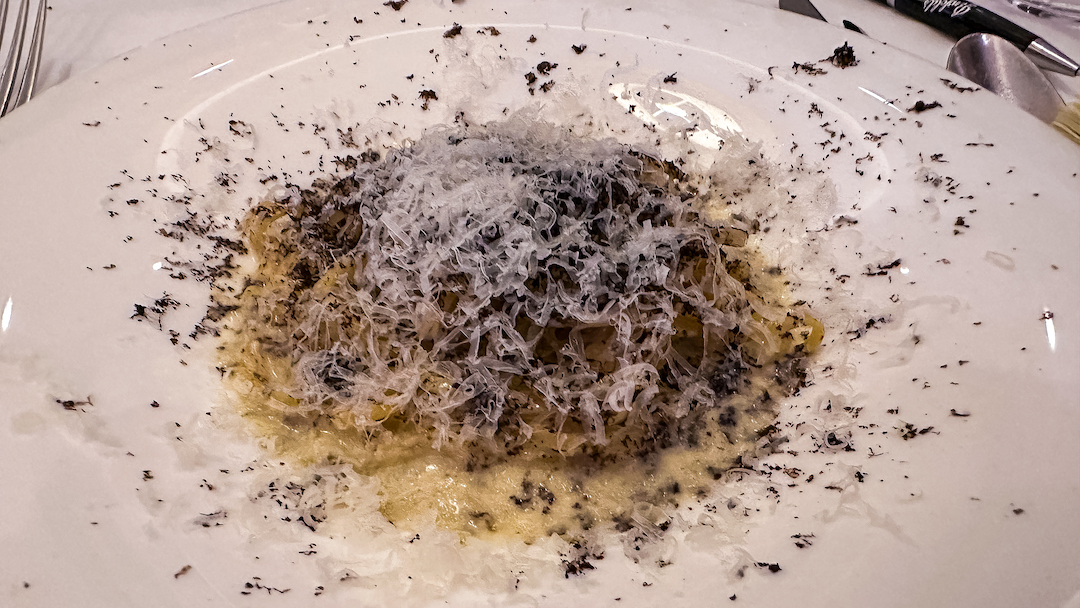
Black truffle linguini.
The black truffle linguini has been a signature dish for years, and the linguine is always perfectly al dente. Let’s face it: you can never have too much truffle, and black truffle is better than white. You know that’s true.
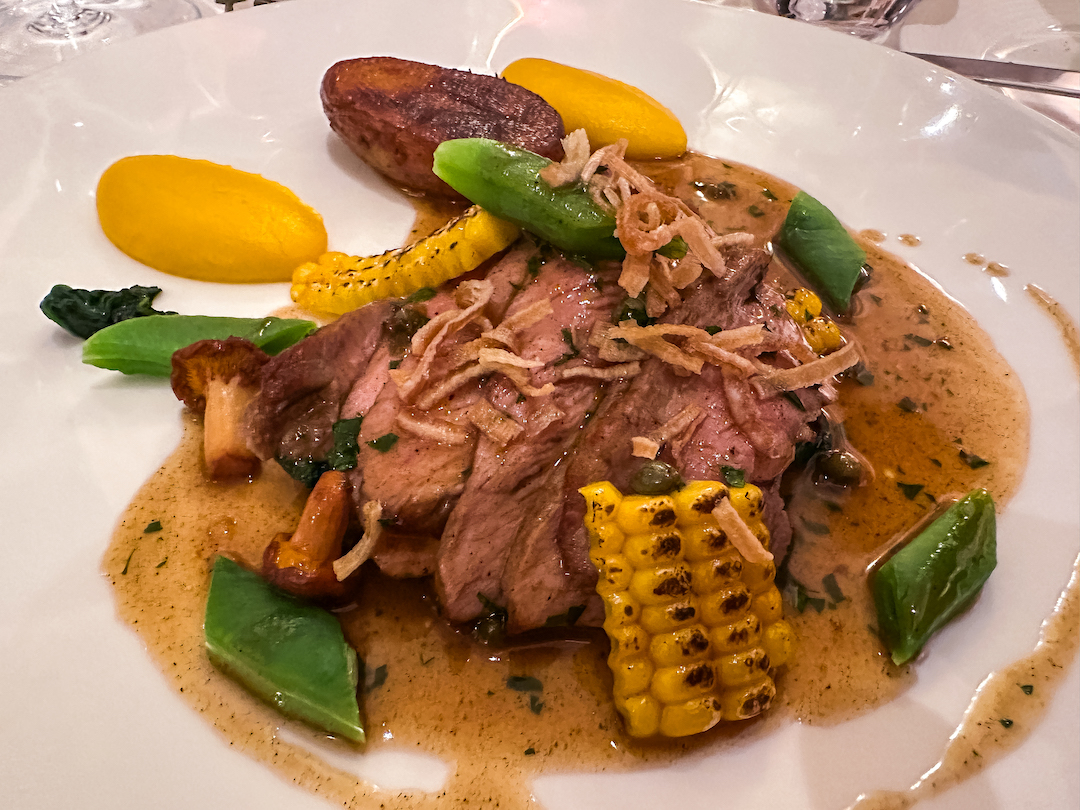
Rump of veal with butternut squash purée, sweetcorn, girolles, fondant potato and roasting juices.
The rump of veal is cooked with a pinkish tinge and marries well with the sweetness of the butternut squash purée. Chunks of sweetcorn lend crunch, and if I need to quibble, then I would have liked a few more girolles to greet me on the plate.
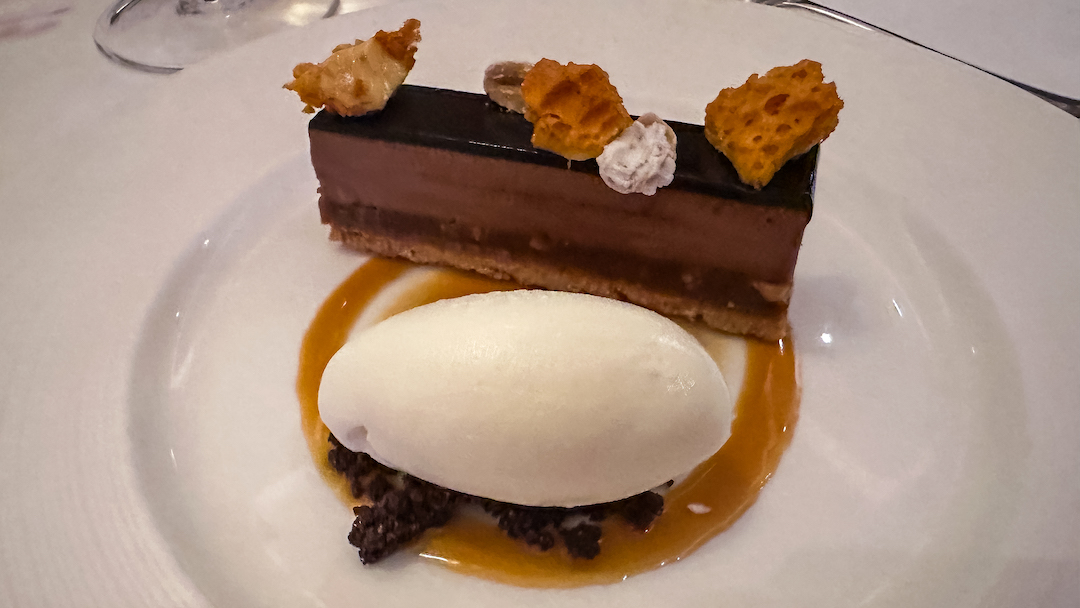
Chocolate, peanut and salted caramel delice with milk ice cream.
Finally, the chocolate, peanut and salted caramel delice with milk ice cream is not overly rich or decadent. It has the finesse you expect from a Michelin-star restaurant, though the standout is perhaps that milk ice cream that keeps the entire dessert on its toes.
I was treated to a bevy of outstanding wines at both dinners. How lucky I am to have friends who generously share treasures from their cellars.
The first dinner was themed around a vertical of Brunello di Montalcino from no less than Soldera. I recommend reading Antonio Galloni’s vertical from June 2024 if you did not do so at the time. Personally, I cannot think of another winemaker who dominates a wine region like Gianfranco Soldera, who passed away in February 2019. Even friends with only passing interest in Brunello di Montalcino place him within an elite group of winemakers who seem to operate on a different plane to everyone else, perhaps Jean-François Coche, Lalou Bize-Leroy, Jean-Claude Berrouet, Jacques Reynaud, John Daniel Jr. (Inglenook) or another legend featured in this piece, Auguste Clape. Men and women whose wines are perceived as being almost untouchable. I never met Soldera myself, and reading that, and I quote, “…he was not an easy man to get on with,” I would have approached such a meeting with trepidation. I missed an epic vertical organized by his UK agent a few years ago. Bottles of these legendary wines infrequently appeared at dinners, but when they did, they lived up to my sky-high expectations.
We commence with my own contribution, not Soldera, but the 1986 Comtes de Champagne from Taittinger, an original release. Burnished amber in hue, this has a fully mature nose of grilled hazelnut, marmalade and brioche, with a touch of dried orange rind. Aromatically, this is perhaps just a bit long in tooth for those who prefer their sparklers young. The palate is well balanced, however, with notes of brioche, Turkish delight, desiccated orange peel and dried honey. I drank this 1986 from magnum a year earlier and, truth be told, this bottle was not a patch on that showing. Based on this, I would drink the 1986 sooner rather than later, though magnums look like the better option.
Though the main event is the vertical of Soldera, we begin with the 1988 Le Pergole Torte from Montevertine, poured blind against the 1988 Soldera. Pale garnet in hue, the Pergole Torte has a pleasant bouquet with vestiges of red fruit, incense and leather, perhaps a little fatigued compared to the Soldera. The palate is framed by rustic tannins, revealing a pleasant piquancy with time in the glass. Allspice and cardamom emerge towards the finish, with bay leaf and tea leaves lingering on the aftertaste. I would not leave this too much longer. The 1988 Brunello di Montalcino from Soldera is in a different league from the Le Pergole Torte. Deeper in color, it has an intense nose of dark berry fruit, briar, potpourri and black truffles, lavender scents emerging with time in the glass. The palate has a sensual, almost velvety texture thanks to its melted tannins, with hints of pain d’épices and aniseed lending complexity on the persistent, tender finish. It is just magnificent at almost four decades of age, a testament to its longevity.
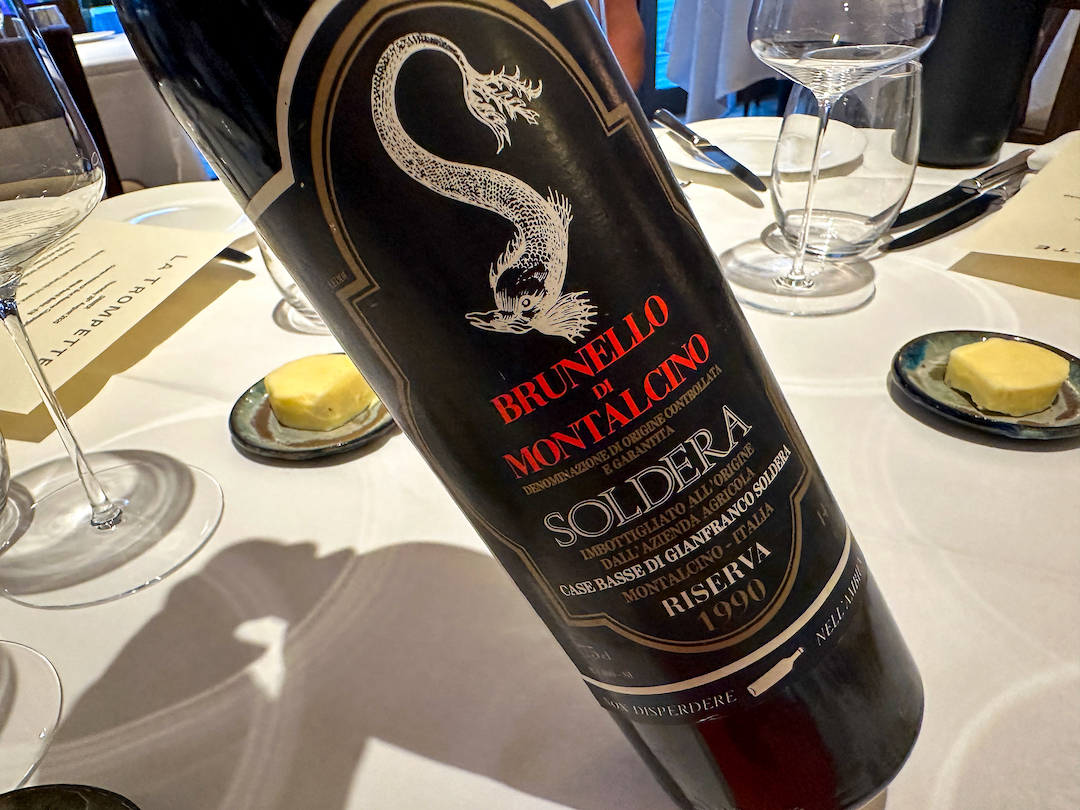
Does the 1990 Brunello di Montalcino Riserva live up to its saintly reputation? You bet. This bottle, which had been purchased on release, is blessed with a spellbinding bouquet: plush black fruit, hints of Christmas cake, fresh prune, licorice, crushed violet and potpourri. It just blooms in the glass with perfectly controlled opulence and delineation. The palate is armed with satin-textured tannins, as smooth as a Ferrari’s bonnet. The 1990 is the most exotic of all the Soldera Brunellos opened at this tasting yet never loses its sense of place. Touches of cassis emerge on the sumptuous finish, which has fabulous delineation and awe-inspiring length. It flirts with perfection. On another night, I might have indeed bestowed a three-digit score.
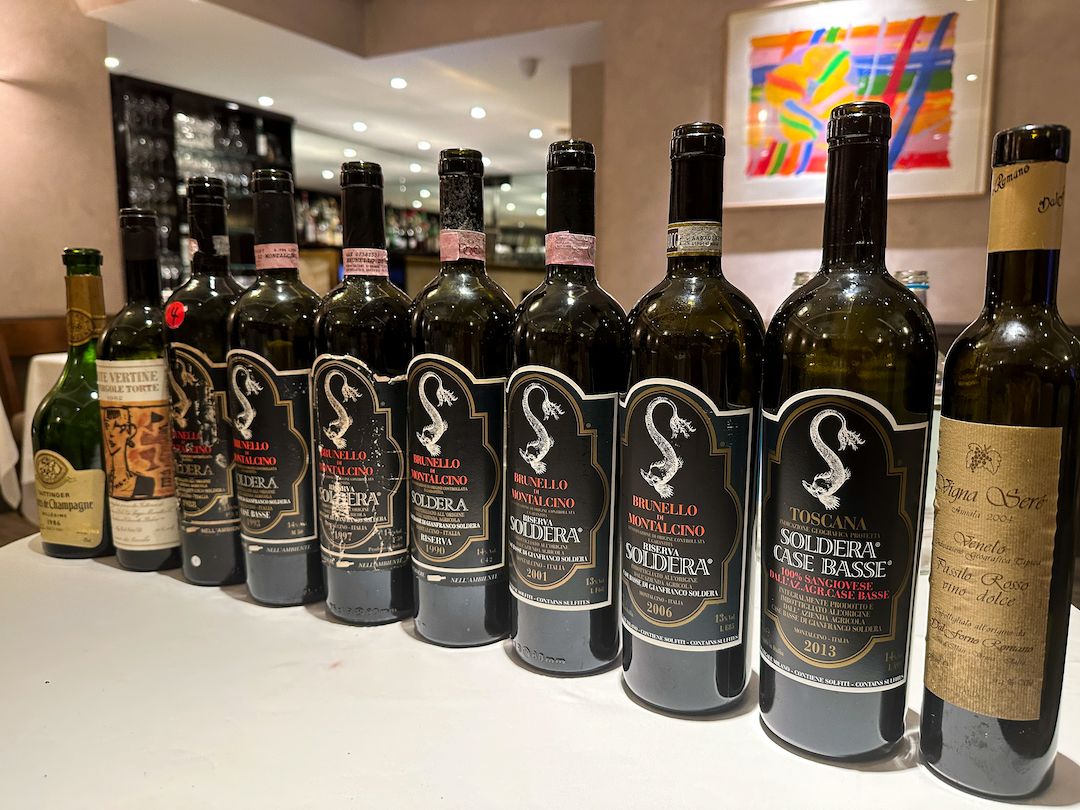
We open two bottles of Soldera’s 1993 Brunello di Montalcino but disconcertingly, both show signs of oxidation. The 1997 Brunello di Montalcino Riserva has the unenviable task of following the 1990, but it acquits itself with aplomb despite a modicum of reduction on the nose. Showing black plum, licorice and touches of golden raisin, the aromatics are beautifully defined and borrow some of the 1990’s opulence. The palate is medium-bodied and extremely harmonious, almost Burgundian in terms of texture, with a beguilingly pure and sensual finish. It is a wine that caresses the senses. The 2001 Brunello di Montalcino Riserva shows a touch of VA on the nose at first, though aeration benefits the aromatics, gaining delineation as hints of caramel and star anise infuse opulent black, plummy fruit. The palate is very well balanced, with silky tannins and a sweet core of candied, more red-toned fruit than the nose. General consensus is that this bottle is not quite firing on all cylinders, just a little too alcoholic on the finish, though still a charmer. The 2006 Brunello di Montalcino Riserva is the surprise package. Quite deep in color, this has an intense nose with black cherries, liquorice, iodine and crushed violets that outclasses the 2001 Riserva. The palate displays impressive concentration without compromising elegance, extraordinarily pure, with a texture that bears similarities to the 1990. Tender, long and vibrant on the finish, this is a supremely gifted Brunello. The final wine from Soldera is the 2013 Toscana Sangiovese. This is quite high-toned on the nose with plush red cherries, kirsch and crushed strawberry, though as it opens, this Tuscan adopts more Burgundian traits. The palate is quite sweet and candied with plenty of kirsch, though overall it has exquisite balance and a sense of tension towards the simmering finish. Maybe give it another year?
We finish the evening with a 2004 Passito Rosso Vigna Seré from Dal Forno. Wow. How good is this? Put it this way…the 2004 almost steals the thunder from the 1990 Soldera! There is a controlled explosion on the nose with black cherries, kirsch, violets and light clementine scents, all intense but brilliantly defined. There is warmth and ripeness, but it’s perfectly controlled. The palate delivers its payload of sweetness (150 grams per liter of residual sugar) with effortless ease, with just a light licorice tincture at play. The finish is caressing and hauntingly harmonious, cassis lingering long on the aftertaste. Despite its audacity and sweetness, the wine tempts you back for another sip again and again. Outstanding.
The second dinner was again themed around wines that I rarely have the opporunity to taste, and it was every bit as enticing as the Soldera dinner. This broached perhaps my favorite region in the Northern Rhône, Cornas, and three of its most revered winemakers: Noël Verset, Thierry Allemand and Auguste Clape. Cornas is a wine that demands maturity, so the youngest bottles were all over a quarter-century old.
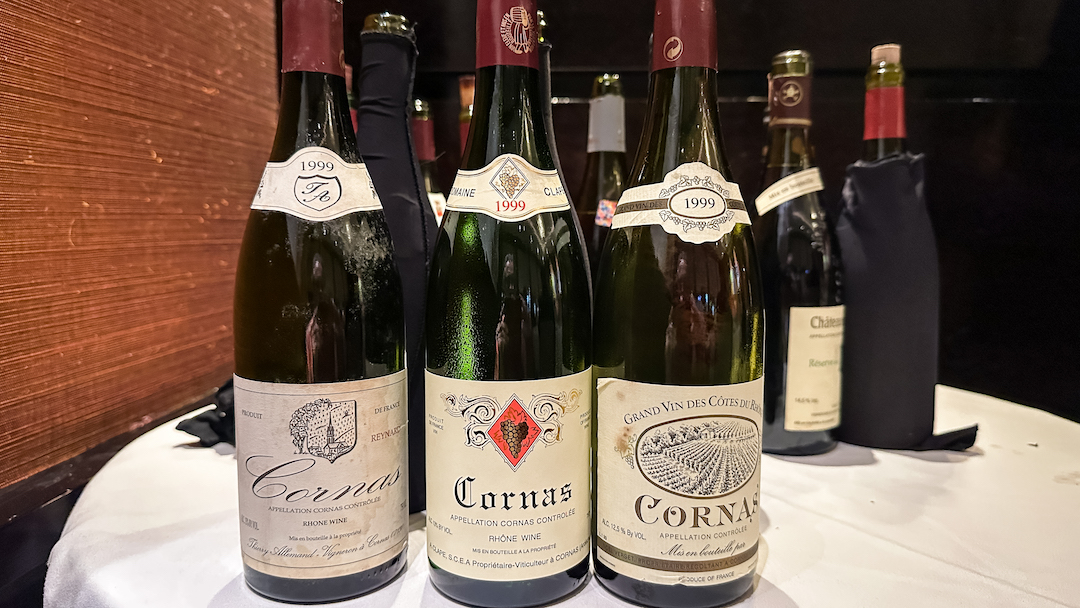
We begin with a mouthwatering trio of 1999 Cornas from its finest exponents. The 1999 Cornas Reynard from Thierry Allemand is sen-bloomin’-sational. It offers dark berry fruit, pencil box and subtle hung-game scents on a nose that maintains stunning definition. Hints of iris emerge with time. The palate is quite tannic with a firm backbone, yet it is supremely well balanced as the vivid, more red-fruited finish disarms with its purity. This Cornas grows in the glass, meliorating with every minute, so do not be afraid to decant it for three or four hours. The 1999 Cornas from Clape is perhaps even better than the Allemand, to several attendees’ surprise. Beautiful aromas of black cherries, licorice and cassis blossom on the nose. Hints of melted tar and lavender join the chorus line with aeration. The palate is medium-bodied, smooth and refined, with a dash of garrigue and white pepper towards the simmering finish that has a surfeit of finesse. There is a sense of completeness that I adore on this Cornas, and it still has plenty in the tank. The 1999 Cornas from Noël Verset leaves me a bit perplexed. It comes across quite herbaceous on the nose, with melted tar, cracked black pepper and pencil shavings. The palate is decidedly old-school in style, but for me, this is just too stemmy, which detracts from the purity and finesse. I am a huge fan of Verset, but this bottle is a bit rough around the edges.
Next, a trio from one of my favorite Rhône producers: Domaine Jamet. The 1995 Côte-Rôtie has a stunning nose with light iris flower and eucalyptus scents, hints of graphite emerging with continued aeration. The palate is medium-bodied with a saline entry, sorbet-fresh, segueing into a compelling yet quite linear finish. This is a fine-boned Côte-Rôtie that perhaps does not quite possess the bravura finish of a top-flight Jamet. I might afford it more time in the cellar, despite its age. The 1999 Côte-Rôtie is more reserved than the 1995 at first, but it repays aeration with seductive red berry fruit, briar, wild mint and garrigue scents. The palate is quite sweet on the entry with polished, saturated tannins, delivering real tension towards the finish. No, there is not an enormous amount of grip, but the refinement here is bewitching. The 1999 Côte-Rôtie Côte Brune has another fabulous bouquet with intense red fruit, incense, Provençal herbs, blackcurrant and violets, all delivered with outstanding precision. The palate has a sweet entry, mainly black fruit infused with camphor, quite linear like the 1995 and very focused on the finish, lingering long in the mouth. It is over a quarter-century old, but it has years and years ahead of it. Sublime.
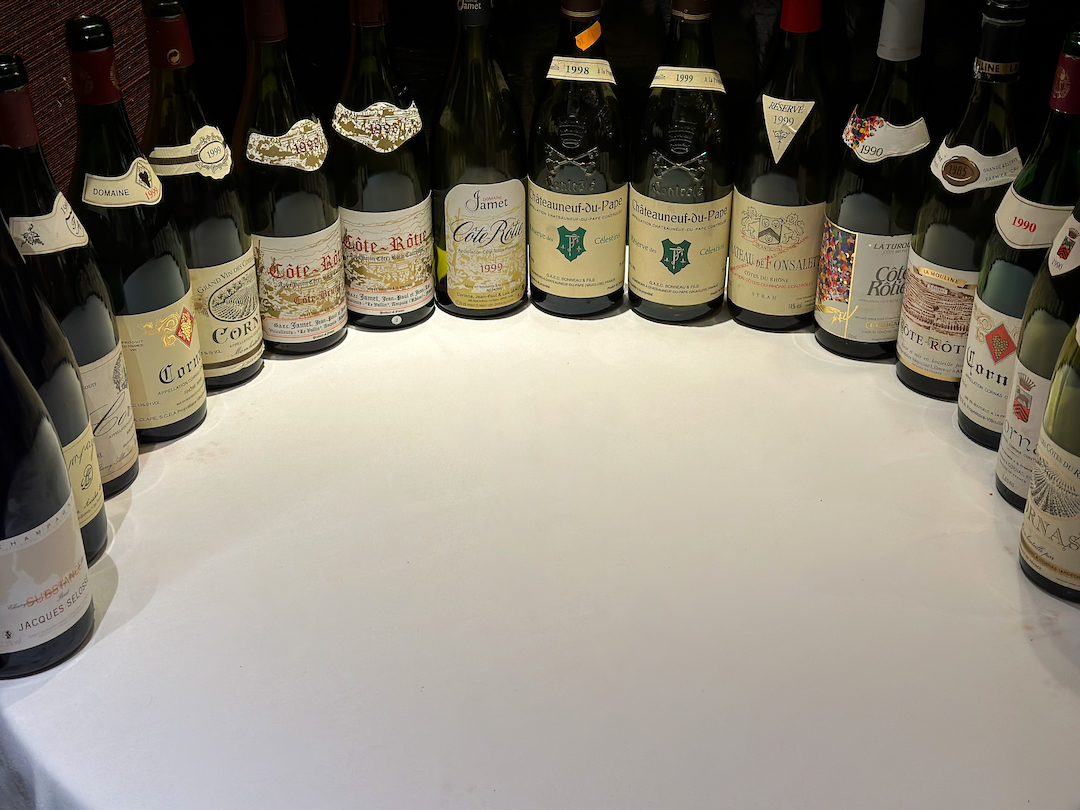
Moving to the Southern Rhône, the 1999 Côtes du Rhône from Château de Fonsalette has an impressive nose with black fruit, cola and graphite, a little tertiary in style, with a subtle marine influence. There is clear use of stems, maybe just a bit too conspicuous? The palate is medium-bodied with sappy red fruit, white pepper and thyme towards a “cool” finish that lingers nicely in the mouth. The 1998 Châteauneuf-du-Pape Réserve de Célestins from Domaine Henri Bonneau has a precocious nose with camphor and lavender as well as touches of caramel and dark chocolate. The palate feels overripe with prune and raisin notes, obviously lacking the class that exudes from the following vintage. I do not think this is a faulty bottle, just a wine harvested too late. The 1999 Châteauneuf-du-Pape Réserve de Célestins is so much better than the 1998. Vibrant red fruit, pressed violets, warm embers and dried Italian herbs are beautifully defined on the nose, with just a touch of glycerin lending opulence. The palate has gentle grip, very focused and long, with a judicious pinch of cracked black pepper towards the persistent finish. This 1999 is drinking beautifully now and will continue to do so for another 20 years.
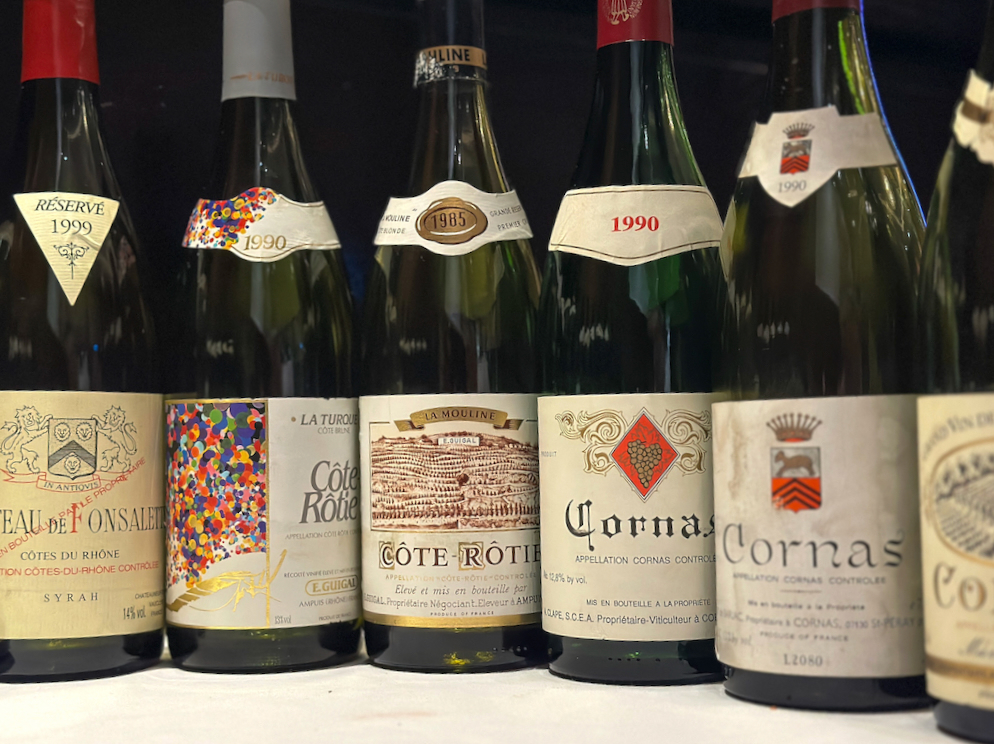
Time to dance our way to La La Land…
The 1985 Côte-Rôtie La Mouline from E. Guigal has a refined cranberry and raspberry nose with truffles and clove, gaining delineation all the time and outclassing the 1990 La Turque served blind alongside. The palate is ripe on the entry with saturated tannins and layers of opulent black fruit. There is perhaps just a bit of warmth, yet the ‘85 has a gorgeously savoury, dried-blood-tinged finish that is captivating. At 40 years old, who says it does not have another four decades of pleasure to give? The 1990 Côte-Rôtie La Turque has plenty of red fruit on the glossy nose, touches of aniseed and leather emerging with time, quite high-toned as La Turque often is. The palate is full-bodied with a veneer of glycerin, backward and muscular on the mid-palate with a ripe, sweet, cassis-driven finish. I would actually give this another four to five years in the cellar.
The 1990 Cornas from Verset has a very stemmy nose, with black fruit, juniper and black olive tapenade cohering nicely after an awkward start. The palate is medium-bodied with plenty of red berry fruit, kirsch and brown spice, notably spicy and certainly showing some Brettanomyces towards the finish. Indeed, with aeration, that Brettanomyces seems to bloom and rudely occludes the fruit profile. A high tolerance to Brett will be required, and I speculate how much that might vary from bottle to bottle. The 1990 Cornas from Clape is far better. A gorgeous nose offers a mélange of red and black fruit, melted tar, garrigue and seaweed, gaining complexity with aeration. The palate is medium-bodied with filigree tannins, plenty of white pepper and clove notes and hints of blood orange towards the refined and effortless finish. What a glorious Cornas this is at 35 years of age! Finally, a 1942 Hermitage Blanc from Maison Chapoutier. It pours out a huge amount of sediment in my glass that I then filter through a cheesecloth. The 1942 has a very oxidised bouquet of smoke and walnut, quite acrid, and yet somehow…I cannot help but enjoy it. The palate is obviously long in the tooth, again quite oxidised in style, yet there are hints of almond and nougat behind it. Just one glass is quite sufficient, but it pairs well with the cheeses.
Both dinners saw a treasure trove of outstanding wines. I had relatively little firsthand experience with Soldera up until that evening. It was easy to see why its wines attract such reverence. That does not preclude criticism and, on the night, despite impeccable provenance, a couple of bottles did not show well.
Though I adore the Rhône, so much time spent in Bordeaux and Burgundy means that I have only visited the region two or three times. It made for a pleasant change to put down the Cabernet and Pinot and drink Syrah, Grenache, et cetera. These wines reaffirmed my penchant for Cornas—a bit of an underdog compared to Hermitage or Côte-Rôtie, but in my opinion, able to reach the same heights. My one takeaway was a renewed appreciation for Domaine A. Clape.
La Trompette served as the perfect venue, as it always does. An exemplar of a one-Michelin-star restaurant, it did what it does consistently well. That is why many of us return again and again. I am due back before the year is out.
© 2026, Vinous. No portion of this article may be copied, shared or redistributed without prior consent from Vinous. Doing so is not only a violation of our copyright but also threatens the survival of independent wine criticism.