
Browse using the new Vinous website now. Launch →
Printed by, and for the sole use of . All rights reserved © 2015 Vinous Media
No Alarm: 2023 Domaine de la Romanée-Conti
BY NEAL MARTIN | FEBRUARY 11, 2026
A profound wine transports the imbiber to another world where random apparitions of fruit, herbs, spices, flowers and a myriad of other things materialise out of thin air and prompt two questions:
Is this what you smell?
Is this what you taste?
I must look like I am in a stupor. I am not alone. Most people in the tasting room appear to be in the kind of mass trance last seen at all-night raves circa 1989.
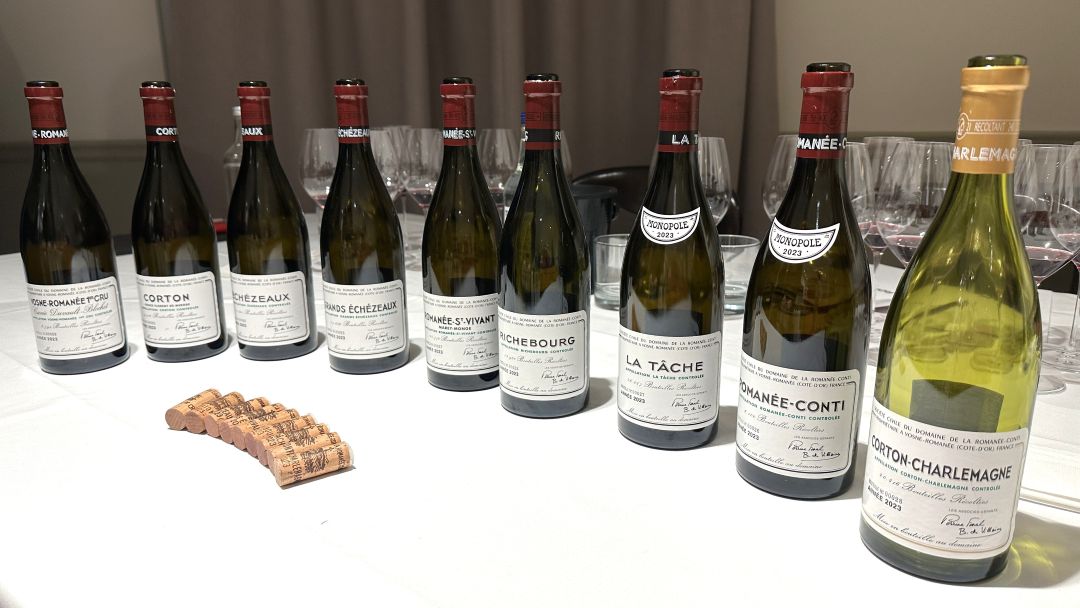
I am readying myself for the Grands Echézeaux when the silence is shattered by the fire alarm. The timing could have been better.
The sound of the alarm whips me back to North Street Junior School. Fire drills are highlight of the day—an unexpected break from the ennui of long division. Mayhem ensues. Teacher yells, “Quieten down! Quieten down!” and the classroom erupts in mock pandemonium, exercise books falling from desks, chairs scraping on the parquet floor, the odd shout of “Fire!” Instructions to file out in an orderly fashion elicit a rugby scrum, every boy and girl for themselves. If this were the Titanic, everyone would have drowned. The entire school gathers in the playground and the unruly mob is requested to line up alphabetically, which is harder than herding cats. We keep swapping positions to force a recount. Teachers give up. Eventually we file back into school, but by then our fragile concentration is broken. Long division will have to wait another day.
Today’s situation is different. Perhaps it was Thatcher’s cutbacks, but if memory recalls, North Street Junior School’s curriculum did not include wine appreciation, nor the geology of the Côte d’Or. No, we had to learn long division, and I have never used that in my wine career, not once. No glasses of Domaine de la Romanée-Conti were lined up on my desk awaiting my assessment as they are today.
The alarm continues. If this is a real fire, would I extinguish it with my glasses of wine? Logically, I would start at the Cuvée Duvault-Blochet and work my way up to Romanée-Conti in ascending order of indignation and tears.
Maybe it has nothing to do with a fire? I consider alternatives.
One: Somebody has spat out the Romanée-Conti. This is an act forbidden under Burgundy Wine Law, and the penalties are severe.
Two: The alarm has been set off by a jealous Burgundy lover. Once the room is evacuated, he or she will sneak in through the window and guzzle all the wine.
Three: It is a brazen attempt by a rival Vosne-Romanée producer to interrupt the tasting.
Four: Bertrand de Villaine and Perrine Fenal wanted to end the tasting early so they can pop over to M&M World in Leicester Square.
Despite the fire alarm, nobody moves a muscle. Most continue to tilt glasses to see how the Pinot Noir glints, or swirl to unlock aromas. We have lost our sense of hearing. What fire alarm? I can’t hear it, can you?
As usual, the annual Domaine de la Romanée-Conti tasting is held at Corney & Barrow, the domaine’s UK agent. For all intents and purposes, the tasting is much like a classroom examination. The only difference is that we do not have to hand in our tastings notes for marking, though it would be quite fun if we did. Place a sommelier in detention for missing the acute accent in Echézeaux where they must chalk “It’s Domaine de la Romanée-Conti not DRC” or “Monopole is not a board game” 100 times on the blackboard. With his broad shoulders, I would imagine Bertrand de Villaine to be a sports teacher with a penchant for rugby on bitterly cold winter days. Perrine Fenal would be our kindly French teacher. Today’s lesson is neither P.E. nor French.
It is the 2023 vintage at the most famous wine producer in the world.
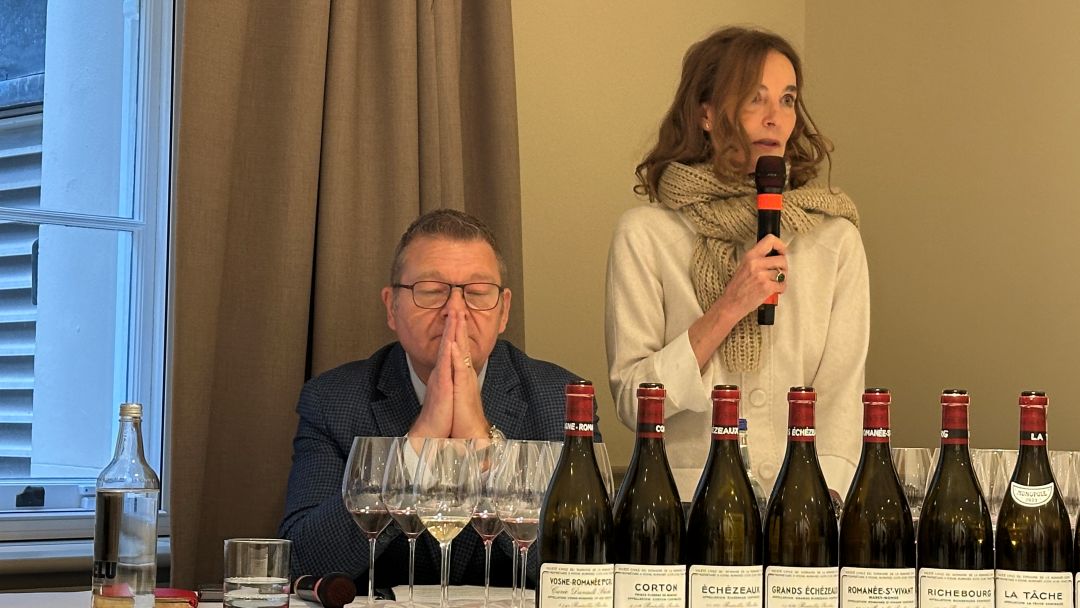
Bertrand de Villaine and Perrine Fenal guide attendees through the 2023 vintage.
Both de Villaine and Fenal colour in details of the growing season. Notably, there was a very successful flowering between May 20 and June 10 that saw a good fruit-set and a potentially large crop. This necessitated crop thinning, overseen by Vineyard Manager Sylvain Pellegrinelli, who commenced his tenure in March 2023. “Pellegrinelli has a strong interest in geology,” Fenal remarked. “He relates to biodynamics and abides by the system as long as it serves the purpose in order to be able to have the best results.” In a way, Fenal was saying that whilst they follow biodynamics in all their vineyards, the domaine is not hidebound by them.
Echézeaux suffered minor damage after hail on June 20. July and August were cooler than the previous season, and given abnormally large bunches, véraison was slow. Berries stubbornly refused to turn from green to purple, so naturally there were concerns about achieving phenolic ripeness. Therefore, the vineyard team undertook further thinning of bunches.
Two heatwaves pivoted the season in a different direction, and sugar levels rapidly increased. Burnt bunches were cut off and thankfully showed no signs of blocked ripening, which de Villaine attributes to terroir. The domaine decided to wait and began picking on September 5 in Grands Echézeaux. A watching Aubert de Villaine commented that he had never seen such large bunches. Harvesting reached full steam two days later using 50 pickers and 20 porters—more than usual, to transfer fruit to the winery as efficiently as possible and avoid the risk of spoilage. Picking dates have become more clustered in recent years; in 2023, all the fruit was picked within ten days, stopping when conditions became too hot. Fenal mentioned that with more uniformity in ripeness across their vineyards, it is becoming harder to select which to broach first.
Tasks such as sorting and transferring into vat must be done efficiently, keeping pace with the incoming fruit, so Cellar Master Alexandre Bernier had to stay on top of things. He had to keep a watch on the higher-than-average sugar levels that risked stuck fermentations, de Villaine mentioning that in warmer conditions, yeasts can be less efficient in converting or might compete with other ambient yeasts. According to Fenal, only La Tâche was slow to ferment its sugars. In 2023, the domaine used 100% whole bunch across the range. The wines were barrelled down between January and May 2025, and there was a single racking during élevage. De Villaine compared 2023 with 2003 and noted that for the first time (and surely not the last) all the cuvées exceed 14% in alcohol.
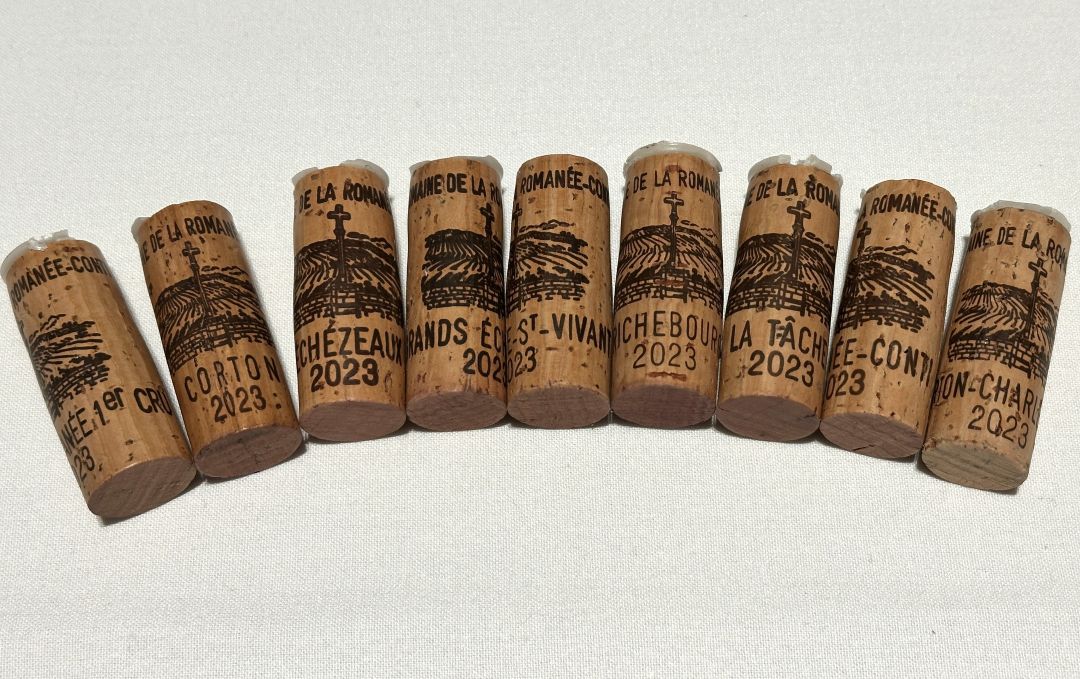
There is more terroir expression, freshness and definition in the 2023s compared to the 2022s, with slightly brighter and more vivid fruit, though keep in mind that the 2022s will ultimately lose their youthful exoticism. In that sense, the 2023s are going to present more immediate drinking pleasure.
This year, the Grands Echézeaux puts a tangible gap between itself and the Echézeaux. There is also a qualitative difference between the Romanée-Saint-Vivant and the Richebourg, the latter endowed with more complexity and length. La Tâche and Romanée-Conti initially were closer, though the latter pulled away with aeration, revealing hidden mineralité and precision, effortless as always.
Apart from the fire alarm, the other point where the tasting went off-script was when a Japanese woman took the microphone and explained how, at her famous high-end London store, a customer had bought a bottle of 2010 Corton. Everyone in the room, including myself, expected her to continue by saying how much he liked it. Instead, she explained that he did not like the style, which left both de Villaine and Fenal a bit lost for words. What can you say? I liked her honesty. It was a reminder that no wine is infallible or will appeal to everyone’s taste. There were good grounds for the customer’s point of view because, as I opined at this tasting, those initial vintages of Corton after its debut in 2009 did not translate the DNA of the domaine. As time passed, that has changed, and the 2023 is “part of the family,” albeit adhering to Côte de Beaune instead of Côte de Nuits. It is important to keep that distinction. Furthermore, one should not genuflect in front of any icon. In that respect, frankly, I do not find the 2023 Corton-Charlemagne really delivers aromatically and is rather neutral, unlike the wonderful 2022. This circles back to needing several vintages under your belt to really understand a new vineyard and learn how it reacts in varied growing conditions.
Final Thoughts
This was my 28th tasting of the newly bottled vintage of Domaine de la Romanée-Conti, an exercise that never fails to fascinate. If anything, my interest only grows, adding to the library of previous vintages, inviting comparison. The 2023s are cut from a completely different cloth than the 2022s and will appeal to those seeking more classical Burgundy. These wines might be expensive, but that does not mean they are infallible, something telegraphed by my scores. However, irrespective of quality, there is something innately magical about this “family” of Pinot Noir and Chardonnay.
That fire alarm took us out of our collective dreamlike state and back into the real world. Had we been instructed to evacuate the room in the middle of the tasting, then I am certain we would have filed out in orderly fashion…at least once we had finished downing our remaining glasses.
© 2026, Vinous. No portion of this article may be copied, shared or redistributed without prior consent from Vinous. Doing so is not only a violation of our copyright but also threatens the survival of independent wine criticism.
You Might Also Enjoy
Burgundy 2024: One Battle After Another, Neal Martin, January 2026
Future Memories: DRC 2022 In Bottle, Neal Martin, February 2025
2022 Domaine de la Romanée-Conti: The Lightness of Being, Antonio Galloni, March 2025
Nature Rules/Nature’s Rules: DRC 2021 In Bottle, Neal Martin, February 2024
Domaine de la Romanée Conti: A Survey of the 2021s, Antonio Galloni, March 2024