
Browse using the new Vinous website now. Launch →
Printed by, and for the sole use of . All rights reserved © 2015 Vinous Media
〒104-0041
Tokyo
Chuo City
Shintomi
1 Chome−5−12
エスパシオ 2階
BY NEAL MARTIN | JUNE 3, 2026
The Food:
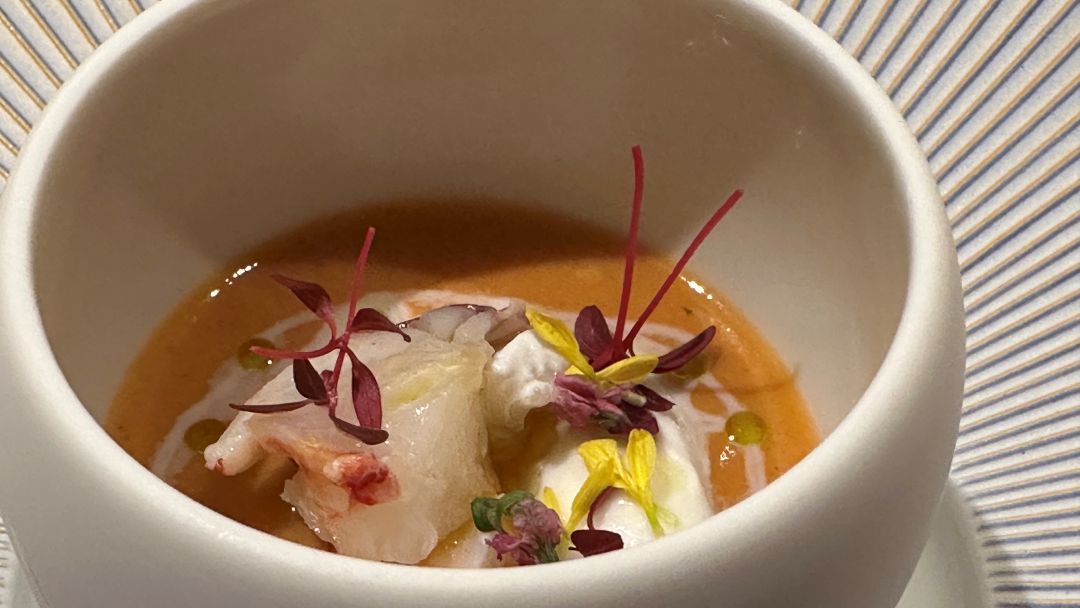
Japanese tomato with lobster, crème fraîche and edible flowers
Amuse-bouches
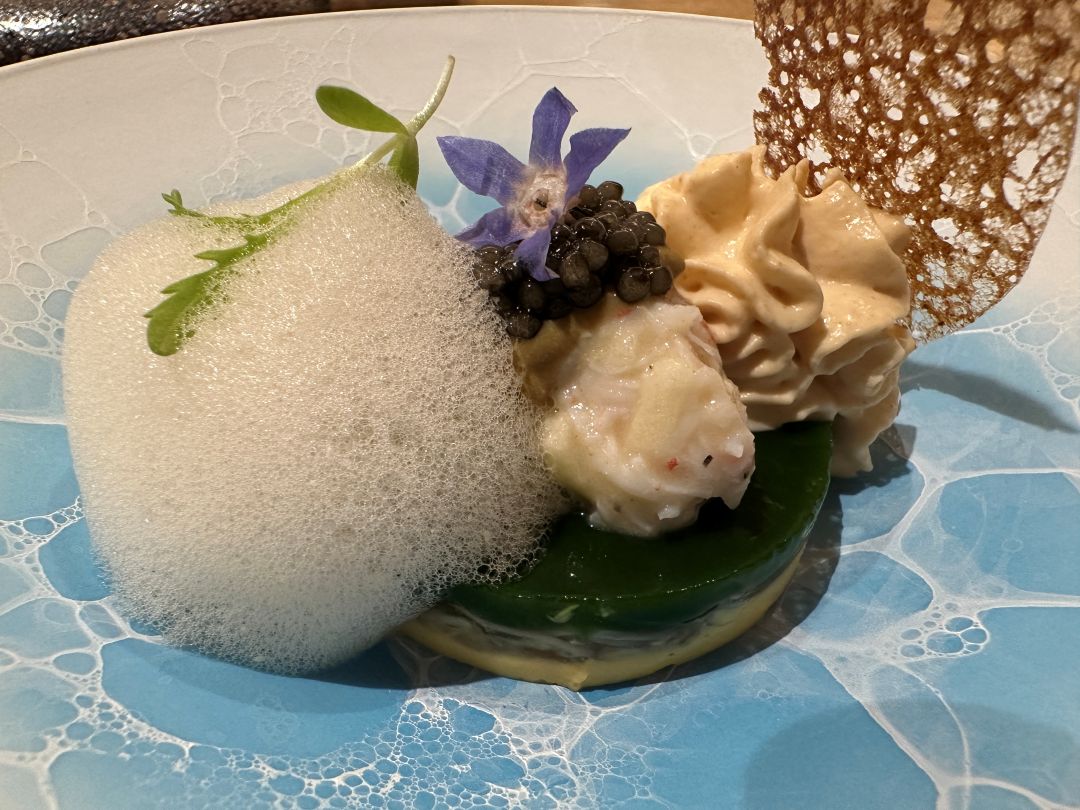
Hokkaido hairy crab, layered types of crab consommé, apple dressing, crab miso and caviar with shellfish stock, crab espuma and miso tuile
Surf clams wrapped in shiso leaves with flounder, beurre blanc and seaweed chips
Golden-eyed snapper, sautéed bamboo shoots, fried garlic sprouts, pea sprouts and green beans
Hida beef steak, beef tongue and stuffed, red-wine-braised shoulder loin; boiled burdock root and potato millefeuille; celery root and black truffle purée
Shellfish risotto with powdered/frozen Perilla leaves
Lychee purée yoghurt, Okinawa pineapple compote and vanilla purée, fresh Miyazaki lychee, rose-scented espuma
The Wines:
| 2024 Hideaki Koyama Rue de Vin Sauvignon Blanc | 86 |
| 2019 Domaine Fontaine-Gagnard Chassagne-Montrachet Clos Saint-Jean Rouge 1er Cru | 92 |
Food is a lingua franca understood by everyone. Delicious food is delicious, whatever tongue you speak. That said, many gourmands feel trepidation ordering from menus in a foreign language. They fear looking foolish or perhaps committing a taboo. This can cause unease for the customer. Japan can be intimidating for the first timer because, communication aside, menus are often written in kanji script. Plus, there are questions of etiquette from the moment you enter and wonder if you should take off your shoes…or not. In a country that rewards the adventurous, language barriers risk herding you into tourist pens and sanitising your entire experience.
Many chefs and hospitality teams across the contemporary Japanese restaurant scene do not speak English, a result of an education system that prioritises reading over speaking. Based on my experience, I would say that for every English-speaking waiter or chef, there are three who will look at you in puzzlement. On the other hand, there is the communicative power of hand gestures, not to mention bilingual menus with photos and illustrations, the beloved plastic recreations of dishes in windows, increasingly efficient smartphone apps and so forth.
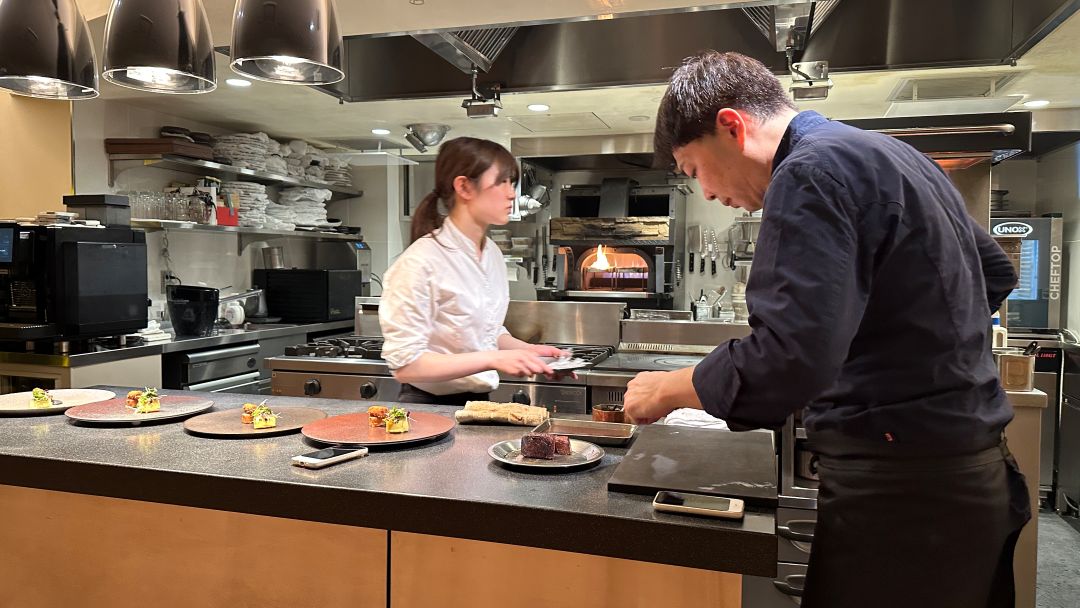
Hortensia’s kitchen is staffed solely by Chef Koga and his assistant, whose expertise in her own right was apparent.
Let us focus on Hortensia. This seven-seat, Michelin-starred restaurant with a hemispherical counter has three staff, none of whom spoke a word of English on the night when two-and-a-half of their four diners spoke not a word of Japanese (I consider myself the “half”). Now, this is not a barrier that could deny anyone from savouring Chef Tetsuji Koga’s culinary skills or experiencing one of the finest dinners in Tokyo. To overcome this obstacle, Koga spoke into a mobile device that instantly repeats sentences in English, with the odd mistranslated word for comic effect. This added to the joy of the evening. Every step of the way, Koga was determined to communicate the minutiae of every creation, from the sourcing of ingredients to concept and execution. What initially felt a little stilted became part of Hortensia’s charm. By the end of the night, Chef Koga had loosened up to the extent that we jabbered away long after the final dish.
The evening had begun four hours earlier with a dinky bowl of tomatoes sourced from around Japan, served with fresh lobster, crème fraîche and edible flowers—perfectly balanced, intense but not overpowering, each element enhancing the other. The dish boasts a sense of sophistication and simplicity, revivifying the senses and prepping them for what’s to come.
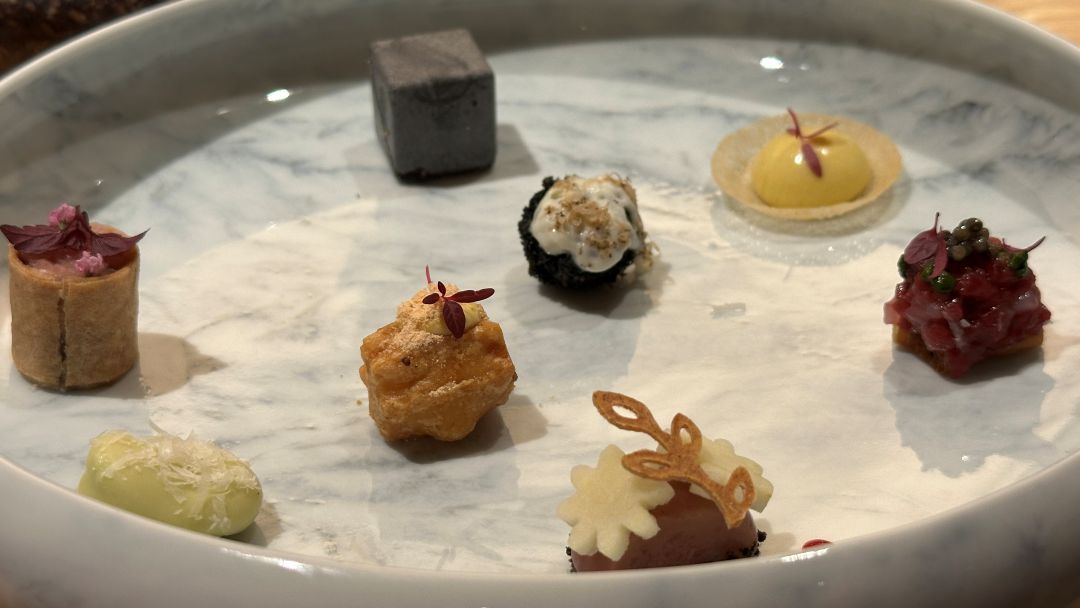
Amuse-bouches.
What follows is an astonishing plate of amuse-bouches, surgically placed one by one with tweezers. The technical prowess of combining so many ingredients in a single mouthful meant that it took a few minutes to explain. We enjoy a stuffed cube of Parmesan cheese and bacon (I assume the dark grey pigmentation derives from squid ink) that is not unlike Japanese chawanmushi; tongue tartare coated with much-coveted Tomigold tomatoes, sweetcorn and vegetable gelatine; potatoes topped with squid tartare and yuzu pepper vinaigrette; a tiny foie gras terrine with raspberry gel, coffee-infused crumble, green apple and Ebisu pound cake; beef tongue boiled with fava beans and coated with cocoa butter and pecorino; a fried Monaka spring roll with potato confit and marinated sardines with ravigote sauce; a tuna and truffle croquette topped with potato espuma and black truffle; and churros made with red shrimp and garlic sauce. The attention to detail, sublime presentation and harmony of diverse flavours are proof of a chef with typical Japanese dedication, going over and beyond what one would expect.
Hokkaido hairy crab, layered types of crab consommé, apple dressing, crab miso and caviar with shellfish stock, crab espuma and miso tuile.
The next dish consists of hairy crab from Funka Bay in Hokkaido. The three layers consist of roasted peppers and crab consommé, then crab consommé mixed with sautéed vegetables and crab meat, and then crab meat mixed with chrysanthemum jelly. Crab on top is combined with apple dressing and garnished with crab miso, caviar, a foam made from crab consommé and ginger juice and finally, a cream espuma made from shellfish stock with crab miso tuile. Heavenly.
Surf clams wrapped in shiso leaves with flounder, beurre blanc and seaweed chips.
Ingredients for the following dish were sourced exclusively from Hokkaido. Surf clams were wrapped in shiso leaves and pork fat and roasted, then placed atop a base of flounder. This is served with a reduced balsamic vinegar sauce and a beurre blanc made from vegetable stock, Calpis butter and Chardonnay, as well as brittle seaweed chips. Again, the balance of flavour is exquisite, with just the right salinity to counter the sweetness of the sauce.
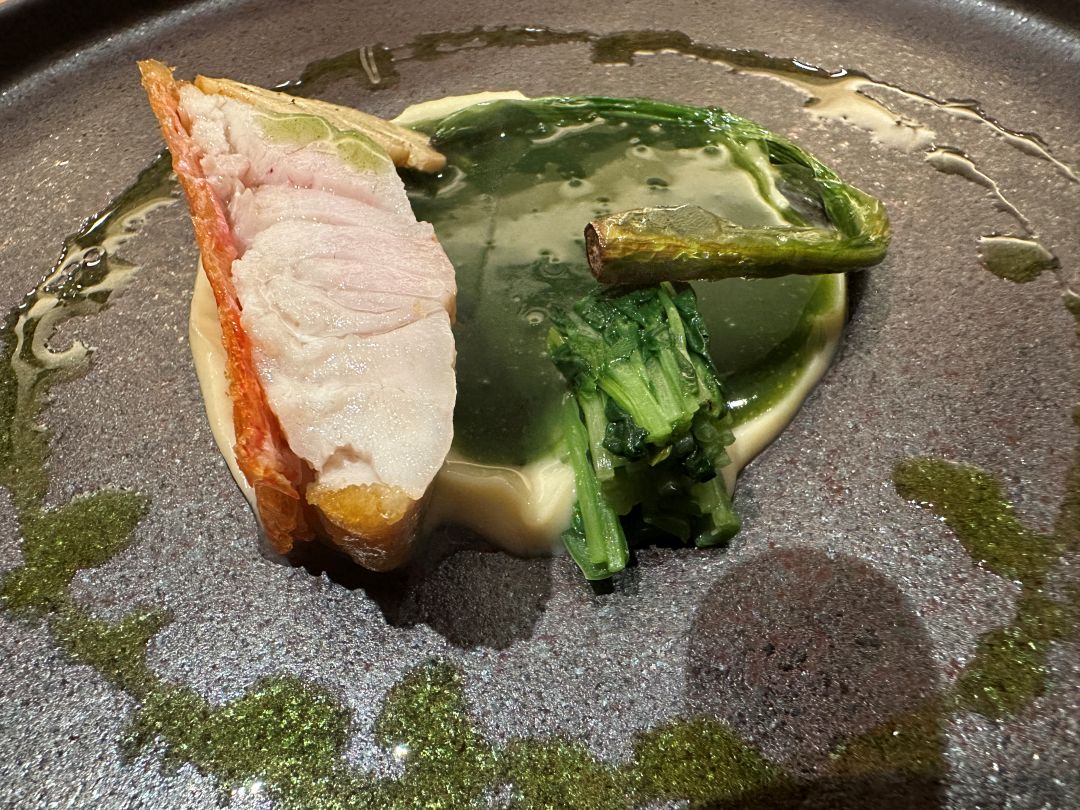
Golden-eyed snapper, sautéed bamboo shoots, fried garlic sprouts, pea sprouts and green beans.
Continuing the pescatarian theme, the golden-eyed snapper from Numazu in Shizuoka comes topped with sautéed bamboo shoots from Chiba, fried garlic sprouts and a salad of pea sprouts and green beans. It is served with cauliflower purée and a drizzle of shiso-infused oil.
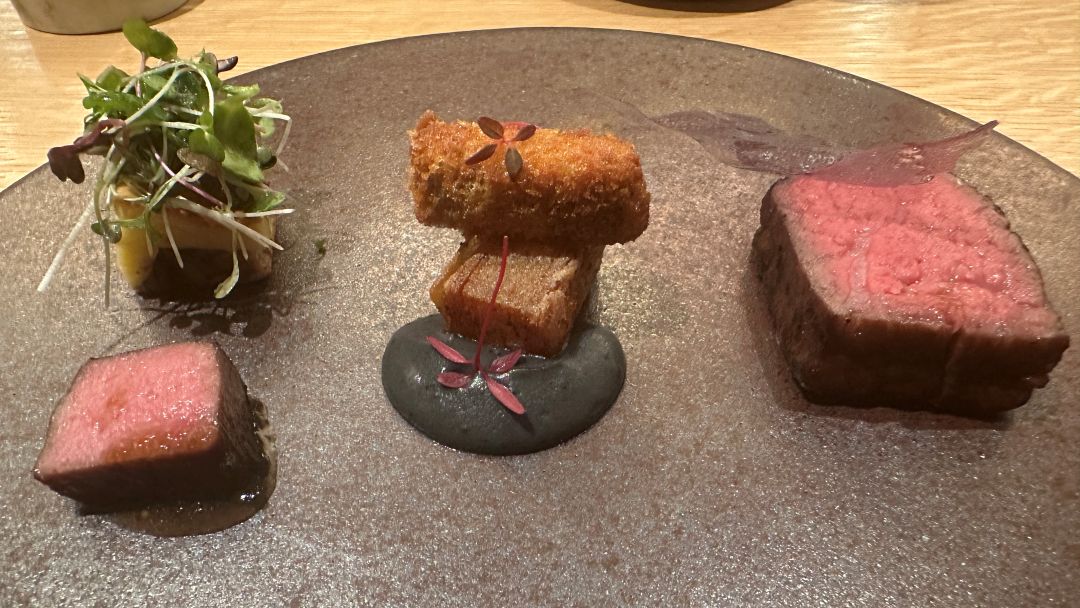
Hida beef steak, beef tongue with stuffed, red-wine-braised shoulder loin; boiled burdock root and potato millefeuille; celery root and black truffle purée.
The cut of fillet steak is a breed from Hida in Takayama, the meat cured in kombu and kiln-grilled for two hours, served with a small cube of beef tongue and stuffed shoulder loin braised in red wine. The salad on top consists of a dough similar to Nagano’s oyaki (a fermented buckwheat dumpling). It comes with burdock root boiled in consommé and cut into fritters, underneath which is a potato millefeuille. Koga spoons on the celery root and black truffle purée, reduced with veal and chicken stock and mounted with a touch of freshly grated wasabi. This is simply some of the best beef you can put in your mouth. The dish’s elements combine effortlessly. I did not want it to end.
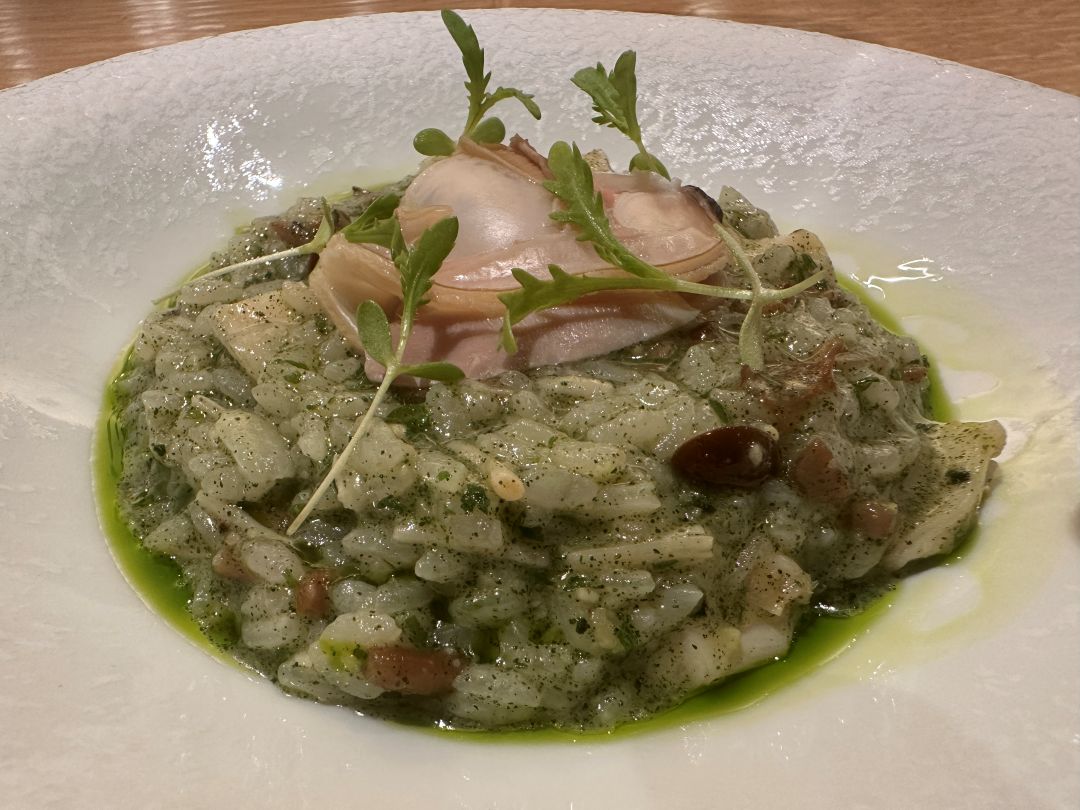
Shellfish risotto with powdered/frozen perilla leaves.
Our final main dish comprises a shellfish risotto cooked in a broth made from scallops, clams and chestnuts. Perilla leaves are flash-frozen with nitrogen then turned into a powder and sprinkled on top. This dish is more neutral in flavour, in a way, homier and comforting—a gentle come-down to avoid overwhelming the senses after the previous gustatory fireworks.
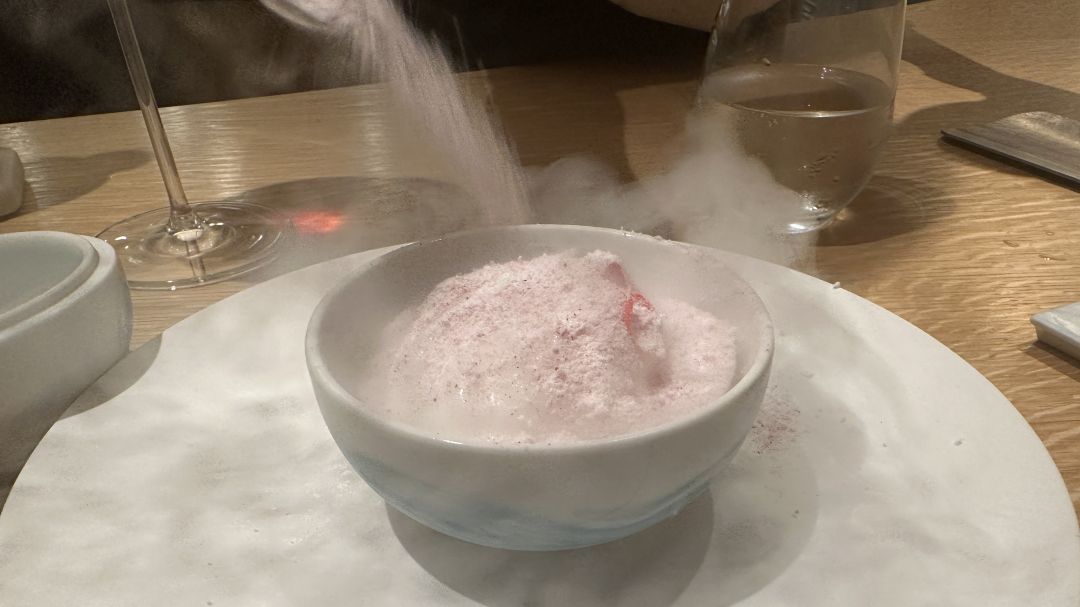
Lychee purée yoghurt, Okinawa pineapple compote and vanilla purée, fresh Miyazaki lychee, rose-scented espuma.
Dessert is a lychee purée yoghurt left to concentrate overnight, served with Okinawa pineapple compote, vanilla purée, fresh Miyazaki lychee and rose-scented espuma. Chef Koga sprays on a powder scented with yoghurt and roses.
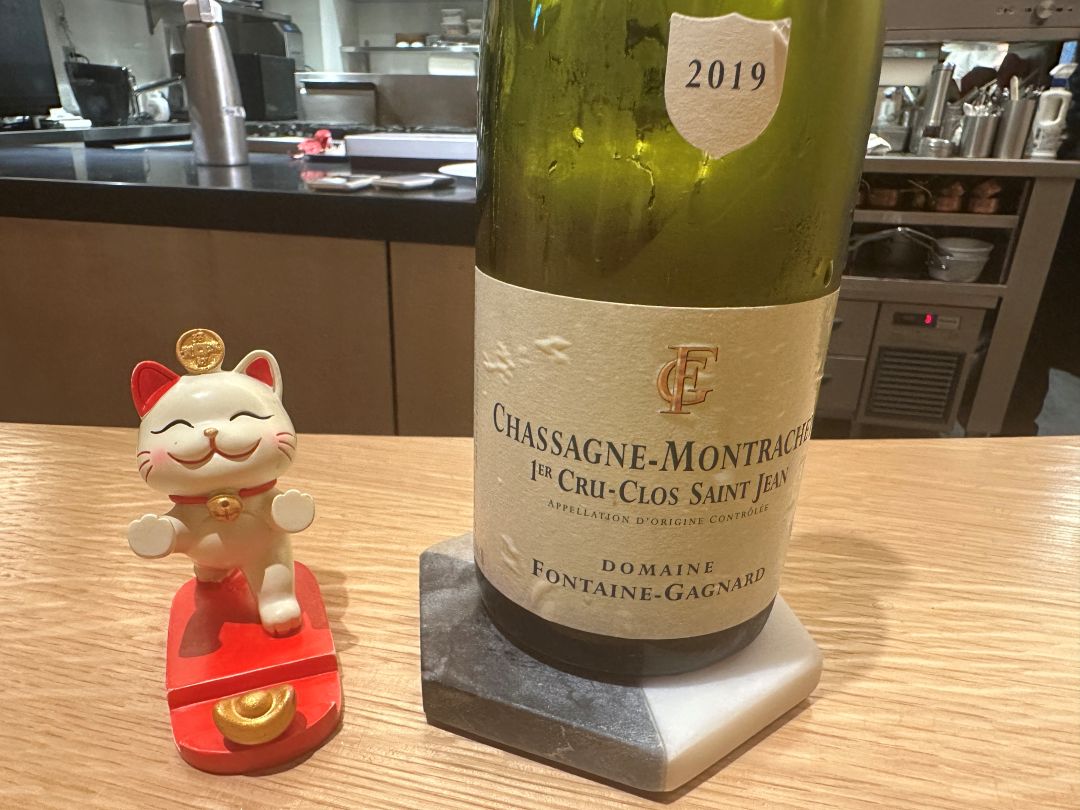
The wine list here is not extensive but it is well chosen and, like many, leans towards Burgundy. I wanted to try a glass of Japanese wine, so I plumped for the 2024 Sauvignon Blanc Rue de Vin from Hideaki Koyama. The nose is not overly complex, with simple gooseberry and green apple scents, just a touch of pyrazine lending it a Kiwi personality. That translates onto the clean, fresh palate, which is simple and malic with a touch of bell pepper on the aftertaste. Nothing to write home about, but at least it is clean and without faults. I paid a corkage fee of 5,000 yen, around £25, for a bottle of 2019 Chassagne-Montrachet Clos Saint-Jean Rouge 1er Cru from Domaine Fontaine-Gagnard. I plucked it from my cellar without examining the bottle, and what I presumed was white was in fact the red version. Sumimasen! That said, sticking it in the fridge and allowing it to chill in the height of Tokyo’s summer serendipitously allowed this Pinot to be poured at exactly the right temperature. The 2019 performs above my expectations, bursting with clean and precise raspberry, morello cherry and crushed stone on the Volnay-like nose that maintains wonderful delineation. The palate has the ripeness of many 2019 Côte de Beaune reds, but with sufficient acidity to maintain tension and shape, the sapid finish beckoning you back for more. Do not overlook this cuvée on the basis that it is the “wrong colour.”
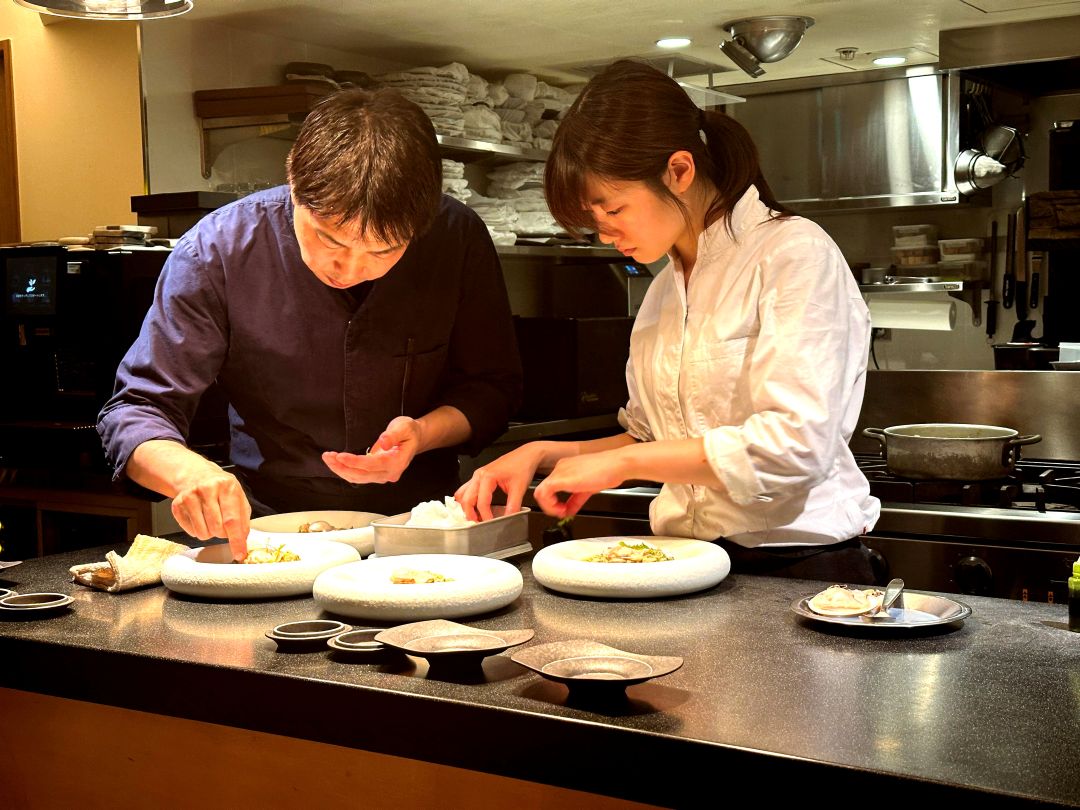
This photo translates the meticulous presentation of every dish. Japanese perfection.
Hortensia was deeply impressive from start to finish. Despite clear technical wizardry, the cooking is self-assured without excess or showing off. Flavours marry beautifully, presentations are stunning and there is continuity between dishes. Nothing is left to waste: Koga reuses parts of dishes, such as the water in which he boils the potatoes, to enhance others. How refreshing to see a concerted effort towards sustainability.
This ten-course omakase menu at 25,000 yen per person (around £120) represents exceptional value given the quality, which borders on two-star calibre. But it was Chef Koga who made the evening, striding over the language barrier with his pocket device. Sure, there was less interaction than between two native speakers, but there was no awkward distance between chef and diner. And let’s get real, counters even at this level are becoming more reliant on foreign epicures, especially on traditionally quieter nights.
Hortensia was not just my favourite meal of this trip to Japan, it was one of my meals of the year.
© 2026, Vinous. No portion of this article may be copied, shared or redistributed without prior consent from Vinous. Doing so is not only a violation of our copyright but also threatens the survival of independent wine criticism.
You Might Also Enjoy
Vinous Table: Moritaya, Tokyo, Japan, Neal Martin, August 2025
Vinous Table: Maison Fujiya, Neal Martin, August 2025
Vinous Table: Uni Murakami, Hokkaido, Japan, Neal Martin, August 2025
Vinous Table: Sens & Saveurs, Tokyo, Japan, Neal Martin, August 2025