
Browse using the new Vinous website now. Launch →
Printed by, and for the sole use of . All rights reserved © 2015 Vinous Media
97 St John's Rd
London SW11 1QY
United Kingdom
+44 207 738 1965
BY NEAL MARTIN | MARCH 27, 2026
The Food:
House bread and butter
Crab and black pepper tartelette
Cured mackerel, blood orange and grape vinegar
Vacherin and lardo croustade
Shiitake, hazelnut, egg yolk and Comté
Trout, pink fir potato and brown shrimp butter
Chicken breast, Black trumpet mushroom, January King cabbage and vin jaune
Duck & Gruyère pithivier with shallot & kumquat
The Wines:
| 1996 Krug Vintage | 96 |
| 2020 Domaine Samuel Billaud Chablis Vaudésir Grand Cru | 91 |
| 1983 Palmer | 96 |
| 1942 Lafite-Rothschild | 92 |
| 1954 Yquem | 90 |
You know what they say…
Eat where chefs eat.
Ploussard has an innocuous glass façade; you could easily walk past this gem hiding in plain sight. Someone who apparently does not walk past is famed chef Michel Roux Jr., who, now that he is no longer running La Gavroche, frequently dines at Ploussard. Since opening a couple of years ago, Ploussard has not garnered any Michelin stars, nor have I come across a great number of professional reviews. Yet this was one of my favourite meals in some time, a restaurant I would warmly recommend to my friends and Vinous readers. In fact, the standard of cuisine and quality of ingredients has surpassed some of London’s more lauded and expensive restaurants.
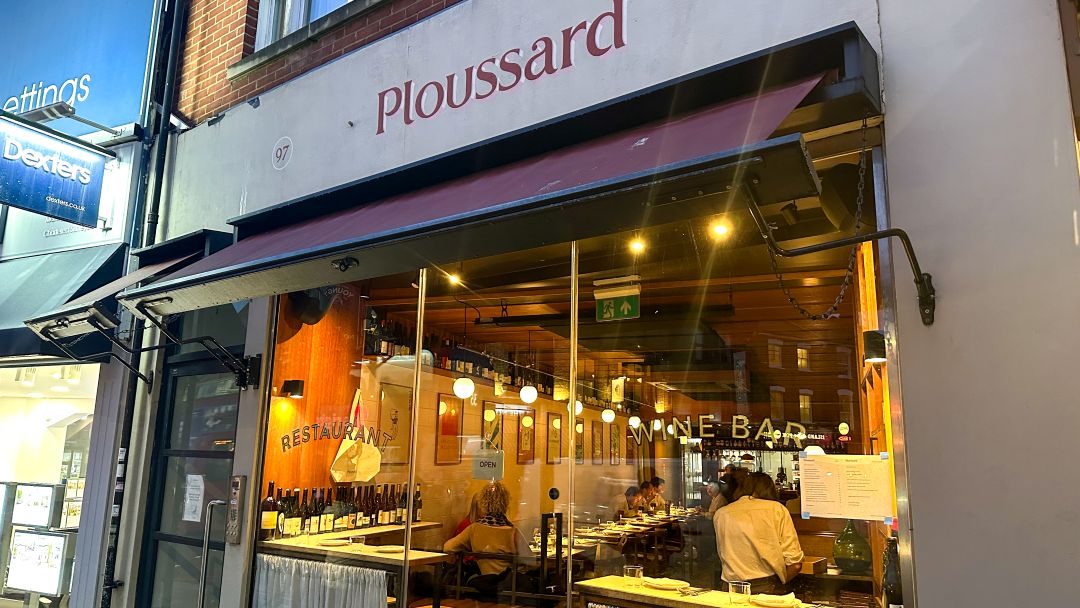
Ploussard is a bijou restaurant, around 30 covers, with simple décor of plain wooden tables and chairs, rows of empty wine bottles lined up on a high shelf (always a good omen), a few discreet art prints and a small kitchen located at the rear. Parisian bistro ambiance relocated to South London. Chef Matt Harris focuses his menu on European dishes. The name comes from an alternative spelling of the Poulsard grape variety that is synonymous with the Jura.
Four of us gather for lunch, including two gentlemen with unparalleled knowledge about the current restaurant scene. One is restaurant critic Andy Hayler, fresh from declaring in a national newspaper that there is not one bona fide three-star restaurant in the UK. That is a debate for another day. What can be said is that London is brimming with great value lunchtime deals. Ploussard offers a set menu for £38, as well as a carte blanche menu for £85.
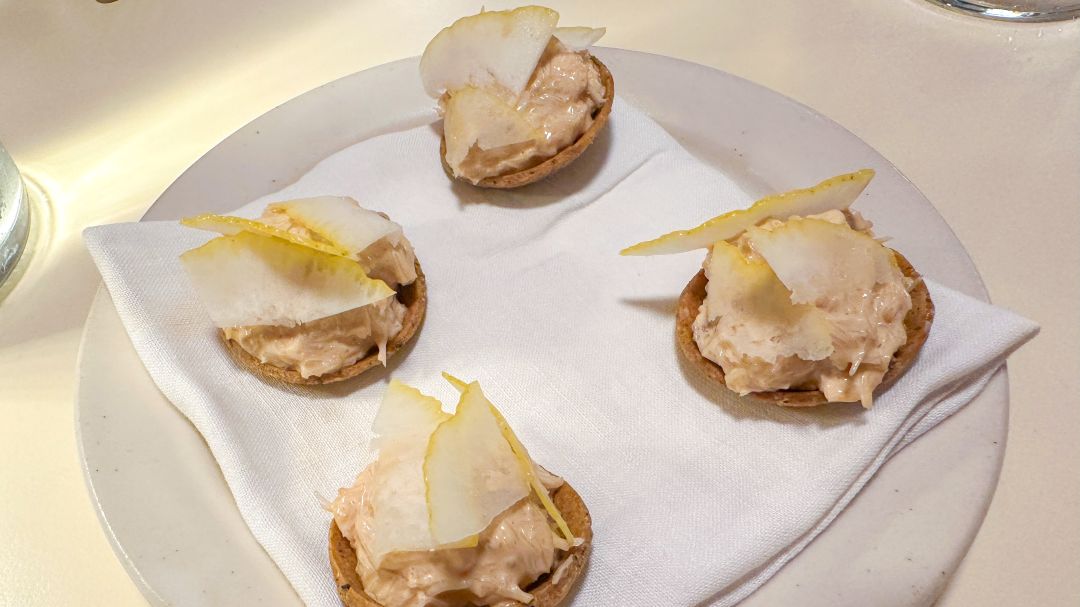
Crab and black pepper tartelette.
We begin with crab and black pepper tartelette. This has a light texture, and the crab flavour comes through strongly, the black pepper lending just the right amount of tang. A strong start. This is more successful than the Vacherin and lardo croustade, the only real misstep during our meal, a bit too creamy and overpowering. I must mention the bread that is baked on site. It is wonderful, quite unusual in texture, with a consistency that reminds me of a warm crumpet.
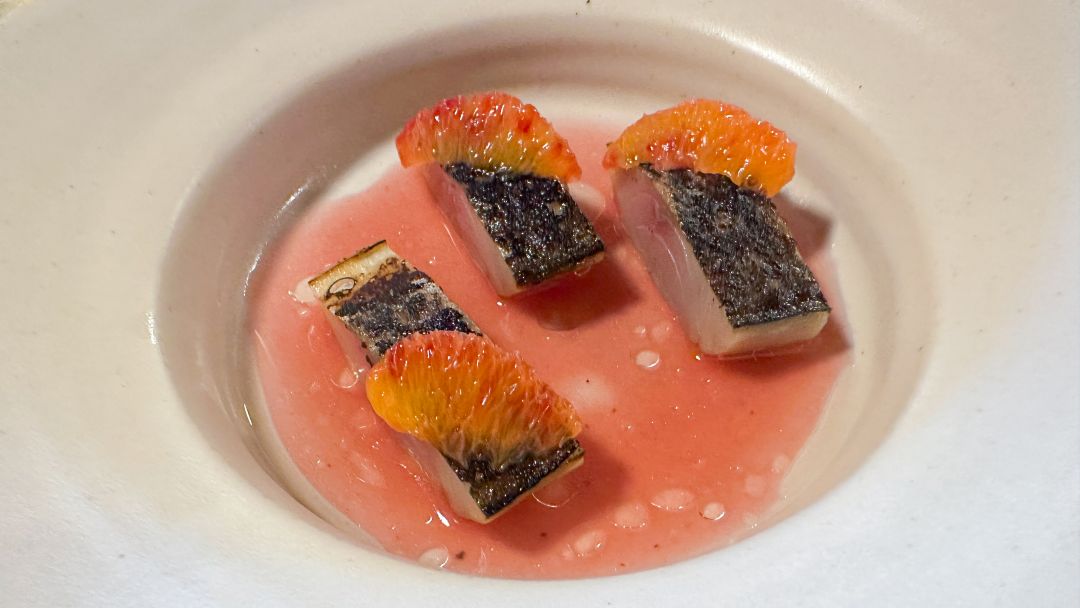
Cured mackerel, blood orange and grape vinegar.
Things get back on course with cured mackerel served with blood orange and grape vinegar. This is a risky dish, so straightforward that it could have easily skidded off track, but Harris pulls it off. The blood orange lends just the right amount of sweetness to marry with the saltiness of the oily finish, whilst the grape vinegar provides a perfect canvas.
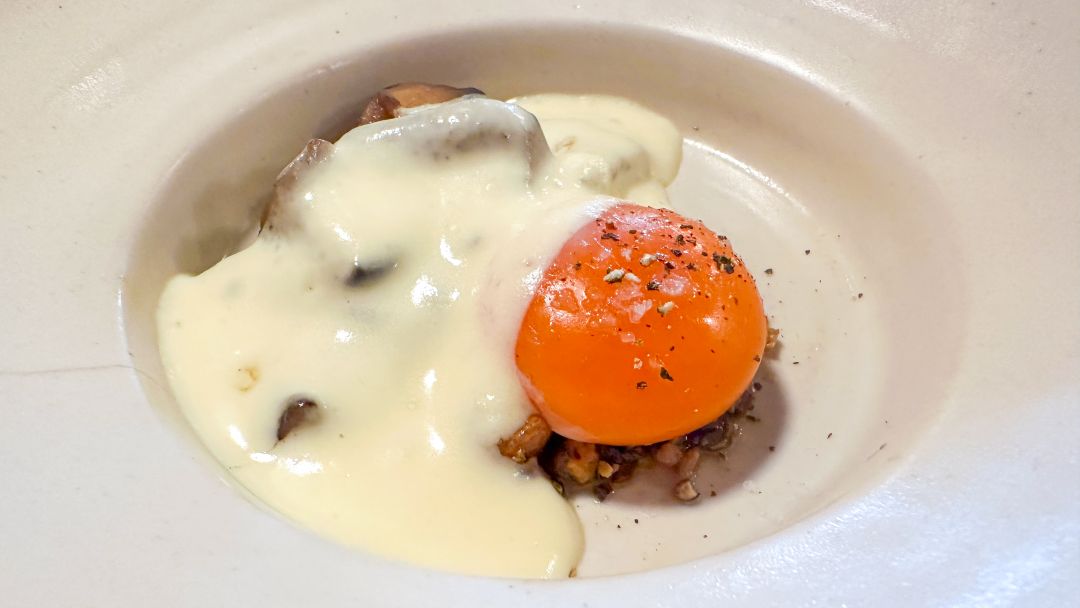
Shiitake, hazelnut, egg yolk and Comté.
I fall hook, line and sinker for the next dish of shiitake mushrooms, hazelnut, egg yolk and melted Comté, a winter dish that instantly warms you up. I might have dispensed with the cheese, though it does not detract from the dish as a whole. The crucial ingredient is the hazelnuts that provide texture and bitterness to counterbalance the sweetness of the yolk.
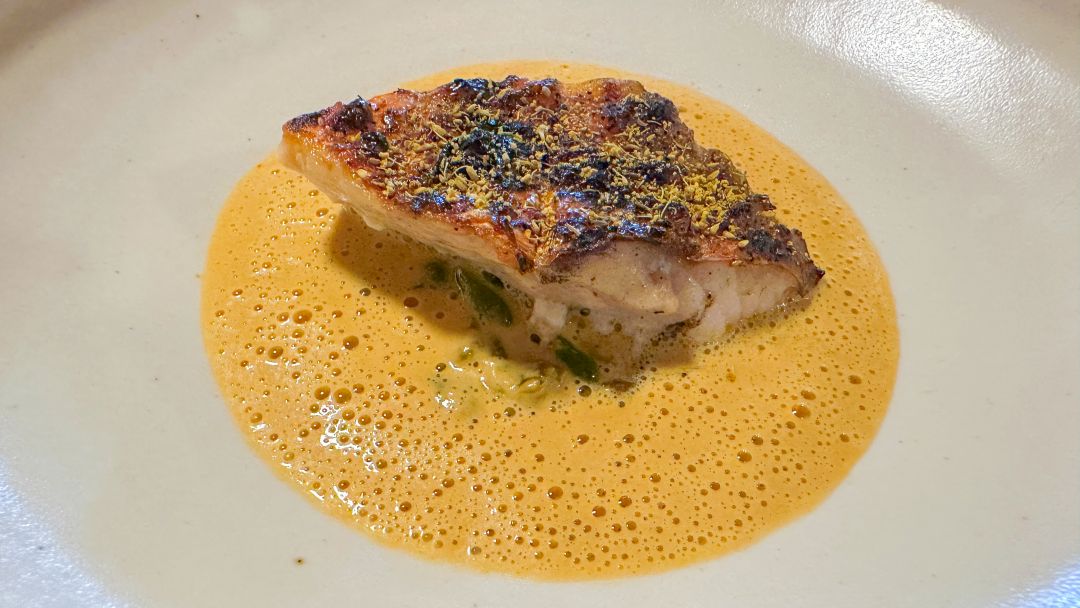
Trout, pink fir potato and brown shrimp butter.
The trout, one of my favourite poissons, comes with pink fir potato and is dressed in brown shrimp butter. Delicious. The fish has an irresistible crunchiness to the skin, the meat tender and moist underneath, the shrimp butter brimming with flavour, almost veering towards lobster in taste. Keep some of the bread handy to mop it up.
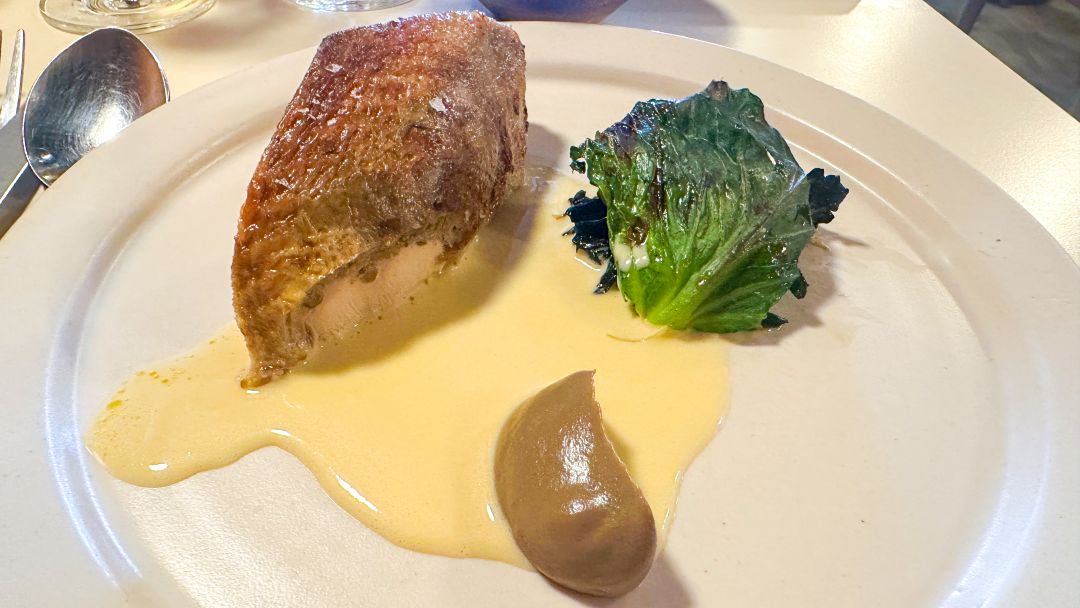
Chicken breast, Black trumpet mushroom, January King cabbage and vin jaune.
The main course is breast of chicken, black trumpet mushroom, January King cabbage and a vin jaune sauce. Enquiring about the source of the chicken, we are informed that these are free-range chickens from Packington, fourth-generation pig and poultry farmers in Staffordshire. My learned friends immediately tell me these are the best in England, indeed, the same used by some of London’s most celebrated restaurants. Quality just shines through on the plate. The chicken is beautifully cooked, moist and flavoursome. The black trumpet purée has a wonderful consistency, the vin jaune lends acidity, and the January King cabbage adds a soupçon of bitterness and crunch. Again, this is not setting out to be a masterclass in culinary wizardry, rather a lesson in execution and showcasing a chef who puts quality of ingredients first and foremost.
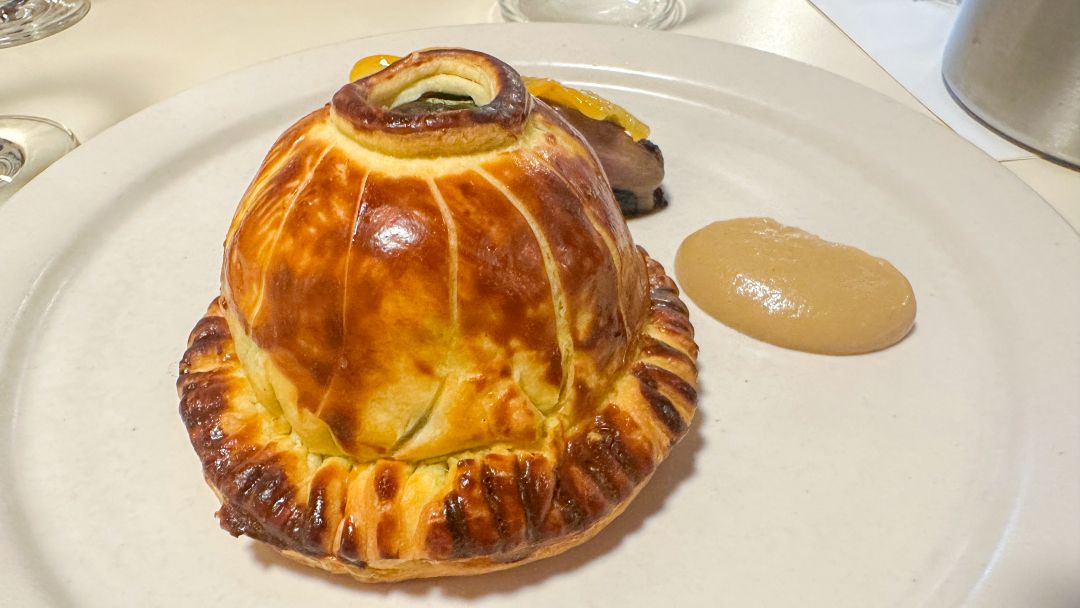
Duck & Gruyère pithivier with shallot and kumquat.
As an extra course, the duck and Gruyère pithivier with shallots and kumquat is like the previous dish insofar that, whilst not overly complex, it is perfectly cooked and seasoned. The pastry is light and flaky, the duck moist and moreish. Because I have dinner booked that evening, I skip the Ossau-Iraty cheese and tonka bean dessert.
Ploussard has a comprehensive wine list centered around French regions. Mark-ups are reasonable, the most expensive offering a Pommard from Philippe Pacalet at £268. Twenty-six wines are served via Coravin or by the glass, ranging between £8 and £26. Where I must wag my finger, not for the first time, is that the range is rigidly “natty,” i.e., almost exclusively biodynamic, organic or natural. Apart from limiting choices, it makes wine black and white, inferring that winemakers who protect their wine with sulphur are committing a crime and therefore do not merit inclusion on the list. This inculcates people with negative ideas about what may be traditionally made, delicious wine.
On this occasion, our host generously provided some gems from his cellar. We commence with a bottle of 1996 Krug Vintage. At 30 years old, it is developing an iridescent straw hue, though not particularly deep. The nose is engaging with walnut, warm bread and light smoky scents of moderate intensity. The palate has the presence one expects from a mature Krug, a very subtle background oxidative element mingling with orange bitters and a little oiliness towards the finish. It does beg the question: where will this go from here? As such, I would not hesitate to open bottles in the near future, but there’s no rush. Next is the 2020 Chablis Vaudésir Grand Cru from Domaine Samuel Billaud. Curiously, I had never tasted this vintage. Frankly, I would not place it among my favourite editions of this wine; it's just missing some of the trademark mineralité and subtle reduction that I associate with one of my favourite Chablis winemakers and lacking a bit of complexity. The palate is better, well balanced with the weight one expects of a Grand Cru, though I prefer more bite towards the finish. Fine, but not up to Billaud’s usual standard.
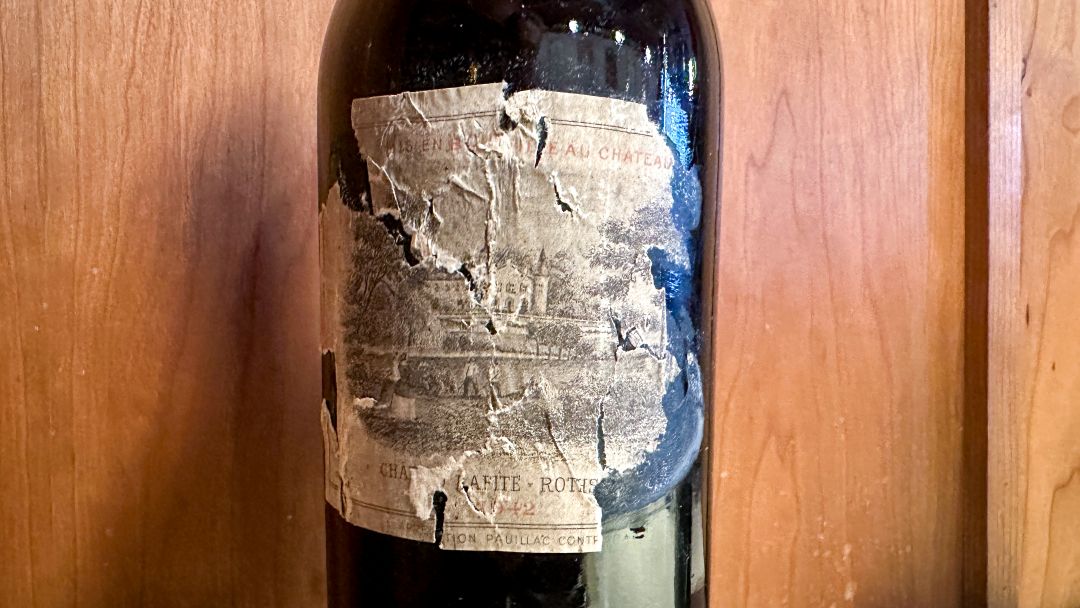
Two clarets with some age came next, purchased at auction for well below market prices, which is always taking a risk since one cannot guarantee provenance. Thankfully, we were treated to two exquisite wines that had evidently been stored correctly. The 1983 Palmer is an absolute peach, though without question, it benefited from decanting. It is one of those Margaux that can feel a bit light at first, yet aeration magically gifts it with weight and density. Leaning a little more towards red fruit, the nose unfolds with tobacco and pressed flower scents, resplendent with that delineation and focus, though never powerful or intense. The palate is very harmonious and refined, understated and perhaps not displaying the fireworks you might associate with a lauded Margaux. Yet it builds in the glass, gaining depth and grip towards the subtly estuarine finish. Beautiful. The 1942 Lafite-Rothschild is a wartime vintage that I was meeting for the first time. Examining the bottle, the level is sound for its age, and as expected, the bottle has a faint blue tint since glass was difficult to come by at the time. Crucially, the colour of the wine is clear, showing a decent amount of bricking on the rim. What I love about the nose is that it delivers all the signature traits of this First Growth: light vestiges of red fruit, autumn leaves, touches of leather and fireside hearth. It gently builds in the glass and coheres wonderfully, but it is a Lafite, so it never gains intensity. Likewise, the palate is fresh on the entry with lace-like tannins that support the pretty remnants of red fruit. This comes across as a “transparent” Bordeaux, not much grip, yet there is presence and tension, with just a little flesh towards the off-dry finish. Next to me, Hayler, who has good knowledge of wine, confesses that this bottle altered his hitherto sceptical view of old claret. Glorious!
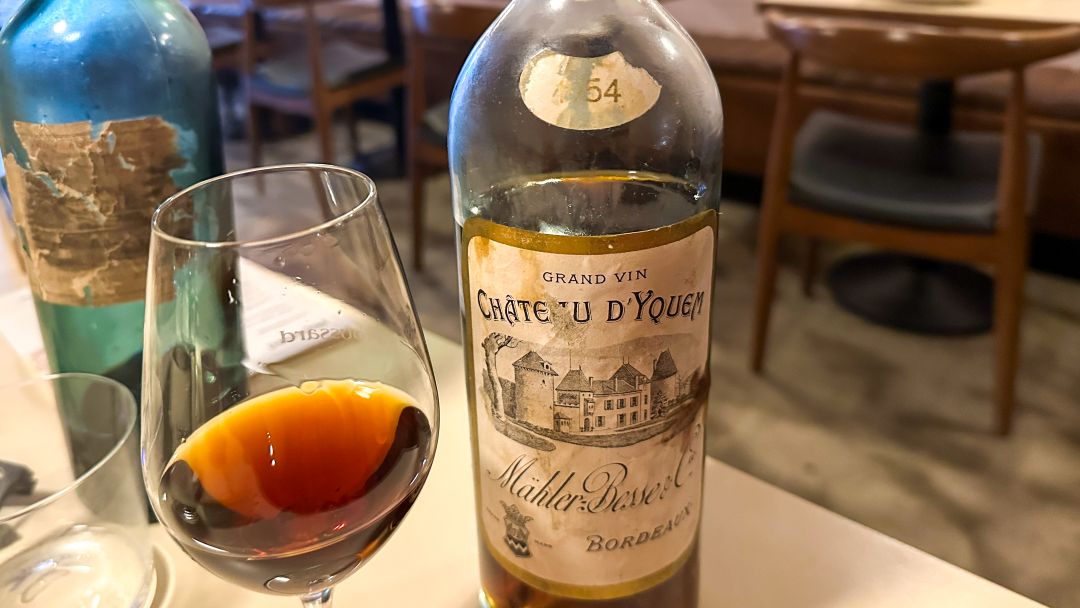
We finish as all lunches ought, with a Sauternes. The 1954 Yquem is a vintage that I encountered at the château a couple of years ago, although, as seen on the label, this was bottled by the Bordeaux merchant Mähler-Besse. It is not dissimilar to château bottling: marmalade and estuarine scents on the mature nose, still vital and fresh. The palate is relatively lighter compared to other vintages, as there is just 79 grams per litre of residual sugar. Mandarin and marmalade emerge once again on the palate. There’s fine weight and a slightly viscous texture towards the finish. The 1954 does miss a bit of bandwidth, but it is still delicious and perhaps not as taxing as a more concentrated Yquem might be. Lovely.
Actually, that is not quite the end. We drink a very special coffee from the multi-award-winning Elida Estate in Panama. The Geisha Classic Natural DRD (Dark-Room Dried) Aguacate Lot comes from an elevation of 1,900 metres in the Barú Volcano National Park, and these highly coveted beans were auctioned for $1,610/kilogram. This coffee is sold in the UK in handy capsule form by The Difference Coffee Company. It is so subtle in flavour, with discreet touches of red fruit and a conspicuous citrus element that enlivens the finish.
Our lunch had lasted around five hours. Apart from uncovering everything I needed to know about the current restaurant scene, our conversation had spanned wine, reviewing, artificial intelligence and politics. Ploussard was a joy from start to finish. It is a refreshingly unpretentious local restaurant south of the river, though not that far from central London. You could cab it quite easily. The food is everything. Instead of investing money in fancy artwork or bespoke cutlery, at Ploussard, it is spent on quality ingredients that are given space to shine on the plate. Less is more. Harris is clearly a very competent chef with the nous not to overcomplicate dishes. Service was friendly throughout.
Making my way back to Clapham Junction station, I completely understand why Michel Roux Jr. comes to Ploussard. If you fancy something off the beaten track that will leave you wanting to return as soon as possible, you should, too.
© 2026, Vinous. No portion of this article may be copied, shared or redistributed without prior consent from Vinous. Doing so is not only a violation of our copyright but also threatens the survival of independent wine criticism