
Browse using the new Vinous website now. Launch →
Printed by, and for the sole use of . All rights reserved © 2015 Vinous Media
Hail! Hail! Yakitori!
BY NEAL MARTIN | JUNE 5, 2026
One of my fondest recollections of living in Japan was walking home from my school on a wintry night as snowflakes covered the ground, the NEC building looming over a yakitori stand. Huddled on a wooden bench with salarymen in the same ill-fitting polyester suits, lit in chiaroscuro light of the bincho coals, we devoured chicken skewers dripping in sweet soy sauce, sunk cans of Asahi Super Dry and chatted about the Queen until the small hours.
Yeah…that was the real Japan.
Yakitori stalls gained popularity in the Meiji Period at the end of the nineteenth century. Until then, Japanese society considered meat consumption unclean and most subsisted on a pescatarian diet. Yakitori surged in popularity after the 1923 Great Kanto earthquake, when poverty eroded society’s bias against meat consumption. Families began skewering cheap cuts of offal known as motsu-yaki, to which I will return later. Indeed, the term “yakitori” is a bit of a misnomer. The word “tori” implies poultry, whereas yakitori, in fact, applies to any meat or vegetable skewered before grilling. That said, chicken forms the majority. Japan bred its own Hinai-jidori breed to cater to burgeoning demand, and other breeds such as Nagoya-kochin and Satsuma-jidori subsequently became renowned for their rearing and flavour.
This Vinous Table is my homage to yakitori. I have written up three yakitori-ya that I visited in July 2025. Each has a different take, but all are a level above what you find in an average izakaya. My decision to combine them does not imply inferiority; on the contrary, two rank amongst my favourite meals of 2025, notwithstanding that one has a Michelin star.
Torishige
2 Chome-6-5
Yoyogi
Shibuya
Tokyo 151-0053
The Food:
Assorted yakitori: liver and spring onion, tsukune, pig intestine, pig temple, sukiyaki egg, chateaubriand and sirloin, pig colon and cartilage, pig heart, beef shoulder and tongue
Somen noodles
The Wines
| 2019 Twomey Cellars Pinot Noir Russian River Valley | 89 |
| 2020 Hirsch Pinot Noir West Ridge | 93 |
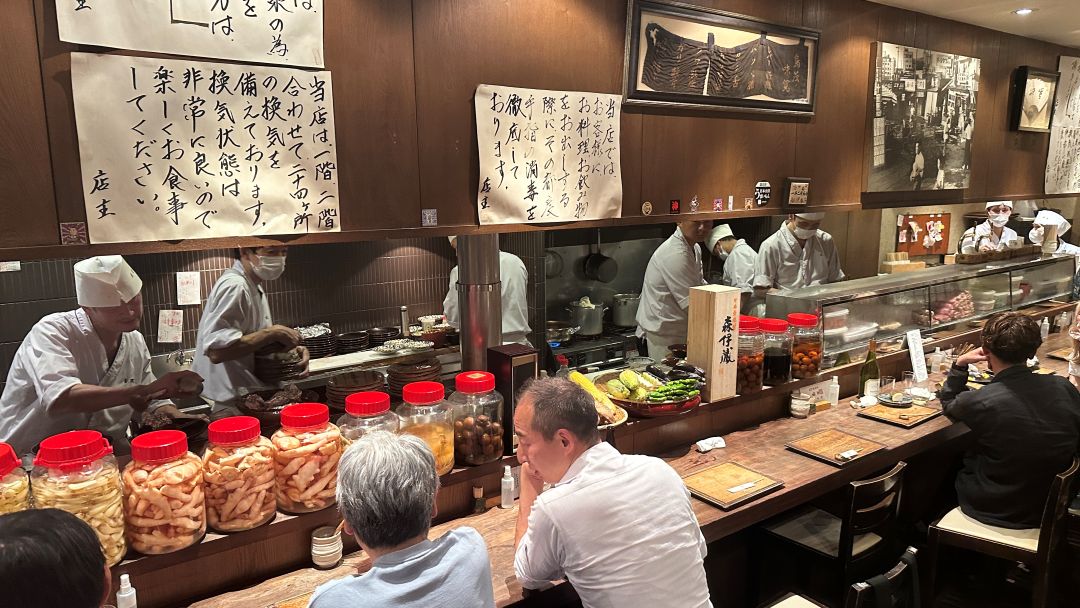
The dining counter at Torishige.
Let us begin with Torishige, just a five-minute walk from Shinjuku Station (or 20 minutes if it is rush hour)! My erstwhile work colleague, Hiro San, chose this place after taking me to Koumoto and Sens et Saveur on previous visits. Torishige is a large, two-floor restaurant that specialises in the aforementioned motsu-yaki. Think of it as “yakitori nose-to-tail eating,” Tokyo’s own St. John. It was founded as a food stall way back in 1949, and Chef Yuji Sakamaki is the third-generation owner. Torishige is also known for inventing stuffed green pepper skewers filled with minced chicken—a must-try.
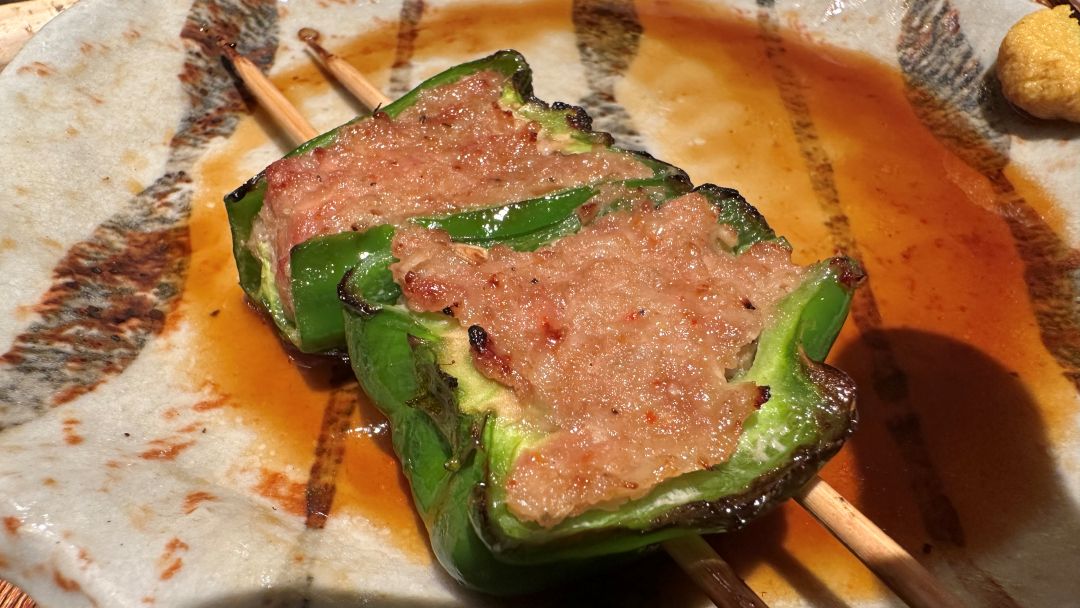
The famous stuffed peppers.
Amongst the yakitori we eat together are…takes a deep breath…liver and spring onion, tsukune, pig intestine, pig temple, sukiyaki egg, chateaubriand and sirloin, pig colon and cartilage, pig heart, beef shoulder and tongue, finishing with some heartwarming somen noodles.
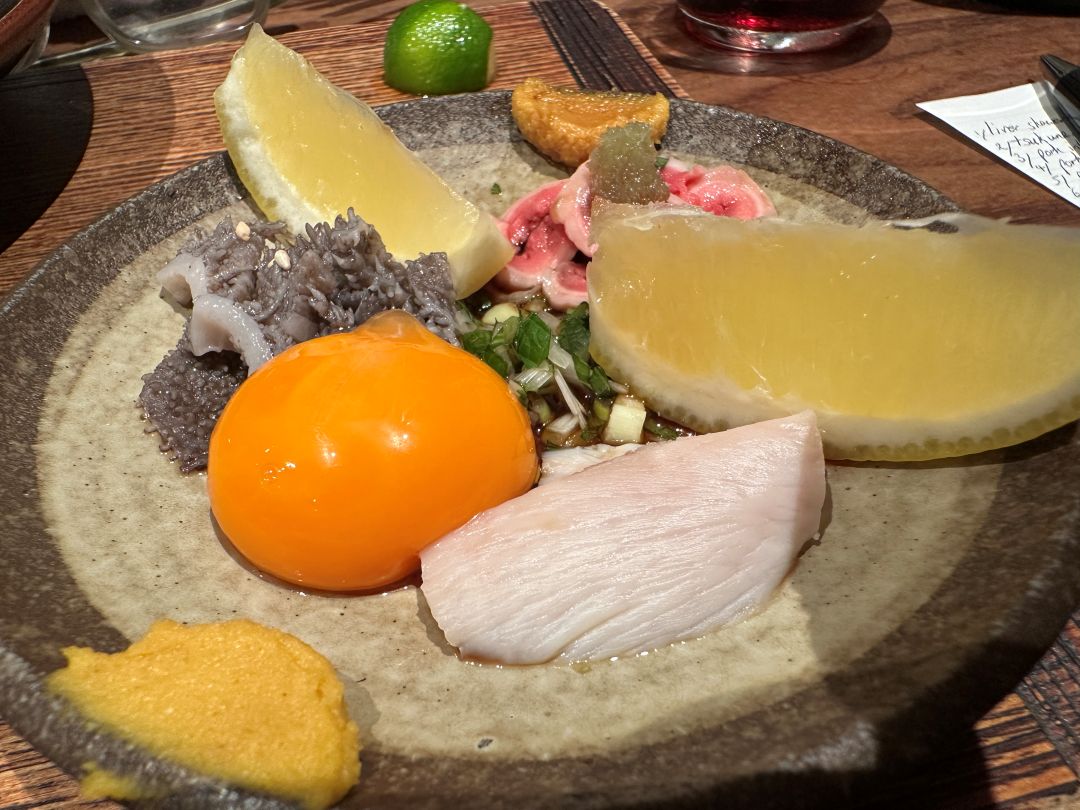
Pig colon and cartilage.
The place is loud, bustling and lively. The yakitori is uniformly delicious in a more rustic style, and it broadened my horizons. Go if you would like a glimpse of what Japanese people were eating a hundred years ago, but I wouldn’t bring your vegan friend.
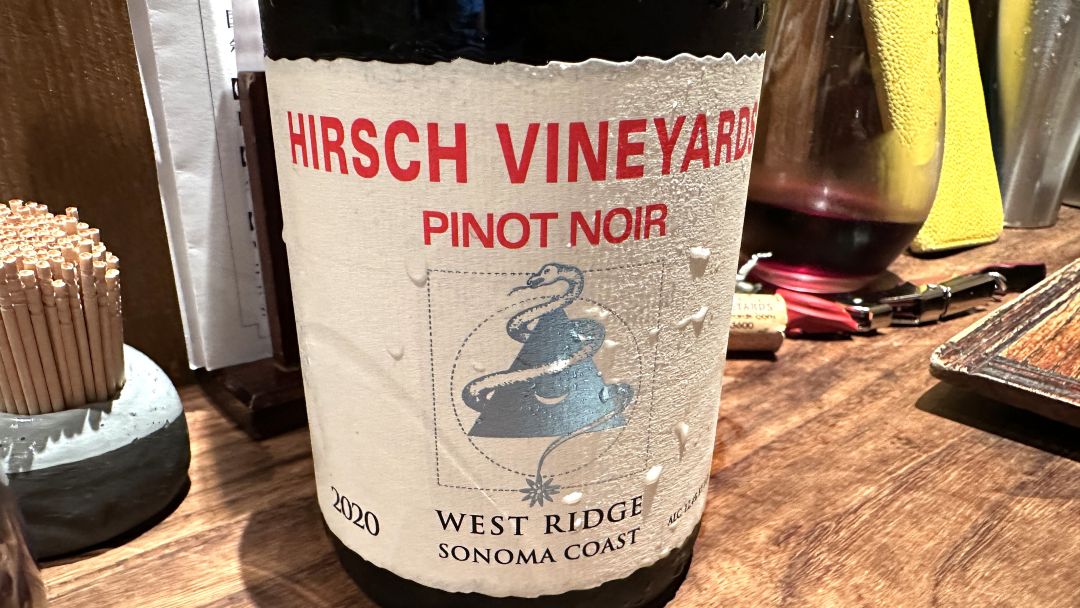
We enjoyed two wines. The 2019 Pinot Noir Russian River Valley from Twomey Cellars is lush on the nose with morello cherry, crushed strawberry and a touch of alcoholic warmth that blurs the edges. The palate is rounded in texture, quite caressing, with generous, plump red fruit, though I feel that it needs a little more acidity to retain tension. The 2020 Pinot Noir West Ridge from Hirsch has no such problem with acidity. Compared to the Twomey, this has more delineation and vibrancy on the nose, with vivid red cherry, raspberry coulis and crushed stone scents, just a hint of rose petal. The palate has plenty of pure red fruit that captures the essence of the variety. Winemaker Jasmine Hirsch managed to impart sufficient acidity to keep this on its tiptoes through the sustained finish. What a wonderful Sonoma Coast Pinot Noir.
1 Chome-3-1 Azabujuban
Minato City
Tokyo 106-0045
The Food:
Octopus
Sea urchin sashimi
Tuna, sea bream and salmon sashimi with shredded daikon and shiso leaf
Oven slow-cooked tomatoes
Assorted yakitori: seseri, bonbochi, chicken heart, chicken thigh
The Wines:
| 2016 Chartogne-Taillet Extra Brut Blanc de Blancs Heurtebise | 96 |
| 2007 Domaine François Raveneau Chablis Les Butteaux 1er Cru | 91 |
| 2010 Domaine François Raveneau Chablis Les Butteaux 1er Cru | 95 |
| 1988 Lisini Prefilloserro | 95 |
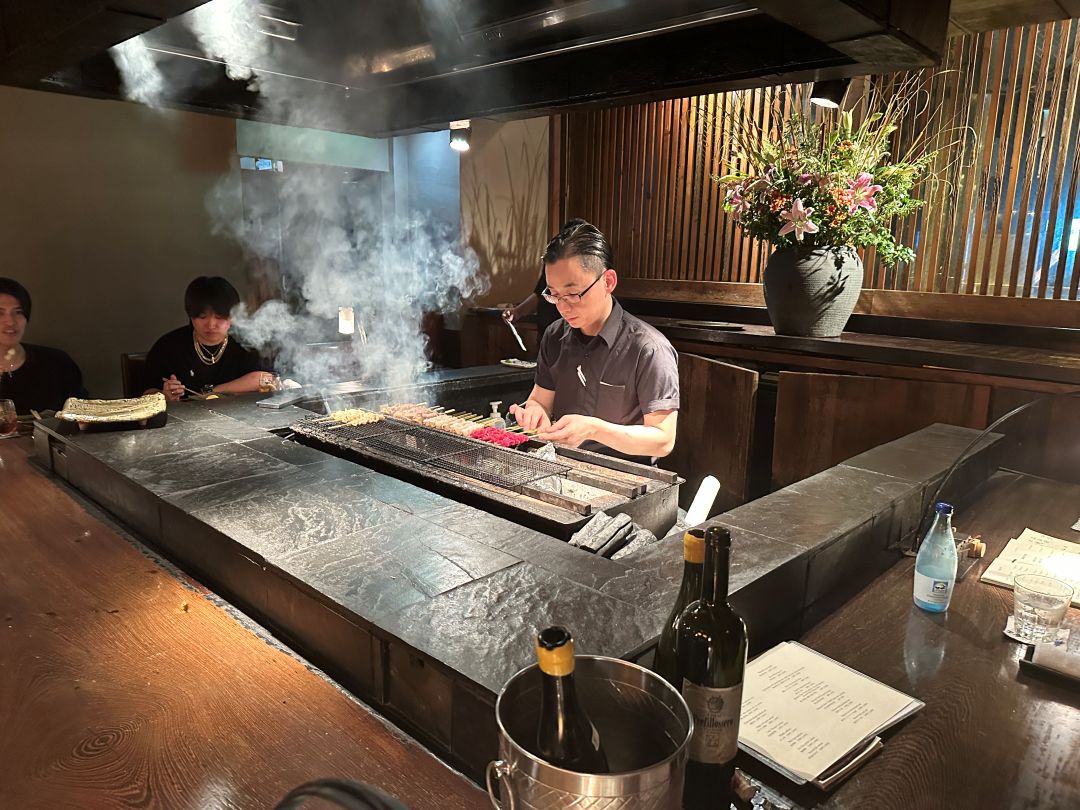
The interior at Gaigai.
Next, Gaigai in Azabu Juban, where I ventured on my first night with two wine friends, Steve and Oliver San, who I must thank for accompanying our yakitori with splendid wines. The buzzy and lively ambiance here strikes me immediately. Dimly lit with dark walls, it feels like the place to be. Apparently, the presence of a nearby TV station means that you might spot the odd celebrity enjoying a late-night libation, since service continues until 4 a.m. The main room centres around the yakitori grill and its surrounding L-shaped counter, with private rooms behind us and an eye-catching vase of flowers behind the chef.
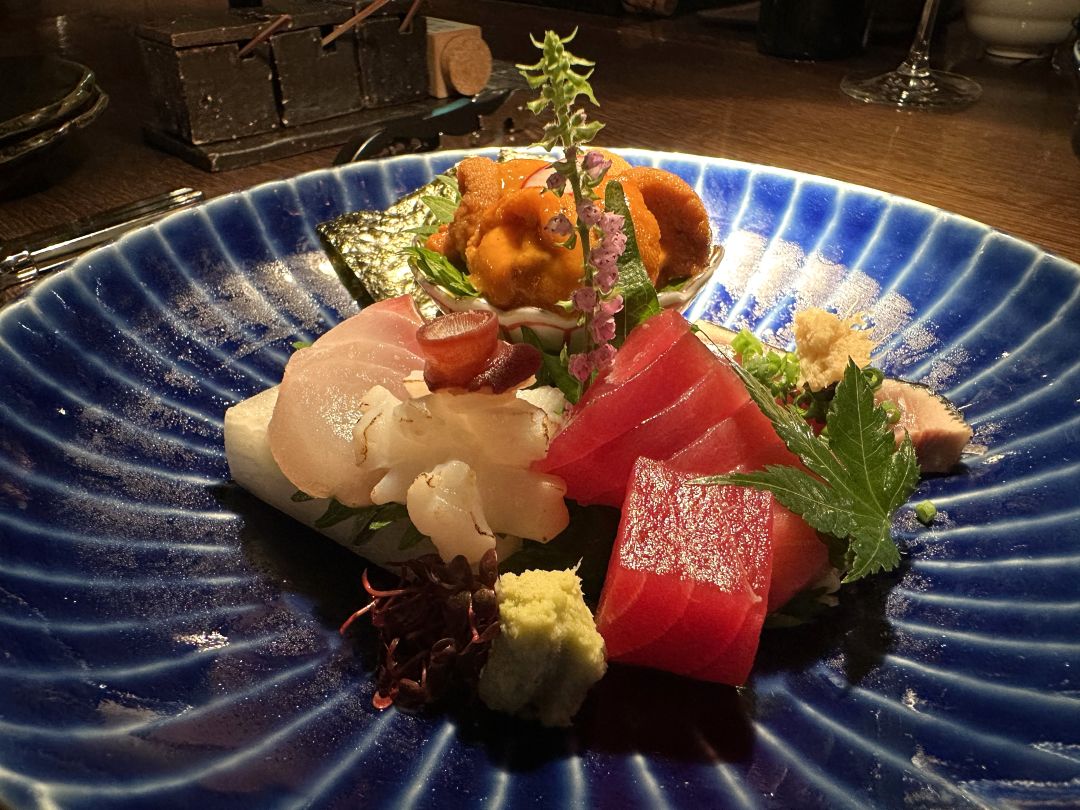
Tuna, sea bream and salmon sashimi with shredded daikon and shiso leaf.
Yakitori is the main feature on the menu, but not the only one. Over this dinner, I ate some of the freshest sashimi and sea urchin of my entire trip, and the juiciest, most intense tomatoes I have devoured in ages, not to mention a chateaubriand that melts in your mouth.
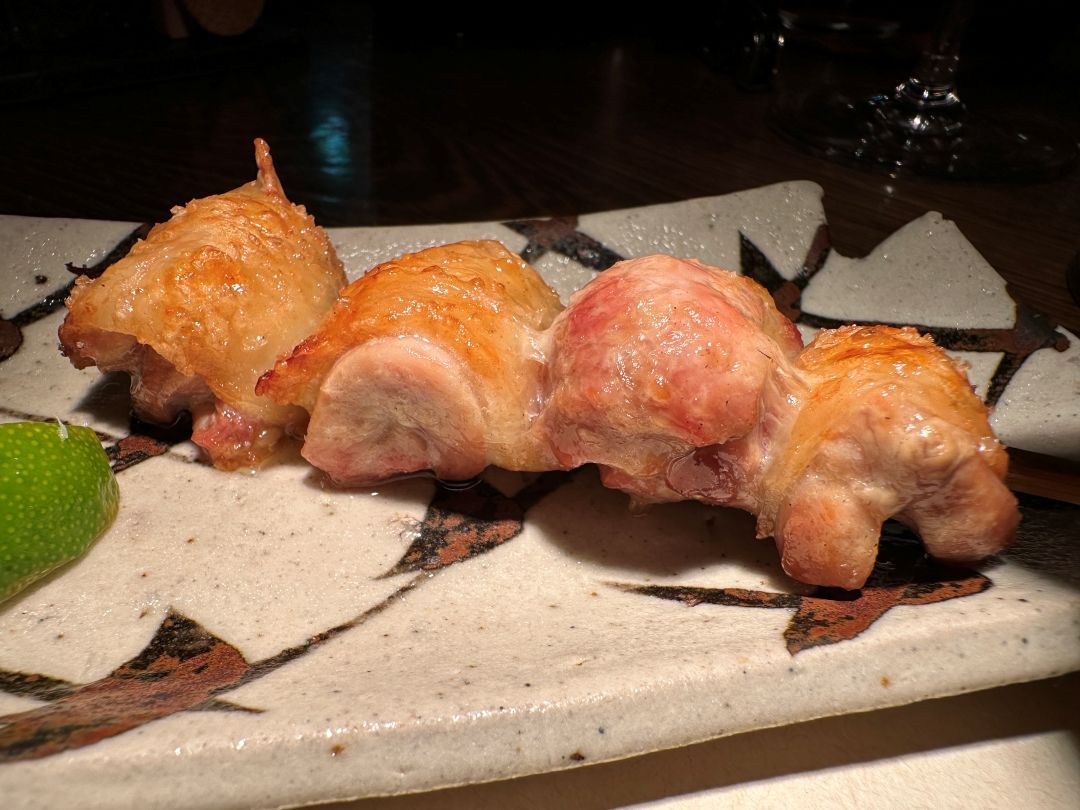
Yakitori.
The yakitori at Gaigai serves rare cuts such as seseri (chicken neck), bonbochi (chicken tail) and chicken heart. I found the quality consistently high, my favourite the chicken thigh from the Nagoya Kōchin breed. This place fits nicely in the sub-Michelin category, avoiding frills but serving dishes that are a cut above the rest at a reasonable price: 7,700 yen (about £36) for a set menu.
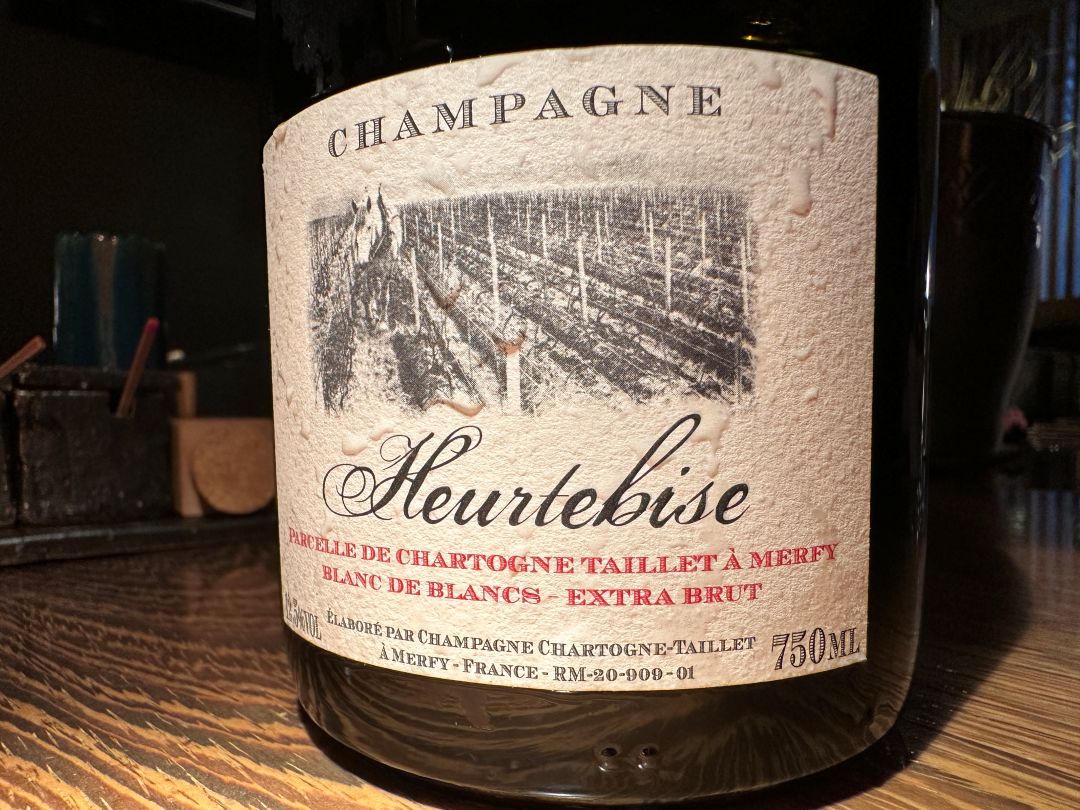
We polished off four splendid bottles, commencing with the Extra Brut 2016 Blanc de Blancs Heurtebise from Chartogne-Taillet, disgorged in November 2019 with 4 grams per liter of dosage. I fell for this hook, line and sinker. With hints of brioche, grilled hazelnut and limoncello on the nose, it displays wonderful delineation and focus, though blind I might have misread it as a Blanc de Noirs. The palate offers all the weight and depth you crave, counterbalanced by a sizzling thread of acidity. Exuding real purity and grace with perfect sapidity on the finish, this is just a fabulous Champagne. Two whites followed: same wine, different vintages.
The 2007 Chablis Butteaux 1er Cru from Domaine François Raveneau has an attractive bouquet with scents of chalk, orange pith and a touch of chamomile. The palate is mature, though the end of its drinking window is certainly not in sight. That said, no producer is beyond criticism, not even one this prestigious, and I feel the 2007 is missing a little race and depth on the finish. That was highlighted by Raveneau’s scintillating 2010 Chablis Butteaux 1er Cru. There is far more energy here compared to the 2007, more articulation of terroir, chalk and sea spray intertwining with a patina of yellow fruit. The palate upholds that sense of drive, deriving electrical tension from its acidity The faintest reduction binds the finish together and lends captivating penetration. Good luck finding a better Butteaux!
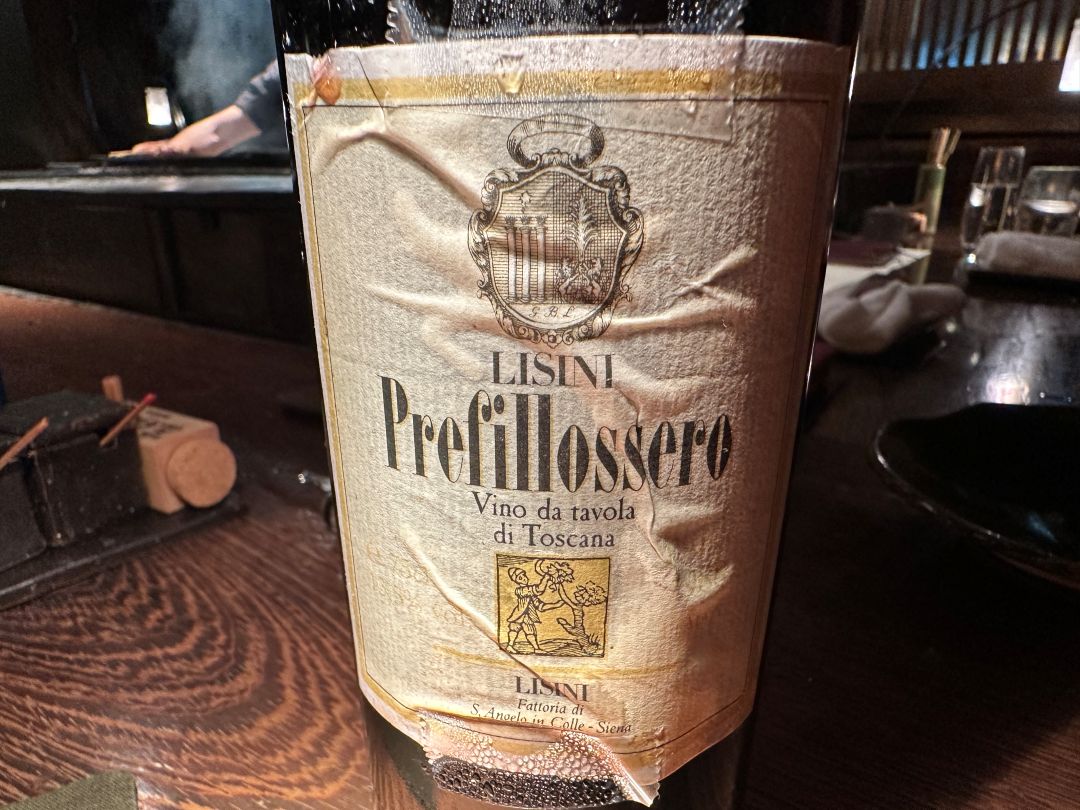
Just one red…but one of the rarest Italian wines that no longer exists. Before expounding the virtues of the 1988 Prefilloserro from Lisini, I do recommend reading my Cellar Favorite for the 1985, which delves into its fascinating backstory. Oliver San had saved the 1988 for my return visit, and again, I fell for its charms. The nose is youthful considering its age, with almost Volnay-like red fruit, gaining complexity with each passing moment. That Burgundian allure translates to the palate, which displays sublime balance, caressing, fluid tannins and gentle yet insistent grip. I actually liked it more than the person who so generously poured his last bottle, though by the end of the dinner, he was just as captivated.
Yakitori Ichimatsu - Osaka
〒530-0003 Osaka
Kita Ward
Dojima
1 Chome−5−1
The Food:
Oden ricotta cheese
Quail’s egg and wood-fired chicken wing yakitori
Chicken pâté sandwich
Assorted yakitori: chicken gizzard, Nagoya chicken thigh and breast with ponzu and ginger, sukiyaki, charcoal-seasoned chicken breast, five-spice seasoned chicken wing, chicken kidney
Star anise-infused rice with chicken stock
The Wines:
| 2020 Alvina Pernot Meursault Les Charmes 1er Cru | 94 |
| 2023 Domaine André Vatan Sancerre Les Charmes | 90 |
Finally, what might be considered the apogee of yakitori: the marvellous Michelin-starred Yakitori Ichimatsu in Osaka. I found this restaurant a couple of weeks beforehand, and though the counter was full, we secured a semi-private room that meant we were not cut off from the action. Chef Hideto Takeda uses the Hinai-jidori breed of chicken from the Akita prefecture and has developed a skin-wrapping technique for his chicken wings to enhance umami and flavour. Like Gaigai, the omakase menu warms up with non-skewered dishes.
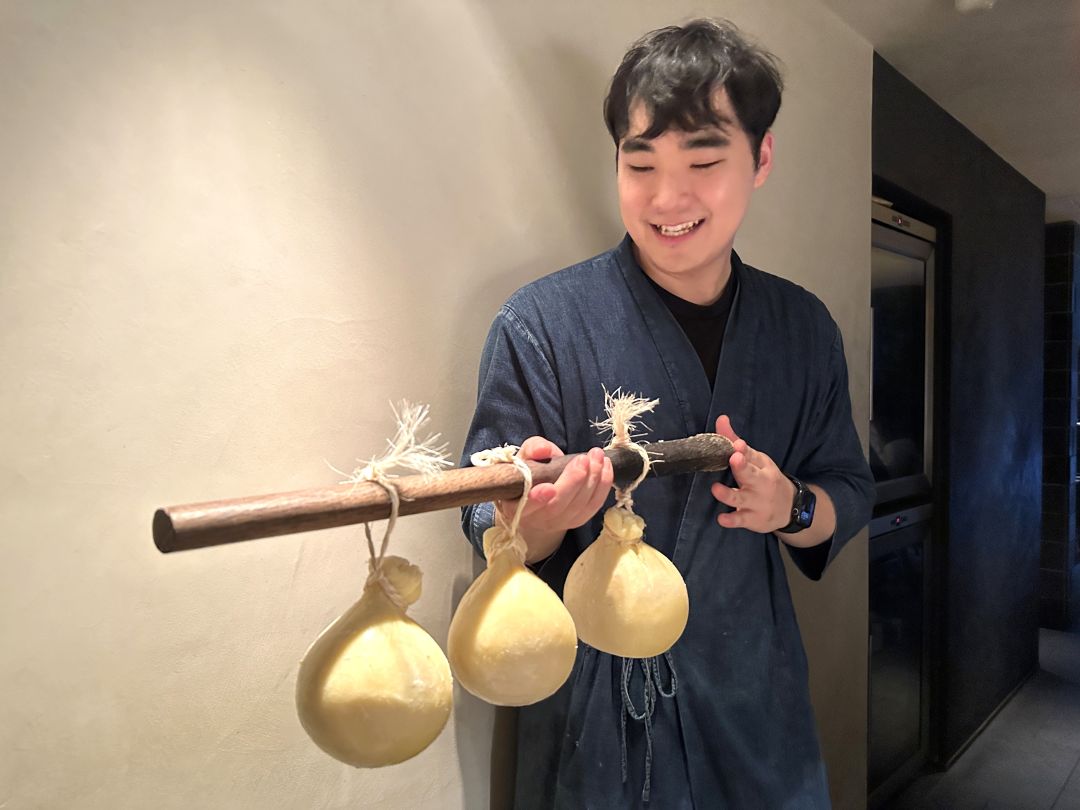
Oden ricotta cheese.
Our waiter enters with three “bags” of maturing ricotta cheese strung to a piece of wood, used for the oden served in a chicken broth. There are indescribably delicious quail eggs that explode in the mouth, so creamy and intense. Then, a small dish of 20-month-aged chicken from Hiroshima, prepared like prosciutto and served with dill flowers and ribbons of daikon, as well as a smoked gratin soup with Caciocavallo cheese.
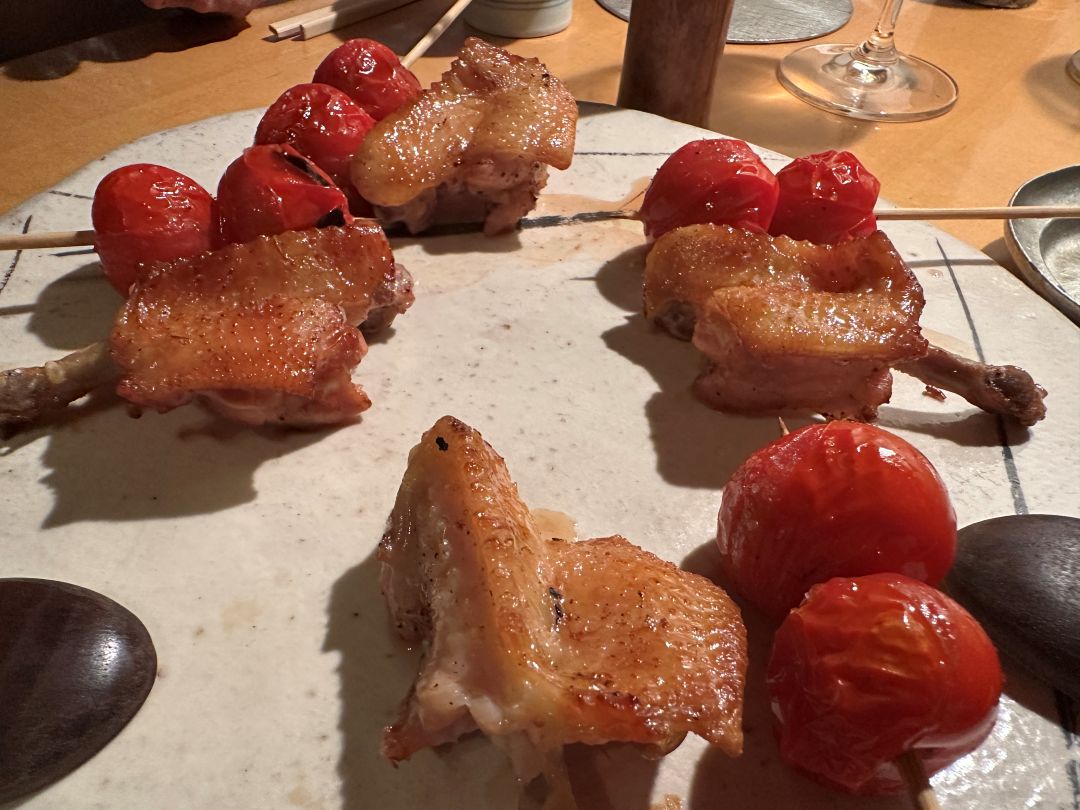
Wood-fired chicken wings with incredibly fresh local tomatoes.
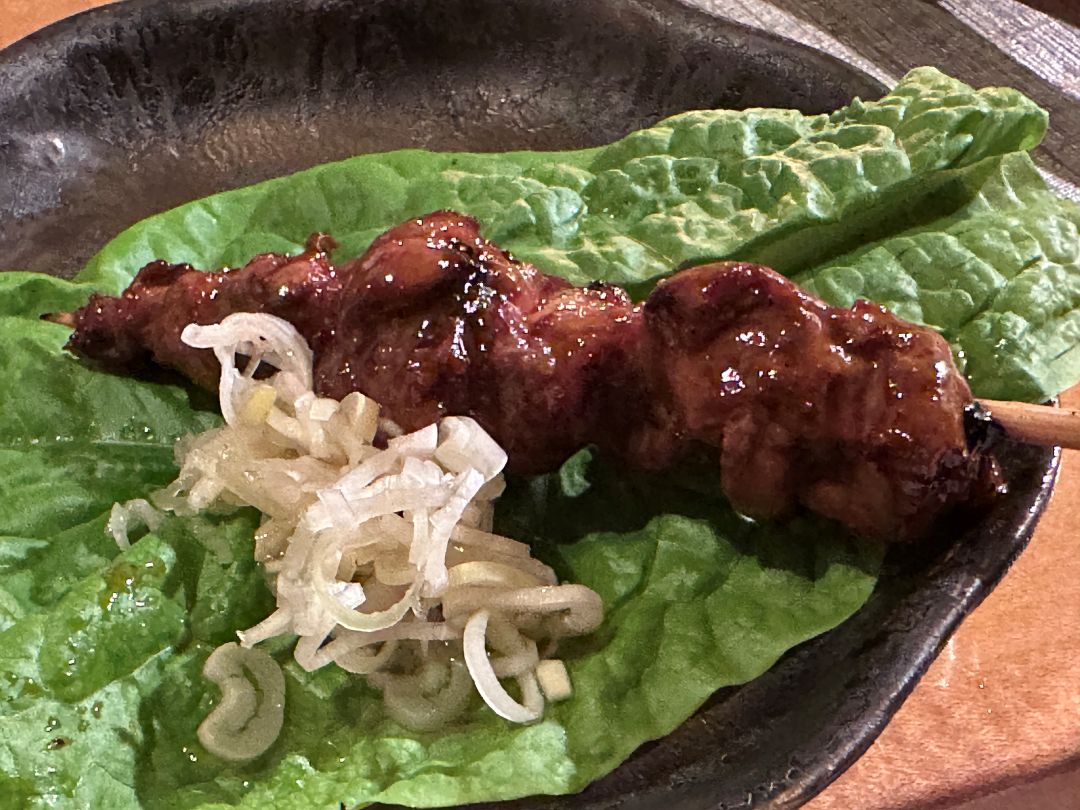
Chicken gizzards taken to their zenith.
Soon, skewers rattle out at such a pace that it is almost difficult to keep up: the chicken pâté sandwich, chicken gizzards, sublime thighs and breast from Nagoya mixed with ponzu and ginger, wood-fired chicken wings with slow-cooked Osaka tomatoes (insane), sukiyaki-style chicken seasoned with coffee beans (you read that correctly), chicken breast seasoned with charcoal powder and five-spice, tsukune, and chicken kidney wrapped in lettuce.
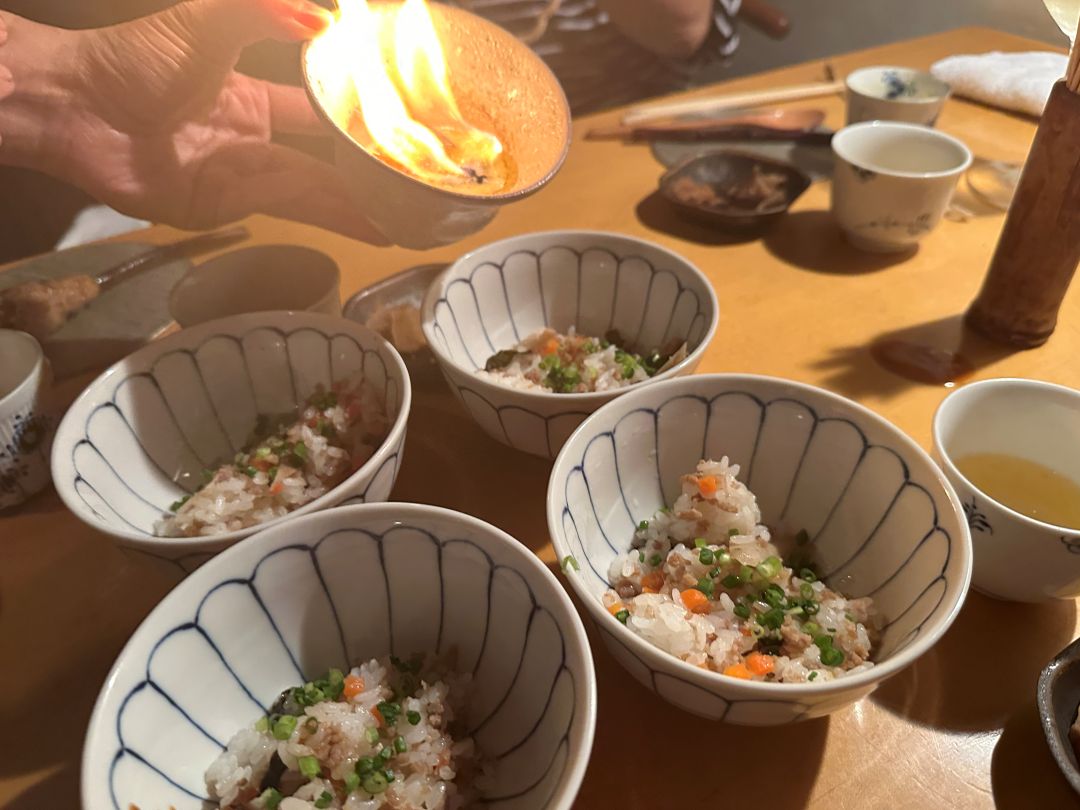
Star anise-infused rice with chicken stock.
Towards the end, our waiter takes the candle that he had lit earlier and pours it into a bowl of rice. Lo and behold, the candle has been melting butter. This is followed by a fiery curry rice made from reduced chicken thigh stock.
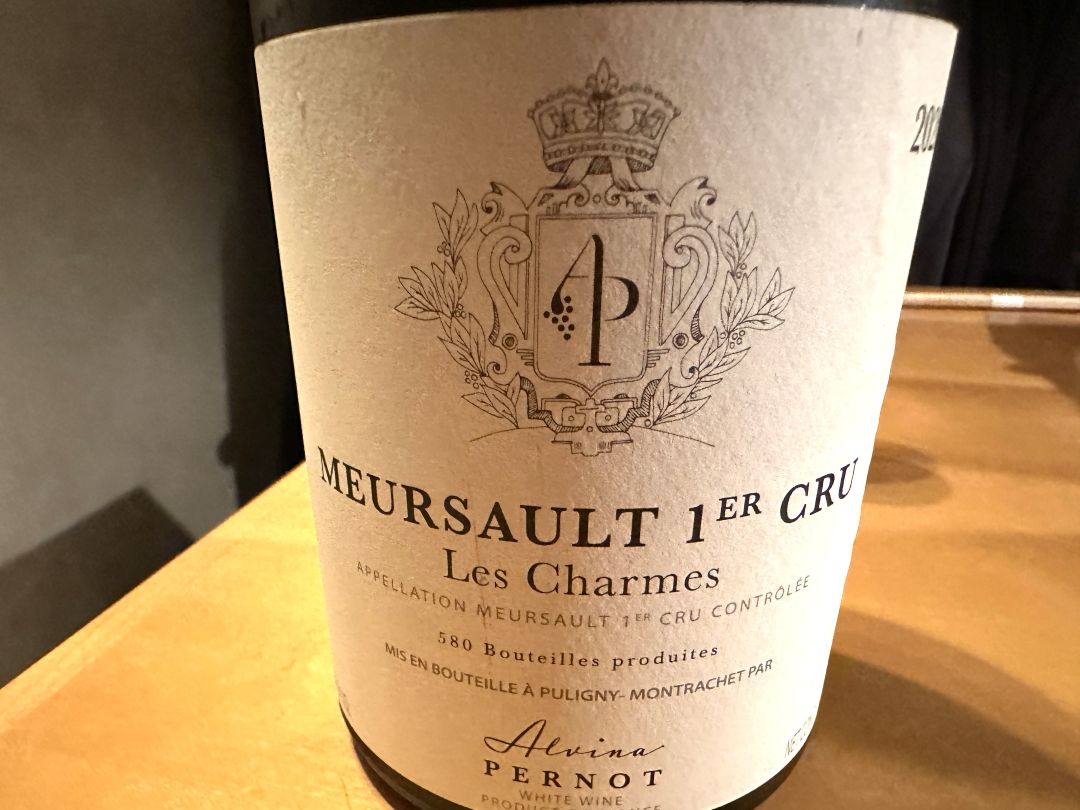
This restaurant has a modest but well-chosen wine list, mainly from classic wine regions, plus some Japanese wine. They were perfectly fine accepting corkage, which was a reasonable 5,000 yen, about £20. The 2020 Meursault Les Charmes 1er Cru from Alvina Pernot is starting to fire on all cylinders. Crisp, vivid and tensile, almost Perrières-like, the 2020 exudes winemaking class and disguises that season’s warm summer with style. The palate has the weight and density one expects from this vineyard, though not honeyed, the acidity exquisitely offsetting the powerful, mineral-rich fruit. I have lauded Pernot’s wines since their inception, and this bottle demonstrates their potential for bottle age. I wanted to order another from their list and chose the 2023 Sancerre Les Charmes from Domaine André Vatan. Gooseberry, nettle and grassy meadow scents unfold on the nose that cannot compete with the minéralité of the preceding Burgundy, but it is nonetheless clean and delineated. Likewise, the palate is simple yet fresh and well balanced, Anjou pear and gooseberry again defining the satisfying finish.
Yakitori is not seen as one of Japan’s delicacies, partly due to its heritage as a staple of the commoners’ diet, born out of poverty. But the country’s talented chefs seek to take yakitori to the highest level by sourcing the finest ingredients and putting their own ingenious twist on standard recipes. I have never lost my soft spot for yakitori, and I am happy to see it being reappraised and reinvented within Japan’s contemporary dining scene.
© 2026, Vinous. No portion of this article may be copied, shared or redistributed without prior consent from Vinous. Doing so is not only a violation of our copyright but also threatens the survival of independent wine criticism.
You Might Also Enjoy
Vinous Table: La Kanro, Osaka, Japan, Neal Martin, June 2026
Vinous Table: Hortensia, Tokyo, Japan, Neal Martin, June 2026
Vinous Table: Moritaya, Tokyo, Japan, Neal Martin, August 2025
Vinous Table: Maison Fujiya, Neal Martin, August 2025