
Browse using the new Vinous website now. Launch →
Printed by, and for the sole use of . All rights reserved © 2015 Vinous Media
2023 & 2024 Barbaresco: Tough Choices
BY ANTONIO GALLONI | OCTOBER 22, 2026
I left Europe in early July during one of the many heat waves that defined a torrid summer. When I returned two months later to taste new releases in Barbaresco, not much had changed. It was hot, hot, hot. Growers have become accustomed to very challenging conditions. That’s exactly what 2023 and 2024 are about. Both seasons pushed producers to the absolute limit. There are some very good wines, but readers will have to be especially selective.
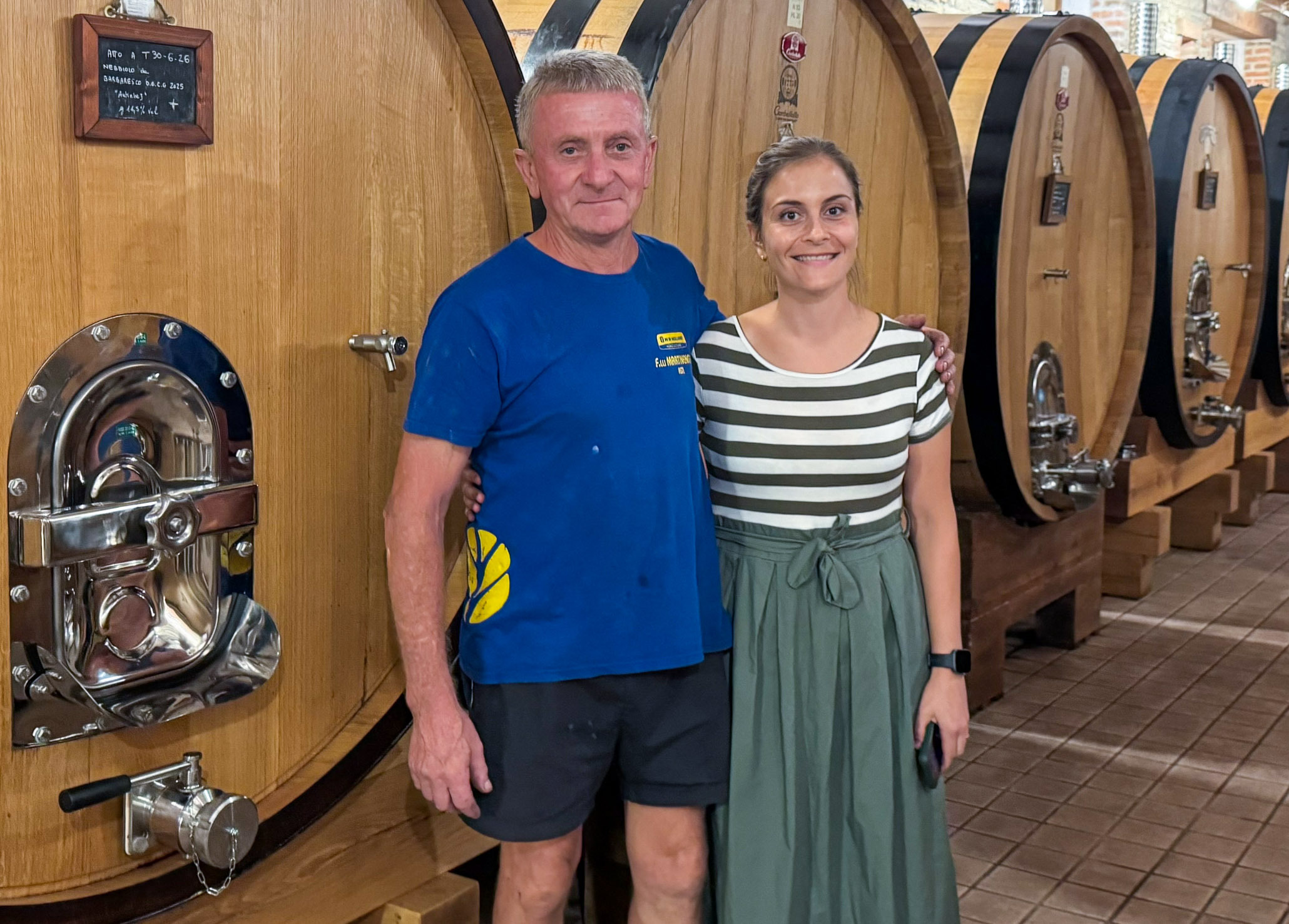
Giulio Grasso and his daughter, Valentina Grasso, in the family cellars in Treiso. The Grassos made some of their finest Barbarescos ever in 2023.
2023: All Over the Place
Two thousand twenty-three was an extremely challenging year. Frost early in the season was an issue. Rain and elevated temperatures were constant themes throughout spring and into summer. Persistent rains in May and June led to elevated disease pressure. “In the last ten years, June has become the most critical month of the year,” Andrea Sottimano explained. “It decides everything. In some years, we get a lot of rain, in other years, rain is more evenly distributed. The trick was to treat the vines early, in the spring and early summer when we had a period of consistent rain, using natural products that protect the grapes and skins without altering their fundamental chemistries. The challenge was getting to flowering in good shape. After that, it was easy. We did not de-leaf and left normal yields on the vine to extend the ripening season as long as possible and protect the vines during the intense heat of the summer.”
A violent hailstorm in early July decimated production. Growers reported losses in the 30-60% range. Interestingly, canopies were not severely affected and were in much better shape than in 2022, which likely explains the generally fine but soft tannins in 2023. Conditions then turned much warmer, especially during August, which saw 20 days of uninterrupted heat. Harvest was seven to ten days earlier than the norm, except for estates where vines needed a few weeks to recover from hail. Sugars are on the lower side relative to recent historical norms.
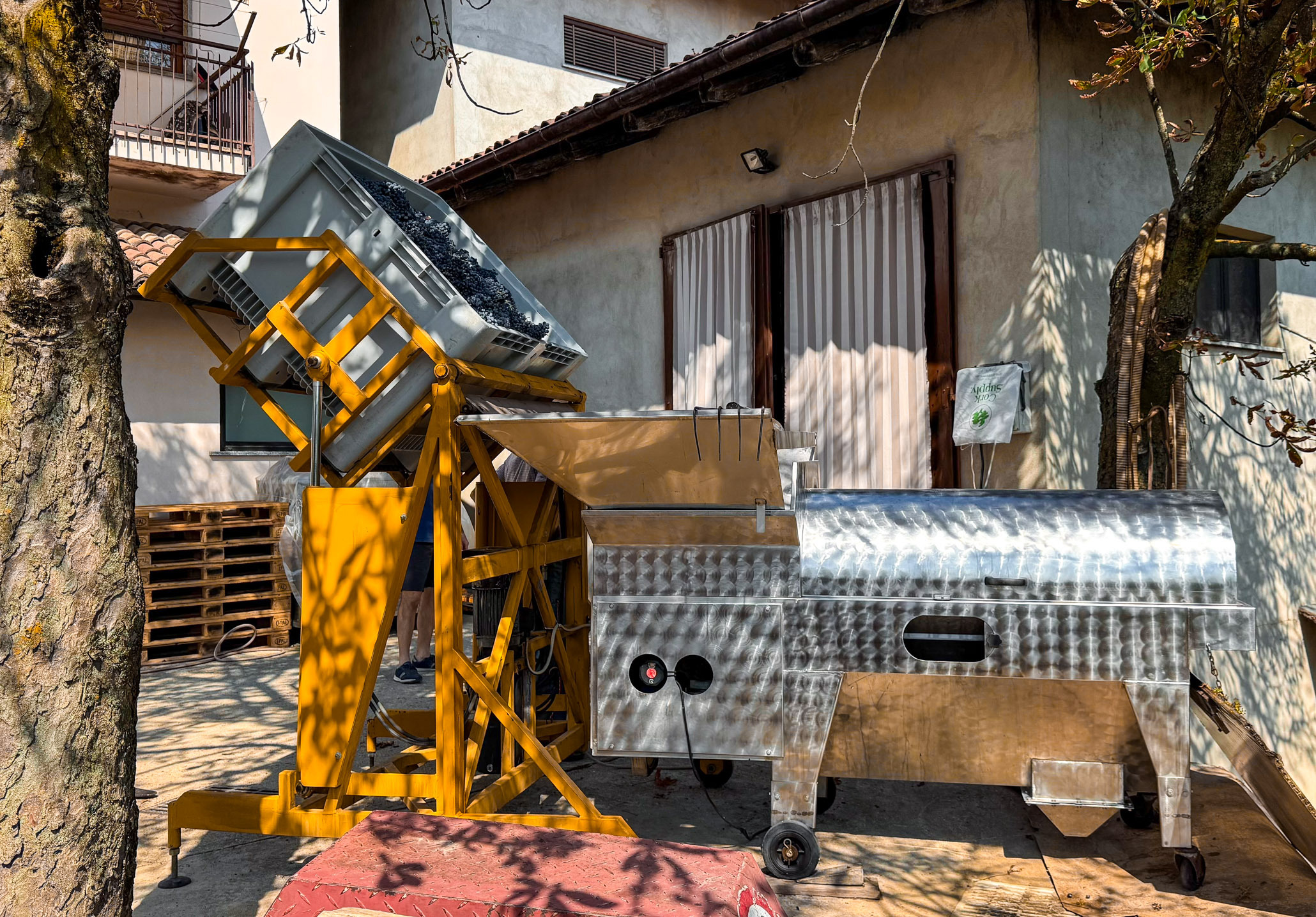
Harvest is a decidedly minimalist, no-frills affair at La Ca’ Nova.
The wines are all over the place stylistically. Some are quite good, but others are excessively light and fleeting. Most importantly, the 2023s do not present the angular contours or awkward green notes that were typical of similar vintages a generation ago. I suspect that is thanks to a combination of greater experience in the vineyard and a bit of good fortune. Most producers bottled their entire range of Barbarescos, although some skipped Riservas. Ca’ del Baio comes to mind — their 2023 Barbarescos are some of the finest wines I have tasted here and no doubt benefit from the greater focus of using all the best fruit for fewer bottlings.
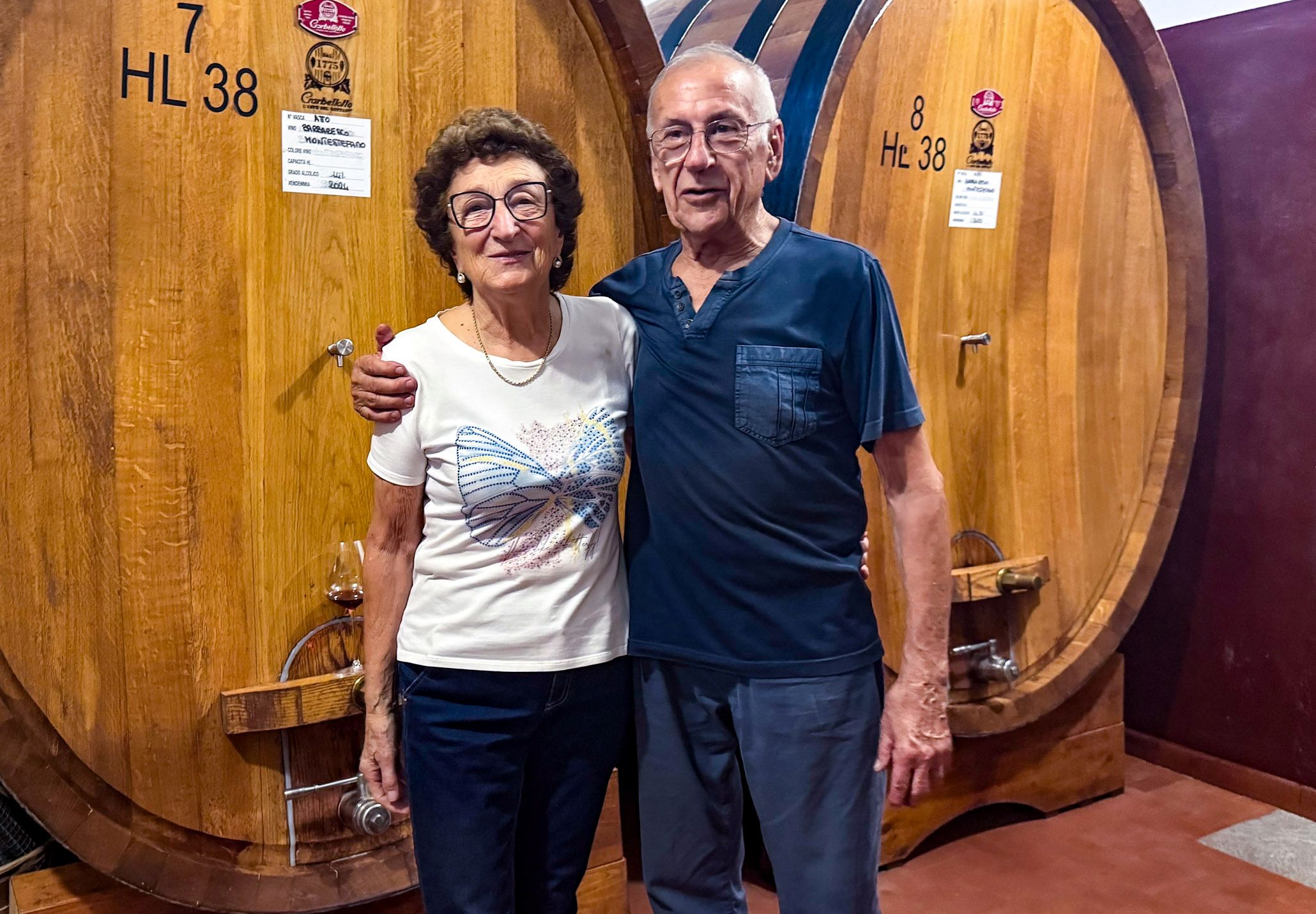
Maria and Teobaldo Rivella make a single Barbaresco from their holdings in the famed Montestefano cru in a decidedly old-school style.
A Deeper Dive on 2023: What Makes a Great Barbaresco Vintage?Over the last few years, I have shared a model for what I think makes a great vintage in Barolo and Barbaresco. It is, of course, the sum of everything I have learned from many people, organized in a way that I think makes sense. Unlike Bordeaux, Piedmont does not have an established framework for what constitutes a high-quality, important vintage. Clearly, many people have views, but I have never seen them codified. What follows is my set of necessary criteria for a Barolo or Barbaresco vintage to be considered truly great. This framework is inspired by the late Denis Dubourdieu and the model he developed for assessing Bordeaux vintages. To that, I add my 20-plus years of visiting Piedmont and all the data I have collected in speaking with winemakers, agronomists and other professionals over that time, plus drinking more than my fair share of the wines. As with Dubourdieu’s model, this addresses the growing season and does not venture into an assessment of the actual wines.
This model was created for the present. It won’t apply as well to vintages from previous eras, especially vintages from the 1950s-1970s. At that time, warm weather was considered quite favorable because grapes struggled to ripen. The warmest vineyards, those that faced due south, the famous sorìs, were the most coveted. Today, you would be hard-pressed to find a producer who believes that south-facing vineyards are ideal. Last but certainly not least, with its varying elevations, myriad exposures and different soil types, Piedmont is inherently complex and not intrinsically well suited to generalizations. Even so, some information is better than none.
- A Long Growing Season — A long growing season, defined as the period from budbreak to harvest, is essential for achieving full physiological ripening of the fruit, skins and seeds. Since Nebbiolo is already a very tannic grape, less-than-full physiological ripeness is heavily penalizing. Persistent rain in spring, frost, hail, elevated disease pressure and then intense heat throughout most of 2023 posed significant challenges. Light colors and lower-than-normal alcohols are telltale signs of a year in which full physiological ripeness was not achieved. Most estates harvested seven to ten days earlier than typical. Some producers reported late-ish harvests, but in those cases, timing was a response to delayed vine recovery following hail. The first condition is not met.
- Diurnal Shifts — The final phase of ripening must be accompanied by diurnal shifts, in other words, swings in temperature from warm days to cool nights. Diurnal shifts create aromatic complexity and ensure full development of tannins, flavor and color. Heat was a constant throughout the entire summer. Temperatures remained elevated throughout the end of August, when temperatures normally begin to subside. Some growers reported elevated temperatures into October. Diurnal shifts were not significant. The second condition is not met.
- The Absence of Shock Weather Events — Frost and hail can severely and irreparably damage the crop. Similarly, periods of uninterrupted heat can block maturation. The 2023 season was marked by a series of shock weather events that included frost, hail, prolonged rain and intense heat. The third condition is not met.
- Stable Weather During the Last Month — The last month of the growing season makes the quality of the vintage. Weather was much more stable towards the end of the season than in the first part of the year, even if temperatures were quite high. The fourth condition is partly met.
- A Late Harvest — Harvest must take place in October (possibly late September in some areas), with the final phase of ripening occurring during the shorter days of late September and October as opposed to the longer, hotter days of August. Harvest ranged widely from estate to estate. Some producers picked on the early side, while others waited for a multitude of reasons, highlighting the high irregularity of the year. The fifth condition is not met.
In conclusion, none of the conditions required for a good-to-great vintage were entirely met. Not surprisingly, quality is highly irregular.
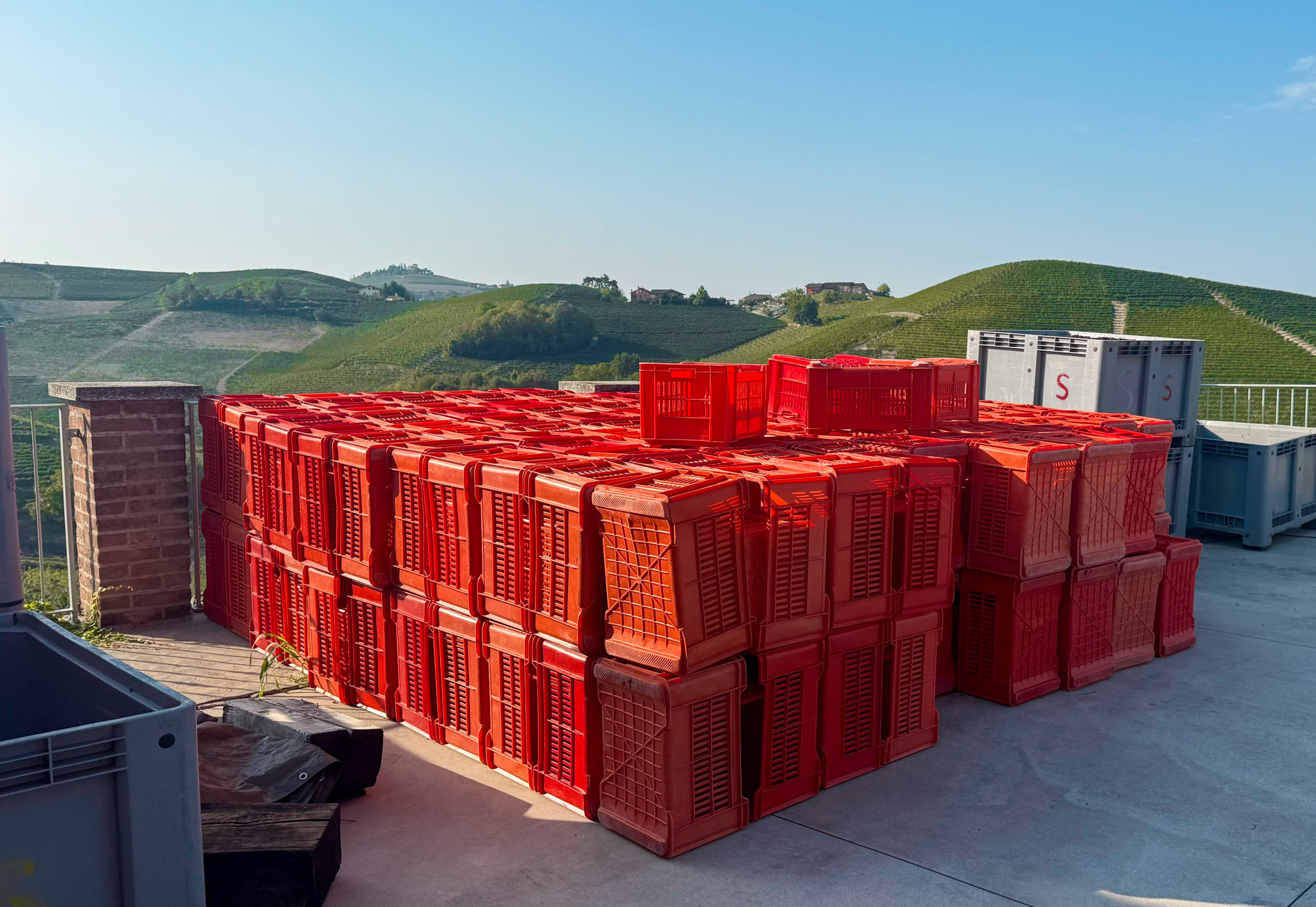
Bins out in preparation for harvest at La Spinona.
2024: Rain, Rain and More Rain
Rain during the critical weeks leading up to harvest and during harvest is the key signature that defines the 2024s. As a result, the wines are light, dilute and lacking in both complexity and character. Only a few producers bottled or plan to bottle all their single-vineyard Barbarescos. These include La Ca’ Nova. “The vintage is obviously lighter, but we aim to make all our wines every year,” proprietor Marco Rocca told me. Danilo and Bruno Nada also plan to release their single-vineyard Barbarescos. "It’s a vintage in which location was everything," Danilo Nada explained. "Even just a small shift towards south-facing exposures provided a bit more sunshine to help dry out the vines. Other sites were severely challenged."
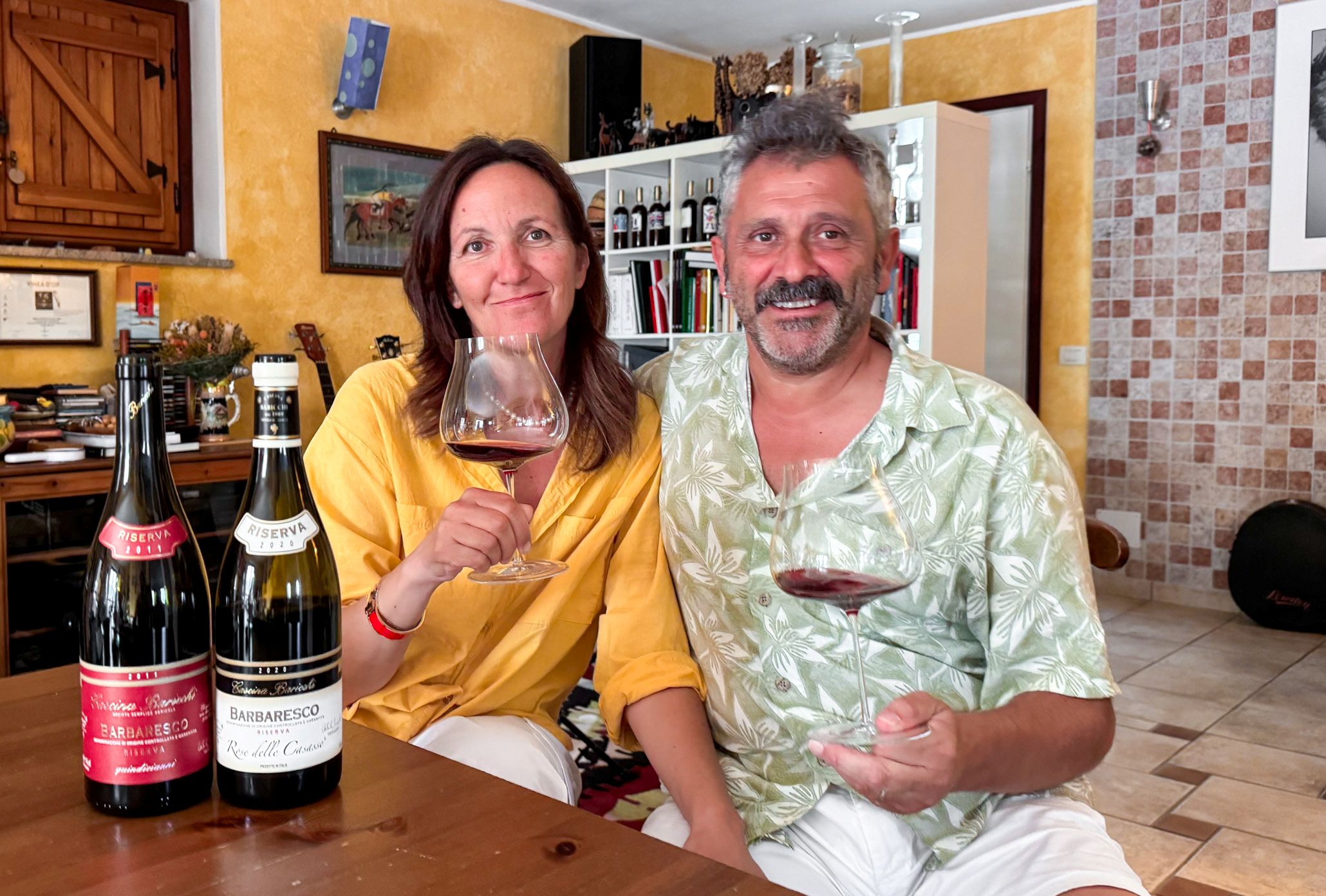
Francesca and Natale Simonetta make distinctive, age-worthy Barbarescos at their Cascina Baricchi estate.
Many estates, including Ca’ del Baio and Bruno Rocca, bottled a single blended Barbaresco. “I really do not like the idea of skipping vintages,” Francesco Rocca explained. Others declassified their lots into Langhe Nebbiolo. "It was a roller coaster year, up and down. You could see the skins were not suitable for making Barbaresco," said Andrea Sottimano. Yet another group of producers has not made final decisions on what they will bottle as of this writing. Marketers will no doubt tempt readers with the idea that declassified wines outperform. They don’t. Producers are not stupid. They know exactly what they had in the cellar. Based on what I have tasted, growers who bottled a single Barbaresco or a Langhe Nebbiolo made the right call. In some past vintages — 2002 comes to mind — some producers regretted not bottling their vineyard designates. Two thousand twenty-four won’t be one of those years. It’s simply a vintage in which late-season rain severely compromised the Nebbiolo harvest. That’s all there is to it.
That said, I was very pleasantly surprised by the 2024 Barberas. The timing of the harvest was more favorable, and therefore the wines are quite good. To be sure, it’s a year in which Barberas are often a bit more savory and less fruit-driven than the norm. Still, overall quality is solid, and frankly better than I expected. I tasted many 2024 Barberas I would be delighted to drink any day of the week.
2025: The Light at the End of the Tunnel
After three very challenging years, growers breathed a sigh of relief as the 2025 growing season unfolded. It’s a year marked by benign conditions and no shock events, although some producers reported poor set and correspondingly shy yields. The first 2025s I have tasted — mostly Dolcettos, Langhe Nebbiolos, Barberas and a few Barbarescos — point to a strong and potentially outstanding vintage. The wines offer joyous, forward fruit purity and energy. It is very likely to be the best vintage since 2021. Two thousand twenty-five is certainly a superb vintage for younger readers who are just starting to explore Piedmont, as well as more seasoned consumers who want to enjoy delicious, artisan wines that won’t break the bank or require much advance planning to simply open and enjoy.
Roero: Here’s Looking at You
Once again, I include reviews from a handful of producers in Roero, a small district just across the Tanaro River from Barbaresco. I continue to be impressed with the new generation of producers, the best of whom are making terroir-driven wines of great character. I have written quite a bit about Roero in previous articles. I still believe the region lacks the critical mass of top estates to merit a separate report, but that may soon change. Roero has all the potential to be the hottest region in Piedmont for the younger generation of wine lovers, sommeliers and trade professionals who have yet to discover the region’s wines.
About This Report
I tasted most of the wines in this article during the ten days I spent in Barbaresco in September 2026, with a few wines tasted in our New York City offices in the weeks that followed.
© 2026, Vinous. No portion of this article may be copied, shared or redistributed without prior consent from Vinous. Doing so is not only a violation of our copyright but also threatens the survival of independent wine criticism.
You Might Also Enjoy
2022 & 2023 Barbaresco: Pushed to the Limit, Antonio Galloni, October 2025
Barbaresco: The Stellar 2021s & Surprising 2022s, Antonio Galloni, October 2024
Barbaresco’s Soaring 2020s & 2021s, Antonio Galloni, October 2023
Focus on Barbaresco – A Close Look at 2019 & 2020, Antonio Galloni, October 2022
2018 & 2019 Barbaresco Take Center Stage, Antonio Galloni, February 2022
Show all the wines (sorted by score)
- Adriano Marco e Vittorio
- Albino Rocca
- Bruno Rocca
- Ca' del Baio
- Cantina del Pino
- Carlo Giacosa
- Ca' Rome'
- Cascina Baricchi
- Cascina delle Rose
- Cascina Luisin
- Cascina Morassino
- Cascina Val del Prete
- Cascina Vano
- Castello di Neive
- Cecilia Monte
- Cocito
- De Forville
- Fiorenzo Nada
- F.lli Cigliuti
- F.lli Giacosa
- Francesco Versio
- Gabriele Cordero
- Gaja
- Giorgio Pelissero
- Giovanni Almondo
- Giuseppe Cortese
- Innav
- Inprimis
- La Ca' Nova
- La Ganghija
- La Spinetta
- La Spinona
- Lodali
- Malvirà
- Manuel Marinacci
- Marchesi di Grésy
- Marco Pezzuto
- Matteo Correggia
- Michele Chiarlo
- Moccagatta
- Paitin
- Piero Busso
- Poderi Colla
- Priolo
- Produttori del Barbaresco
- Prunotto
- Rizzi
- Roagna
- Rosavica Benotti
- Scarpa
- Serafino Rivella
- Socré
- Sottimano
- Valfaccenda
- Vite Colte