
Browse using the new Vinous website now. Launch →
Printed by, and for the sole use of . All rights reserved © 2015 Vinous Media
Ferrando: The Essence of Carema
BY ANTONIO GALLONI | MARCH 26, 2026
Nebbiolo is such a beguiling, complex, mysteriously beautiful grape. In Carema’s best sites, the indigenous biotype of Nebbiolo known as Picotendro yields wines like no other—aromatic, structured reds that capture the essence of place and vintage. The Ferrando family has turned out compelling wines here since the 1960s, wines that define what Carema is all about. Two recent vertical tastings provided an incredible opportunity to survey Ferrando’s wines all the way back to 1964, prior to the creation of the Carema DOC.
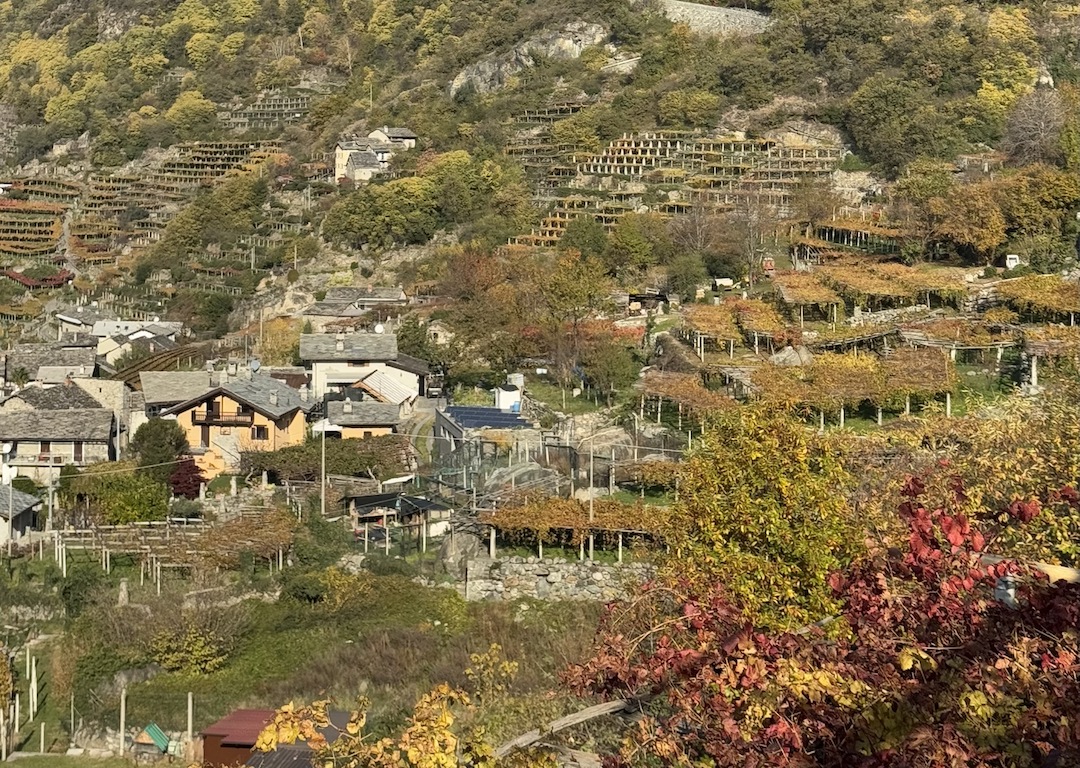
Small, terraced vineyards are one of the key distinctive features of viticulture in Carema.
Carema: Small but Beautiful
With its striking terraces and dramatic, steep hillsides, Carema is one of Italy’s most evocative appellations. After many years of decline, this tiny region nestled at the foothills of the Alps in Northern Piedmont is undergoing a renaissance of sorts. At one point, Carema encompassed well over 100 hectares under vine. The combined effects of phylloxera with the extreme demands of farming vineyards entirely by hand led to a sharp decline in plantings. By the time Carema became a DOC in 1967, there were only 42 hectares under vine. That gradual decline continued for decades. At one point, there were only 13 or 14 hectares planted. Carema faced irrelevance, extinction or both. In recent years, a new, younger generation of growers has slowly undertaken the task of reclaiming abandoned vineyards and clearing forests that had overtaken the vines.
Today, Carema encompasses approximately 22 hectares under vine, divided into 43 mini-crus, or terraces, all tiny holdings owned by as many as 100 families and their offshoots. It does not take a mathematics expert to understand that the average holding per owner is a fraction of a hectare. The Cantina Produttori Nebbiolo di Carema, the local cooperative, controls 15 of those hectares; the rest are divided among ten or so tiny grower estates. Nebbiolo is known here as Picotendro because of the naturally small size of the bunches, which are also described as being “tender.”
The casual visitor surveying the landscape will take in panoramic views framed by mountains planted with tiny parcels on rocky terraces that gradually lead down to the valley floor, a quaint town center, and a mix of residential buildings and more small vineyards. Most of Carema’s rocky terraced sites were built by seasonal workers who arrived from nearby mines in the Swiss Valle d’Aosta in winter, when the mines shut down. They traded room and board for the painstaking manual work required to build these dramatic sites. Getting around the vineyards today requires quite a bit of physical fitness and the ability to navigate steep, rocky staircases that connect parcels that are literally carved into the hillsides. The term “heroic viticulture,” often used here, is highly appropriate.
Vineyards in this remote corner of Piedmont date back to a time when families farmed grapes to make wine for personal consumption. Land was scarce, so every centimeter counted. Vines were (and still are) farmed with pergola training, a system that freed up surface area for the cultivation of other crops. Most families had access to forest land, where they were able to source chestnut wood for the traditional posts used to train vines. Nebbiolo was the main variety, but other local grapes were also present, sometimes used to bolster production during a time when volume was the main objective.
Unfortunately, farming here has become prohibitively expensive. Many abandoned vineyards are so remote and require so much manual labor to restore that they will almost certainly never be replanted, which means Carema is unlikely to return to the 42 hectares that existed when the DOC was created. In previous generations, most of the vineyard work was borne by owners and families using their own natural resources (such as wood for posts), which hid the true cost of labor and raw materials. When these expenses are properly accounted for, the true costs of farming vineyards in Carema are exceptionally high.
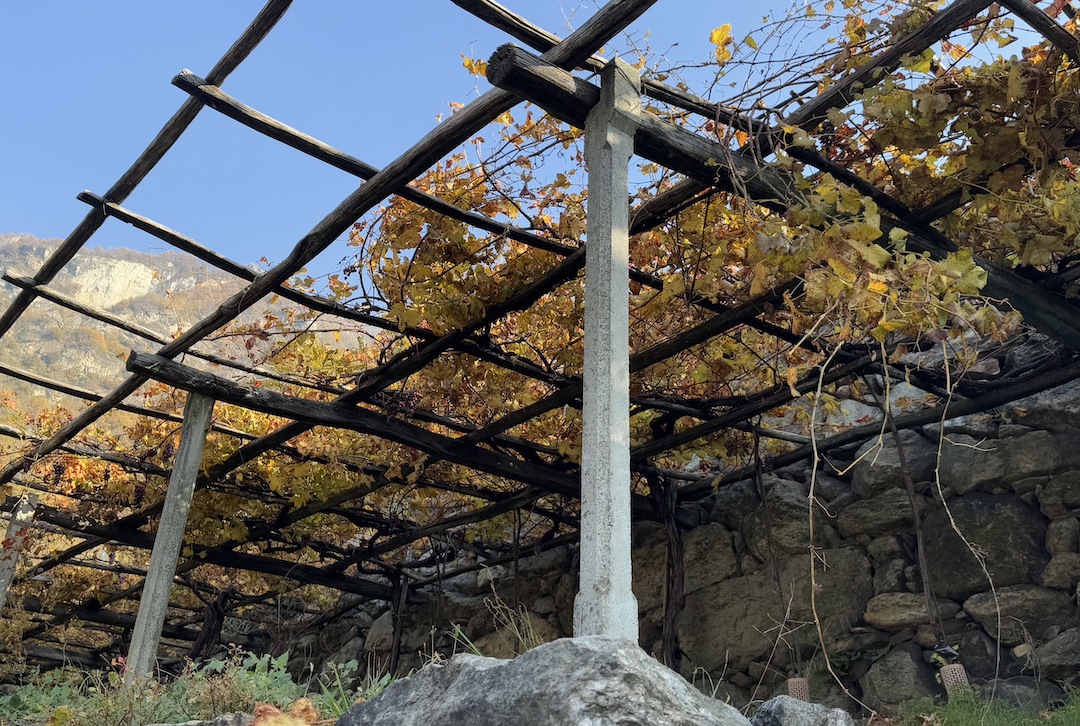
Pergola-trained vineyards were originally developed to maximize the use of land for both the cultivation of grapes and other crops.
Delving into History…
Ferrando is Carema’s standard-bearer, the reference-point producer in a region where there are only about a dozen or so wineries to start with. The Ferrandos were merchants based in Valle Bormida, in Piedmont’s Alessandria province. In 1890, patriarch Giuseppe Ferrando moved the family to Ivrea, which he chose because of its strategic position between Piedmont and Valle d’Aosta. Ferrando bought wine in cask from producers in Piedmont’s Asti region and then sold it to trattorias and restaurants in bustling Valle d’Aosta. These were very different times. Wines were transported in cask on horse-drawn carriages and racked directly into demijohn at the customer’s location. A trip that today might take a few hours at most took days.
Son Luigi Ferrando expanded the family’s business by entering production. His son, Giuseppe, released the family’s first wines from Carema with the 1957 vintage. For the first three years, Ferrando purchased finished, bottled wines from other growers and sold them with their own label. Quality was naturally quite variable. Wanting to make better wines, the Ferrandos began producing their own Carema in 1960, using mostly purchased fruit. In 1964, the family built a cellar and production facility that is still in use today. Roberto Ferrando, the fifth generation, joined in 1995. His time at the helm coincided with many stellar vintages, but also a general decline in plantings in Carema that has only recently changed course. Like many small, family-owned wineries, Ferrando reached an inflection point. The winery needed investment, but Roberto’s sons and his brother’s family were more interested in pursuing other opportunities. The Ferrandos eventually sold the winery to Neal Rosenthal, their long-time American importer, in 2023.
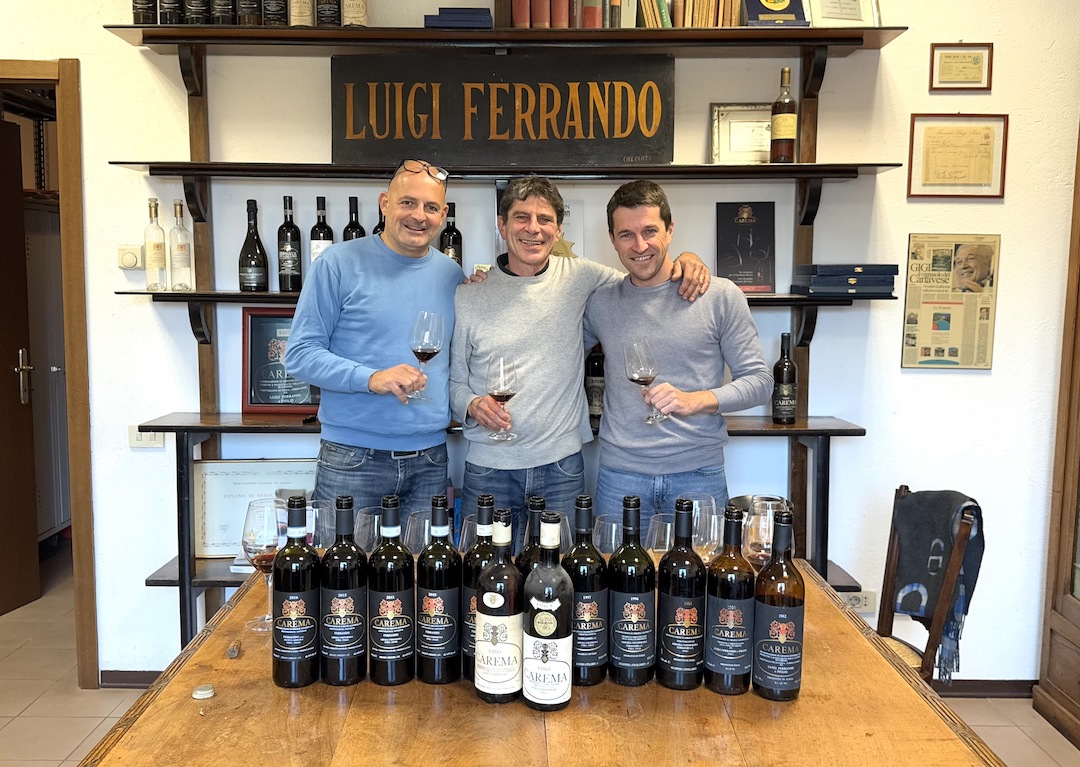
Roberto Ferrando (center) flanked by new winemaker Vittorio Garda (right) and Simone Pozzo, Rosenthal’s right-hand man in Italy (left).
A New Chapter Opens
Neal Rosenthal might seem like an unusual steward for an iconic family estate in Northern Piedmont, but he is a longtime champion of Carema and one of the most pivotal figures in the American wine industry over the last 50 years. Along with contemporaries such as Kermit Lynch, Robert Chadderdon, Leonardo LoCascio, Philip di Belardino and others, Rosenthal introduced American consumers to fine European wines just as the baby boomer generation started to discover wine in the 1980s. To be sure, figures like Alexis Lichine and Frank Schoonmaker paved the way, but the importers who were active starting in the 1980s had the benefit of a new generation of young consumers who were just getting into wine and who were eager to learn.
It's safe to say no one has done more to promote Carema in the United States than Neal Rosenthal. Today, Carema and Alto Piemonte are all the rage. That’s a very recent development. When I started writing about these wines 20 years ago, interest was minimal. It’s a very different story these days. Throughout the 1980s and the decades that followed, hectares under vine in Carema declined precipitously because the land was just too difficult for the intense manual work required to farm these sites. In the meantime, Rosenthal purchased 75-80% of Ferrando’s production for his clients in the United States, also cobbling together five tiny parcels to form one hectare of estate vineyards to ensure Ferrando had continuity of access to top sites.
Neal Rosenthal’s life in wine happened by chance. Rosenthal earned a law degree at Columbia University and became a successful international tax attorney, but he gradually became disenchanted with practicing law. His parents operated a drugstore and lunch counter in New York’s Upper East Side. Over time, that business had become hard to manage, and the family transitioned their activity to selling wine and liquor. Rosenthal’s parents knew very little about wine, so he began to advise them, ultimately opening the door to a new career. Rosenthal eventually bought the liquor store from his parents. In 1980, Rosenthal opened an importing business. He started with three wineries: De Forville, Voyat and Ferrando. He has since built a highly successful company representing artisan wineries throughout Europe. When the Ferrando family decided to sell, Rosenthal was the natural buyer.
Rosenthal has not wasted much time. He brought in winemaker Vittorio Garda, one of Carema’s emerging superstar producers, with the 2026 vintage. Garda has made waves with his Sorpasso wines. It will be fascinating to see what he does at Ferrando. Rosenthal plans to keep the Etichetta Bianca and Etichetta Nera, but also shared that he is looking at bringing back some of the single-terrace bottlings. The old, dilapidated winery is also set for a much-needed major renovation. As good as these wines can be, some vintages display an element of rusticity that I expect the new team will address in short order.
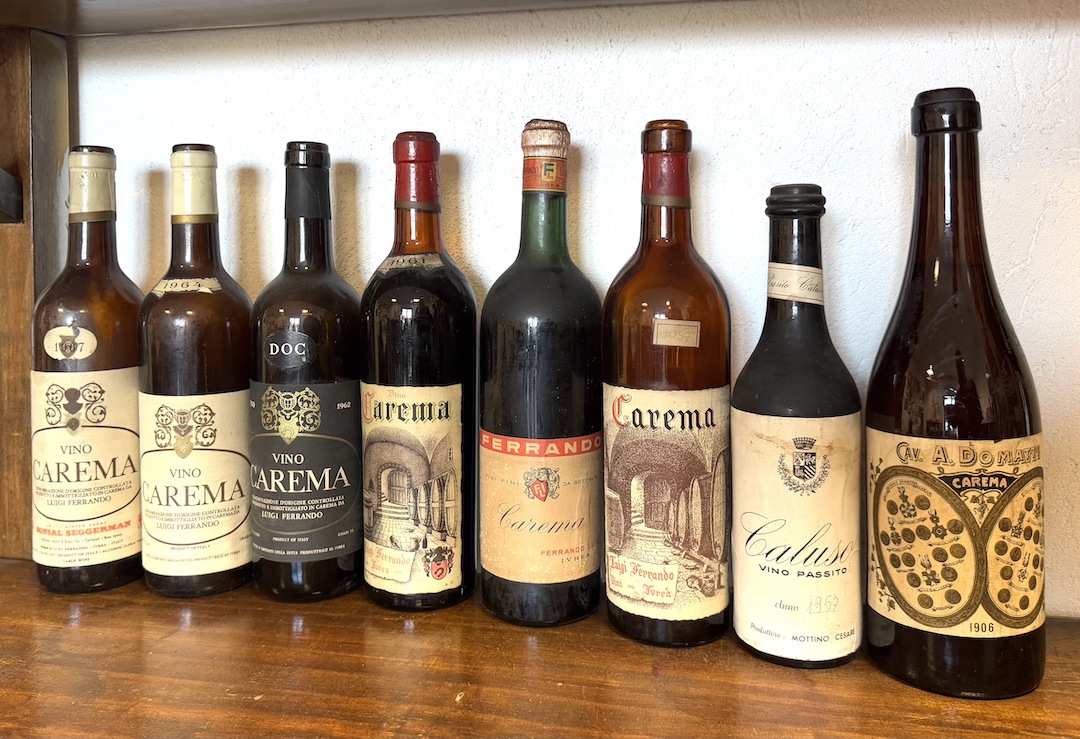
A collection of older, long-emptied bottles that chronicle Ferrando’s rich history.
Vineyards and Wines
Ferrando currently sources fruit from five hectares of estate vineyards (three in Caluso and two in Carema) and several non-estate sites. Total production is 40,000-45,000 bottles. All the wines are notable, but the two Caremas are the flagships. While regulations specify that Carema must contain a minimum of 85% Nebbiolo and 15% other local varieties, the Ferrando Caremas are 100% Nebbiolo. Both wines spend 15-20 days on the skins. Malolactic fermentation takes place naturally the following spring, after which the wines are racked into oak. The wines spend 30-36 months in wood, depending on the vintage, quite a bit more than required by regulations (12 months for Carema, 24 months for Carema Riserva).
The Carema Etichetta Bianca (White Label) is a blend taken from parcels around the appellation, with a core of sites in cooler, northern-facing microclimates and soils rich in clay and organic matter. These sites yield perfumed, lithe wines that respond so well to aging in larger-format wood ranging from 500L barrels to 20HL casks. Although the Etichetta Bianca is the lighter of the two Caremas, it is a relatively rich, weighty wine, especially compared to the style many growers are pursuing today. This is likely a combination of the focus on Nebbiolo and the longer aging relative to most Caremas.
Ferrando bottled their first Etichetta Nera (Black Label) in 1962. In those days, the Etichetta Nera was conceived more like a Riserva in that it was only released in the very best years. It was a very different time. Much younger vineyards, a cool microclimate and the tendency to farm for production more than for quality meant that the conditions required to make an Etichetta Nera only presented themselves every few years. When the DOC was created in 1967, wines were required to spend five years in barrel, which they surely needed to tame acid and tannin.
In the 1960s and 1970s, Ferrando also released small bottlings of single-vineyard Caremas from Siei and Sillanc terraces (both from purchased fruit), and Laurei, which was an estate wine. The first French oak barrels arrived in the 1980s, a decision driven by the dual desires to make more contemporary wines and as a means for dealing with the practical requirements of aging smaller volumes.
Today, the Etichetta Nera is made from parcels in Carema’s northern sector that are south-facing and therefore naturally warmer and drier. The Laurei terrace, one of the best-known sites in the appellation, has long been the core site. The Etichetta Nera is aged in neutral French oak barrels. Not surprisingly, it is quite a bit more powerful than the Etichetta Bianca, but I often prefer the Bianca, as I find it more transparent and typical of the lithe, svelte style that is such a signature of Carema. Simply, I view the two wines as different expressions of Carema, as opposed to one being better or more important.
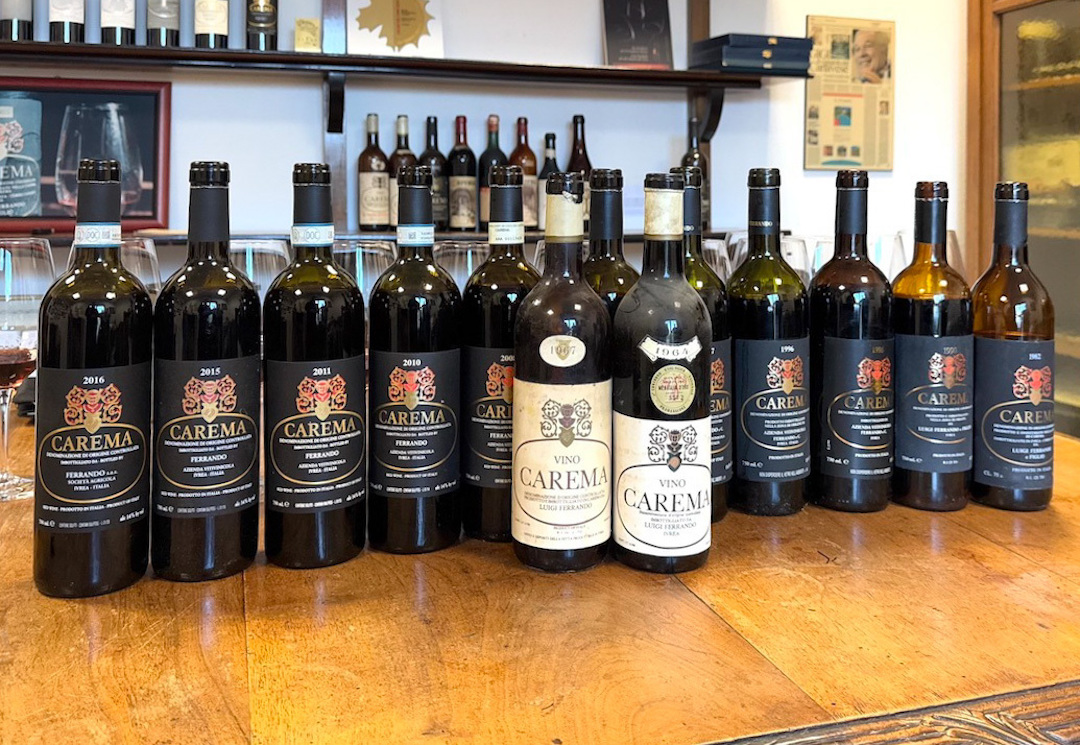
This remarkable flight concluded with the 1967 Carema Etichetta Bianca, from the first vintage in which Carema was a DOC, and the 1964, which pre-dates the creation of the appellation.
Readers who want to explore Carema would do well to start with Ferrando. The wines should be treated like Barolo, Barbaresco and fine Alto Piemonte reds in that they benefit from being served on the cooler side. I prefer to open bottles an hour or so in advance, which helps with integration of aromatics, fruit and tannin, but I prefer not to decant (older vintages excepted), as following the journey these wines take in the glass over the course of a meal is a large part of what Carema (and other top-flight Nebbiolo) has to offer.
I tasted all the wines in this report between August and November 2025.
© 2026, Vinous. No portion of this article may be copied, shared or redistributed without prior consent from Vinous. Doing so is not only a violation of our copyright but also threatens the survival of independent wine criticism.
You Might Also Enjoy
The Fantastic Four: Alto Piemonte, Canavese, Valtellina & Valle d’Aosta, Antonio Galloni, February 2026
Alpine Soul: Exploring Alto Piemonte & Canavese, Antonio Galloni, February 2025
Alto Piemonte: Small Is Beautiful, Antonio Galloni, February 2024
Nebbiolo Shines in Alto Piemonte, Carema & Valtellina, Antonio Galloni, June 2023
Alto Piemonte, Valtellina & Points North, Antonio Galloni, March 2022