
Browse using the new Vinous website now. Launch →
Printed by, and for the sole use of . All rights reserved © 2015 Vinous Media
Remembering Michel Rolland
BY NEAL MARTIN | MARCH 20, 2026
Michel Rolland lived life at 100 miles per hour. He slowed down in his mid-seventies to about 97 miles per hour.
Rolland often mentioned that he needed to take his foot off the accelerator. The problem was that he loved life too much, whether that was his family or his countless friends; whether it was his beloved Pomerol, Bordeaux or the joy of travelling the world; building his laboratory in Catusseau, enjoying fine cuisine, hunting or golf, and of course, what all those things orbited around…wine. His sudden passing from a heart attack came out of the blue. Perhaps we naively think that bons vivants are immortal, and therefore it becomes inconceivable that one day they are no longer here.
Michel Rolland was born in Libourne, France, on Christmas Eve 1947, his favourite vintage of all time. He was the younger of two sons in a family that owned a scattering of parcels in Pomerol, Saint-Émilion and Lalande-de-Pomerol. Rolland once told me that as a young boy, he never thought about becoming a winemaker. Nevertheless, he was expected to join the family business and spent summer holidays on a tractor. He joined the oenological faculty at La Tour Blanche in Sauternes, and he became one of five students accepted at the Bordeaux Oenology Institute at the University of Bordeaux, where he studied under legendary professors Émile Peynaud and Pascal Ribereau-Gayon. During his studies, Rolland met and fell in love with a fellow student; he married Dany Rolland in 1970. Three years later, a serendipitous meeting with the owners of a laboratory at a car rally led to the couple buying shares in the business and eventually buying it outright. They became acquainted with local winemakers, offering prognoses and remedies for “misbehaving” wines, Rolland regularly visiting vineyards and accreting first-hand knowledge. After his father’s untimely passing in 1979, the running of Le Bon Pasteur suddenly landed on Rolland’s lap, and he set about improving the quality of its wine. The 1982 was his first great success.
In 1983, during primeur for the epochal ’82 vintage, he met an up-and-coming wine critic, Robert Parker, born the same year. Rolland said that they instantly became “mutual admirers.” Their relationship went on to be extraordinarily influential in terms of modernising Bordeaux wine, though Rolland’s burgeoning reputation meant that he began to receive requests from overseas producers. He began consulting in the United States in 1986 and was soon tagged a “flying winemaker.” Over his career, he built up a roster of 150 properties where he was directly involved, far more if you take into account his growing team. “Rolland” became a byword for quality, especially in the all-important US market. Some winemakers and consumers protested that his wines tended to be picked too late, or were too alcoholic, or had too much oak. When I questioned him about those causes célèbres, Rolland smiled and replied, “It is better to over-hit rather than under-hit a golf ball, because you should at least make sure it reaches the hole.” It was an exquisite analogy that explained his rationale.
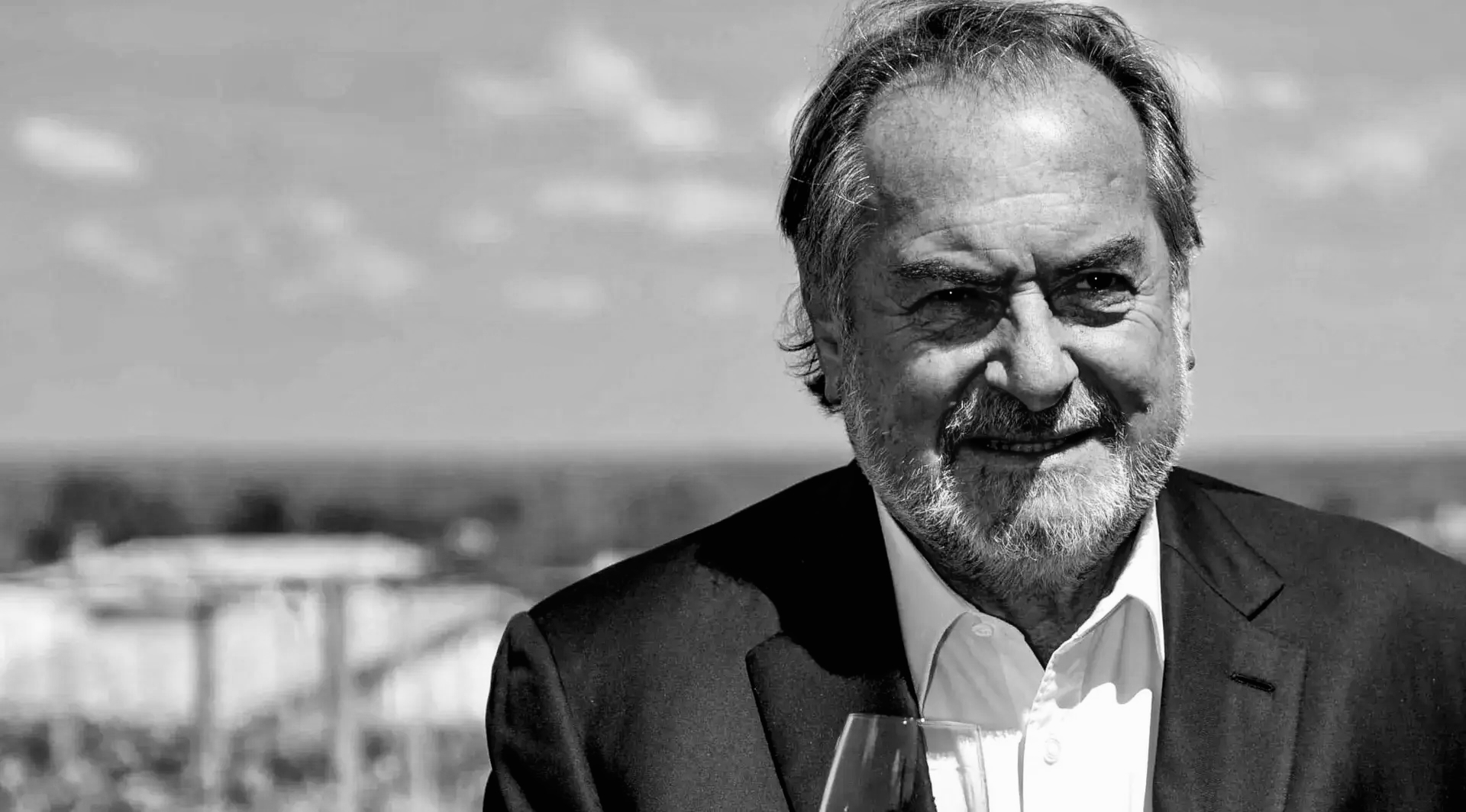
The first time I met Michel Rolland was in London around the late nineties, not for a Bordeaux wine, but for the launch of his Argentinean project, Clos de los Siete. Just a flash of his smile and I could see how the most ardent critic would fall for his charm. Rolland was an exceptionally kind person. He was incredibly supportive during the writing of my Pomerol tome. He was serious about his work but was endlessly entertaining and funny. He never lost his boyish humour or curiosity. As tastes moved away from the tropes associated with Rolland, he shrugged off the criticism. It was part of the job. Yet he had the nous to appoint protégés with different takes on wine and eventually sold the business to them. Whenever we shared lunch together, he would often pour a wine blind, one that I had castigated in a recent report. Eventually, as for the umpteenth time, he asked what I thought about our lunchtime wine. I replied, “…one that I probably gave 83 points.” He burst out laughing.
Michel Rolland’s passing feels like the closing of a chapter. Irrespective of whether you agree with his tenets or not, no one can dispute that he was instrumental in improving the quality of wine, that he was a naturally gifted blender or that he was a fun person to find at your dinner table. Rewatching Mondovino, a documentary that many felt marred his image, I noticed that among all the interviewees, Michel was the one who exuded passion, who was enjoying life the most. He was the one laughing and smiling. That is how I will remember him.
© 2026, Vinous. No portion of this article may be copied, shared or redistributed without prior consent from Vinous. Doing so is not only a violation of our copyright but also threatens the survival of independent wine criticism.