
Browse using the new Vinous website now. Launch →
Printed by, and for the sole use of . All rights reserved © 2015 Vinous Media
Keeping Everyone Happy: Southwold Bordeaux 2022
BY NEAL MARTIN | MARCH 19, 2026
The annual Southwold tasting is the highlight of every January…apart from Epiphany…and my eldest’s birthday.
Southwold is the third-best event in that most miserable of months.
Though I have attended it since 2007, its roots stretch back to the mid-1970s, when the tasting was inaugurated by the late Clive Coates. A raft of luminaries have sat around this table to proffer their thoughts over the years, journalists only allowed once Coates retired.
This unique blind tasting is the only peer-group assessment of top Bordeaux wines deprived of status or context, bar their appellation. Winemakers and critics leave egos at the door—it is up to the wine alone to prove its mettle. In this era of endemic score inflation, self-proclaimed greatness and questionable impartiality, blind tastings like Southwold should be mandatory for every wine region and professional critic.
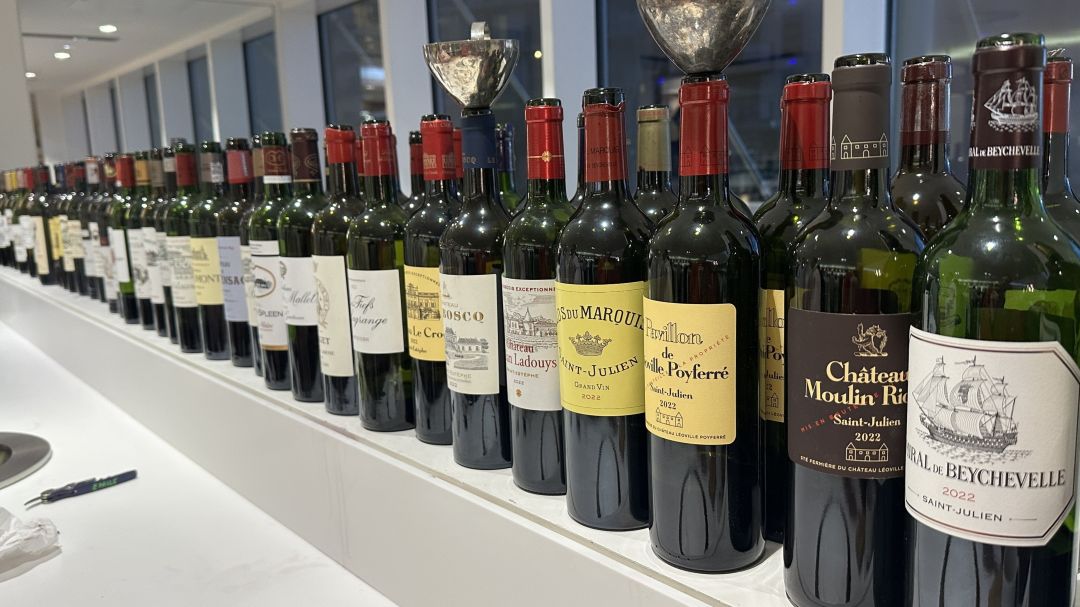
Following the passing of Bill Blatch last February, Southwold’s future cannot be guaranteed. He was solely responsible for gathering samples, sending feedback to châteaux and most importantly, placating bruised egos when necessary. His unique position of independence and respect accrued over decades meant that his shoes will be impossible to fill. I sincerely hope it does not spell the end of this vital tasting. It would constitute a loss for readers, the châteaux and myself. It serves as a rigorous test of my own palate. I learn an immense amount from analysing not only my own judgements, but those of fellow participants. I’ll keep my fingers and toes crossed that we can work out the logistics and maintain support from the châteaux. Practically every winemaker seemed crestfallen at the prospect that Southwold might not continue. There are a tiny handful who steadfastly refuse to participate, which is completely their prerogative, though none have been First Growths that arguably have the most to lose.
For now, let us shine a light on the 2022 vintage, which has been lavished with praise. It is seen as the epitome of a solar vintage that managed to find an equilibrium between fruit concentration, alcohol, acidity and purity. First, a reminder of the growing season.
The Growing Season
As usual, I have reproduced the growing season summary that I composed for my en primeur report, in a slightly abridged form. I described 2022 as a “season of paradox and luminosity.”
The 2022 vintage saw a return to the warm, dry summers that headlined the 2018, 2019 and 2020 trio. The 2021 growing season experienced higher-than-average rainfall that replenished reserves, not least in porous clay soils. Low rainfall in the first three months of 2022 led to an uneven, slightly delayed budbreak in late March, before temperatures plummeted between April 2 and 5, as low as -7°C in some prone areas. Frost affected some 50% of vineyards, though the damage was less severe than in 2017 since bud development was less advanced. April saw just 58 mm of rain, compared to 104 mm and 111 mm in 2019 and 2020, respectively. Flowering was around two weeks earlier than in 2021, without coulure or millerandage, so there were hopes for a bumper crop. One long, balmy dry spell followed three or four mini-heatwaves, the first of which ran from May 8 to 22. Between May 7 and September 23, the average temperatures was 24°C, with 38 days exceeding 32°C. There was some rain on the weekend of June 18, after a period of intense heat when the mercury tipped to 40°C. On Monday, June 20, two bands of destructive hail strafed the northern Médoc in a southwest/northeast direction. Another battered the far southern Médoc between Côte du Bourg and Fronsac/Lalande-de-Pomerol.
Rain varied per region in June: 140 mm in Saint-Estèphe, 134 mm in Pauillac, 82 mm in Margaux, 72 mm in the Graves and 69 mm in Saint-Émilion. Then, Mother Nature turned off the tap. July saw a measly 3 mm of rain (zero in some locales), less than in 2016 and 2020. Warm and dry conditions set in unusually early in the season, steeling vines for the forthcoming drought by forcing roots deeper, restricting lateral shoot growth and limiting the size of both leaf and berry, the latter of which informed the 2022s’ style. Unlike in 2003, vines mostly shrugged off these unprecedented conditions. Some fledgling vines on free-draining soils suffered, whilst some producers insisted that they did not spot a single brown leaf. Still, hydric stress was evident, with self-protecting vines closing stomata to prevent the evaporation that stymies photosynthesis and bifurcates phenolic and alcoholic ripeness. The INAO allowed growers in Pomerol to irrigate, and some mounted tractors to quench vines’ thirst. However, it was too late to make a significant difference. Oddly enough, there was more rain in August 2022 than the previous year, with a revivifying 27 mm compared to 24 mm.
May, June, July and August were the hottest since 2009, averaging 18.7°C, 21.0°C, 23.4°C and 24.1°C, respectively. In particular, July was 1.8°C hotter than in 2020, and August was 2.3°C hotter. Despite these figures, the viticultural vista is very different from that of 2003. Now, winemakers practice minimal de-leafing (or de-leafing on one side) to maintain shadow cover; prudent canopy management, with many (including First Growths such as Haut-Brion) no longer practicing rognage (hedging); and lastly, widespread and assiduous use of cover crops to enhance humidity and replace depleted nitrogen/organic matter in soils. Unlike in 2003, nighttime temperatures fell to 16-17°C, giving vines welcome relief from the heat. Vines with subterranean reserves of water could continue photosynthesis, but vineyard managers had to be vigilant amidst such unrelenting luminosity, constantly regulating sugar accumulation and preventing the vines from shutting down. Many proprietors muttered about the tiny crop whenever I raised the topic, the drought chipping away at their hopes for high yields at flowering. The region produced 410,000 hectoliters of wine with an average yield of around 37 hL/ha. That is around 15% less than the 2011-2020 average of 487,000 hL. Yields differ between the Left and Right Banks, with the Left often averaging 30 hL/ha or less but the Right delivering 40-50 hL/ha.
Down in Sauternes, the heatwaves that started in May concentrated berries and reduced volume. There were hailstorms and frost on April 2 and 3, setting the tone for a smaller crop. May was the driest and hottest month ever. Flowering was early, and chefs de culture were concerned that any rain would create overripe berries. Workers in Sauternes conducted some nettoyage in September, when there was some sporadic early botrytis. A little rain followed the hot weather at the end of September, which predicated botrytis formation in October, but winemakers had to wait for berries to progress from the rôti stage. Finally, thanks to the easterly wind, there was widespread botrytis around October 23-24. Sugar levels galloped ahead as pickers streamed into vineyards. Time was of the essence, since many feared the levels would become excessive. Indeed, at Yquem, the team did not use fruit from the final two tries. Hence, the 2022 Sauternes contain higher residual sugar than recent years, with slightly higher pH levels. Yields average around 15 hL/ha for the appellation.
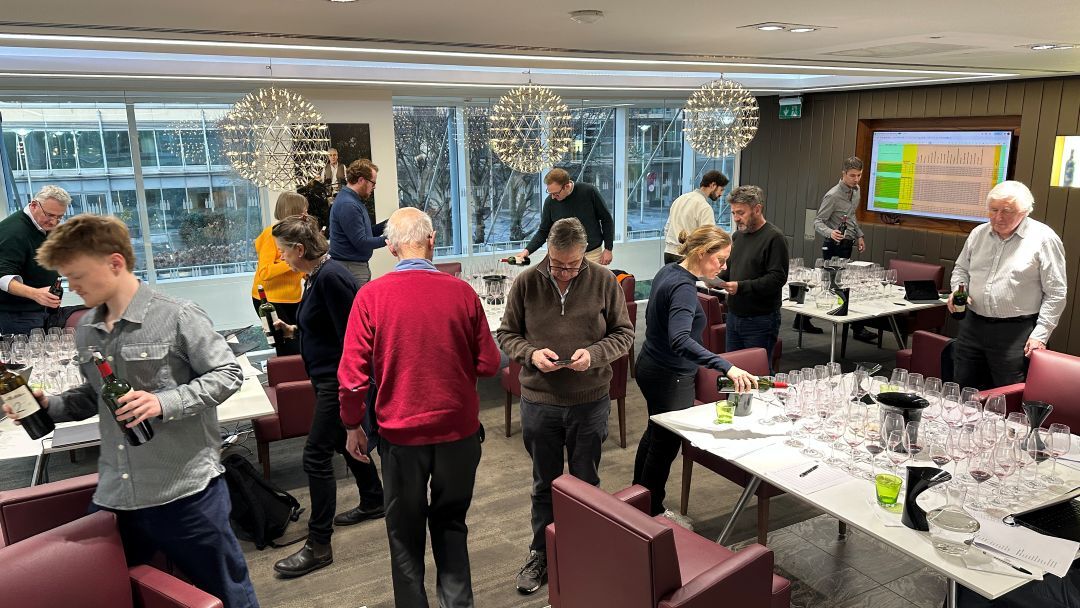
The room abuzz as the flights are set.
How
The Wines Were Tasted
The Southwold tasting followed the same format as usual, with a series of peer-group flights broadly organised by appellation. We began with the dry whites and Sauternes on the first day, yours truly hotfooting it directly from Bern’s Steakhouse in Florida. The second day was dedicated to the Right Bank and inroads on the Left, with the latter completed on the third day. Identities were revealed after scoresheets had been handed in and entered onto a spreadsheet, privy to attendees only.
I anticipated a taxing tasting. It is far easier to taste through vintages with less fruit, lighter tannins and higher acidities than those with concentrated fruit and plenty of structure. I avoid both Bordeaux and Burgundy 2022s whenever I see them listed prematurely in restaurants, because the wines simply need time. Therefore, assessing a number of them will inevitably push you physically and mentally. To make things more difficult, there was some miserable weather, and atmospheric pressure does affect wines by exaggerating tannins and compressing fruit. Thirdly, these are powerful wines with relatively high alcohol levels. As I have explained previously, vintages like these tend to show greater bottle variation than lighter years, and that played out as expected at this year’s Southwold.
It was no surprise to find some deviance from last year’s in-bottle report—in some cases, markedly so. This is particularly true for the slightly underwhelming flight from the normally dependable Saint-Julien. As a consequence, I redacted notes that bore little correlation to either primeur or post-bottling reviews, where I deemed the bottle unrepresentative or, God forbid, I misread the wine. Irrespective of quality, some wines shine in their youth or in blind tastings, while others need bottle age or wish they were not at the beauty pageant. To quote Bruce Hornsby: “That’s just the way it is, some things will never change.”
The Wines – Left Bank
Brane-Cantenac.
I told you, right? You know this. You’re ahead of the pack. Hopefully, you heeded my effusive praise that everyone knows I do not dish out freely, and went long at en primeur.
You did?
Great.
Southwold is the true litmus test and the 2022 Brane-Cantenac proved once and for all that this is a wine for the ages. Let’s put that into context. Its average score at Southwold outperformed a couple of the First Growths, and Brane-Cantenac received the fifth-highest average score of the entire tasting. Sure, it was marginally eclipsed by the heavenly 2022 Château Margaux, a strong candidate for wine of the vintage, but then again, that First Growth demands a few more of your pennies. The flight of Margaux wines was one of the highlights of Southwold. Other strong performers include Giscours, unequivocally one of the best vintages under Alexander van Beek, and Siran, rejuvenated under Edouard Miailhe. There was also a wonderful Rauzan-Ségla and an almost lascivious Palmer, the “Margaux Robbie” of the appellation (I thought that was quite clever, no?). The 2022 Pavillon Rouge from Château Margaux is also magnificent, though prices have escalated. I wish the First Growths would keep a lid on the release prices of the Deuxième Vins. Spare a thought for those not born millionaires. In that respect, a wine like the Ségla consistently offers outstanding value, and is one of the best Deuxième Vin out there.
By contrast, as already mentioned, the normally reliable flight from Saint-Julien was vexing and seemed to blemish participants’ view of the vintage as a whole. Some bottles veered markedly away from previous reviews, and this series was prone to greater bottle variation than I would have liked. Even some that I praised out of bottle, like the Gruaud Larose and Branaire Ducru, just did not turn up on the day. Weather? Possibly. Léoville Las Cases scored well, though it belongs to that cadre of wines with a tendency to close up in its youth like a stroppy adolescent. That said, the 2022 Ducru Beaucaillou is utterly sublime, closely followed by an outstanding Léoville Barton and Gloria. Also, Jean-Michel Laporte has clearly improved the wines at Talbot, imparting the mid-palate grip that they previously lacked.
The Pauillac flight was what you might call “solid.” Highlights include, predictably, the three First Growths with just a hair’s breadth between them. Nipping at their heels are the Lynch Bages and Grand Puy Lacoste, which you could argue represent better drinking value, ditto a superlative Les Forts de Latour. The two Pichons, Comtesse and Baron, were marginally behind the best examples I encountered. The Pichon Baron in particular might be starting to close up, hence my score. Kudos also to the 2022 Lynch Moussas, a château that has definitely improved in recent vintages and received deserved compliments at Southwold.
Among the Saint-Estèphes, the Montrose reigns supreme—an absolutely stunning wine from a château that is enjoying a purple patch at the moment. Do not ignore its stablemate, the 2022 Tronquoy. Having dropped the “-Lalande,” this estate has rapidly improved, some Montrose glitter rubbing off on its sibling. This outshone some of the more illustrious names and might well represent one of the best buys in the flight. The Cos d’Estournel felt a bit aloof compared to the bottle I tasted a year ago, though it will come around with time. Who knows, one day it might match the sublime bottle of 1945 that we martyred for dinner afterwards. But we cannot leave the appellation without mentioning the Meyney. Under winemaker Anne La Naour, this estate has a tendency to come out trumps in blind tastings. The 2022 appears to have meliorated in recent months, and is another one of Bordeaux’s best values.
I found the Pessac-Léognan wines a little more up-and-down. Here, terroir really underpins the greatest successes. I have to say that I was nonplussed by the dry whites, with the exception of the La Mission Haut-Brion Blanc (pricey) and the de Fieuzal Blanc (less pricey). The Domaine de Chevalier and Smith Haut-Lafitte also showed their mettle. Others seemed denuded of acidic drive compared to previous encounters. The reds were quite variable, with a couple showing nothing like they did 12 months ago. However, the top performers deliver, namely the Haut-Brion pipping the La Mission Haut-Brion, the Domaine de Chevalier, the Smith Haut-Lafitte and the Malartic-Lagravière. Either I misread the Les Carmes Haut-Brion and Haut-Bailly or the bottles were not representative, so I will revisit them later this year.
The Wines – Right Bank
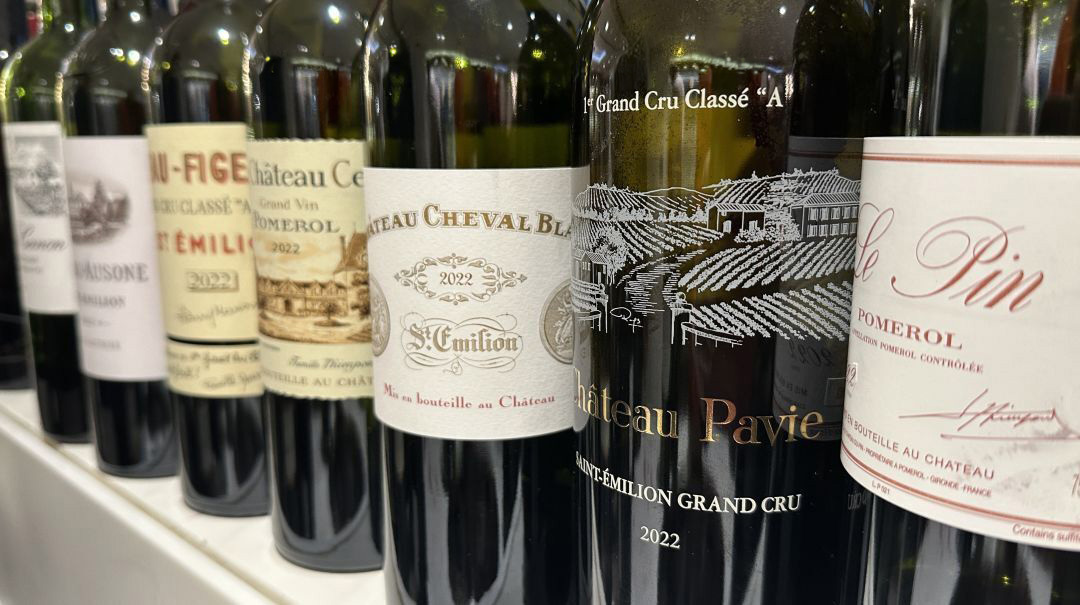
As I have written many times, Saint-Émilion has moved away from the bombastic style prevalent in the nineties and noughties. Perhaps a more accurate word is “diversified,” since there are still some properties that pursue that style, and why not? There is an audience for it. It’s a broad church. Generally, there is a plethora of great Saint-Émilion wines, even if they showed more bottle variation vis-à-vis other appellations. Standouts included the obvious ones, such as the Cheval Blanc, Figeac and Ausone. But again, as this blind tasting revealed, there are alternatives that are kinder to wallets. An absolutely stunning 2022 Canon won praise from all quarters, as did its stablemate, the Berliquet. I would also consider the Troplong Mondot, a resurgent Trotte Vieille, Clos Fourtet, Larcis Ducasse and Quintus, although the latter divided opinion.
During the notoriously hot summer of 2003, Pomerol fared worse than other appellations. Vines wilted in the heat, with brown leaves falling to the ground in August. It is a remarkable testament to how vines and winemaking practices have adapted in tandem that in 2022, the region has turned out some of its greatest wines.
It is crowned by a Petrus that will rank among the true greats, and that comes from someone lucky enough to have tasted most. It is sensational. Chapeau to Olivier Berrouet and his team. The Vieux Château Certan is fabulous, with a cashmere finish that is utterly irresistible. The Le Pin exudes class and panache, while the L’Eglise-Clinet, which has a propensity to show awkwardly in its youth, is a long-term runner. Ditto that now most famous Vin de France of them all, the Lafleur. I must admit that this caught me out blind, as it can feel a bit stylistically abrupt in its youth and as we all know, demands a decade in bottle to show its chops. The Les Pensées has no such qualms about dishing out loveliness. Indeed, it is a strong vintage for Pomerol, with wonderful contributions from La Conseillante, La Fleur-Pétrus, Clinet and Le Gay. Perhaps the only disappointment was a querulous bottle of the Hosanna. Two bottles were opened and both felt out of sorts. so I did not score it.
The two flights of dry whites were commendable. Consensus around the room was that this category has improved since it first emerged around a decade ago. At the time, demand for sweet wines had withered like a botrytised berry on the vine—what else could they do? Still, these dry whites do raise the question of where and when you would choose one. Personally, I find that the texture from the Sémillon makes them perfect for spicier fare, especially Thai or Chinese food. My pick would be one of the pioneers, Coutet’s Opalie, or the Grand Vin Blanc Sec courtesy of Suduiraut. The one that caught everyone off guard was the Y de Yquem, because its perceived residual sugar was exaggerated by its context. I reached out to CEO Lorenzo Pasquini, who explained that the intent for this bottling is to present a different expression of Yquem’s terroir, which is defined by botrytis and how they play with the sugar. The residual sugar has fallen from 10-15 grams per litre (g/L) to 5-7g/L today, designed not to bring sweetness, but rather to link it to Yquem.
One of the risks of blind tasting is that, devoid of context, you could well criticize a wine for being sweet within a flight of dry whites as an unintentional winemaking fault, whereas in reality, it is intentional. Transfer it to the sweet botrytised flight of Sauternes, and you might mark it down for lacking residual sugar! The Y de Yquem sits in between the two stylistically, which means you need that context to properly assess it.
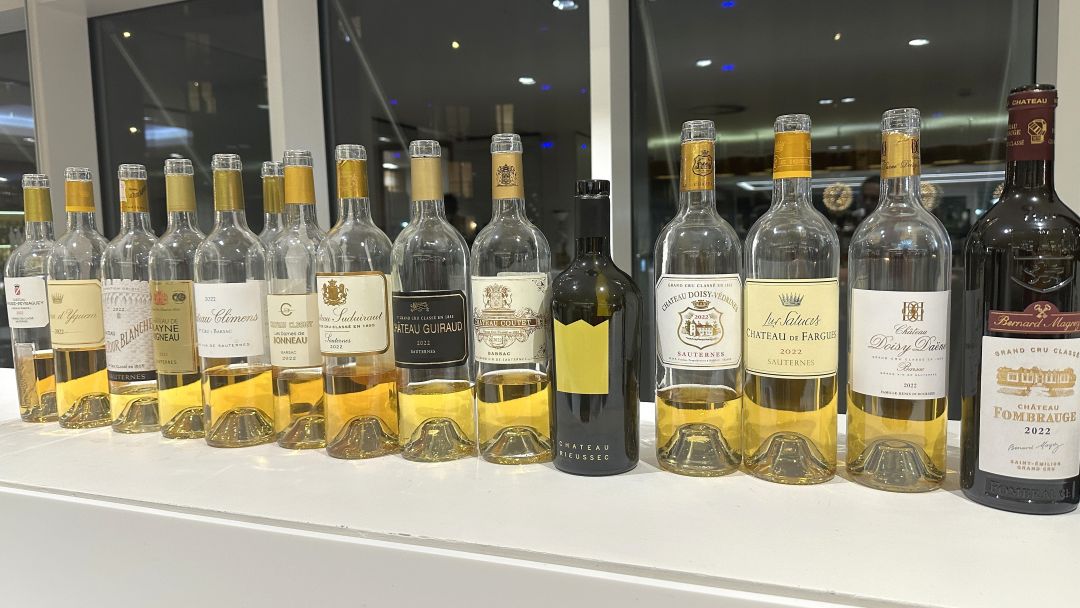
Finally, the Sauternes. You might assume that Yquem would have come up trumps, but on this occasion, its neighbour Suduiraut shone brightly. The Yquem was just behind, with creditable performances from the Lafaurie-Peyraguey, Coutet, Doisy-Védrines and Rieussec. I am not convinced that it is a stellar vintage for Sauternes, since it was less consistent than I would have liked, but there are certainly extremely fine examples in 2022 that should give immense pleasure over many decades.
Final Thoughts
That concluded this year’s Southwold. I foresaw the vintage not meeting some people’s high expectations. This is a tricky juncture at which to assess the 2022s. Many of these wines would have benefitted from three or four hours’ decanting, though every wine was given a double decant. I habitually score lower in blind conditions. Peer group tastings cajole you into finding shortcomings, when in reality, these wines will be preferable after their tannins have completely polymerised, when you can savour an entire bottle without the pressure of rapid assessment. There are concerns about irregularity between individual bottles—predicated by higher alcohol levels and more concentration—that, in the longer term, renders them more sensitive to storage conditions. Nevertheless, when the 2022s are great, they achieve lofty peaks. I suppose the question is how they compare to similarly lauded vintages like 2019, and you could argue that the ‘19s are more consistent across the region. Both vintages need several years in bottle to reveal a clearer picture.
Southwold provided irrefutable evidence that this is a vintage for the long term. Though nobody disputes that improved tannin management has rendered Bordeaux more approachable, you cannot and should not alter its DNA. In vintages like 2022, the ineluctable fact is that these wines possess the concentration to warrant cellaring over many years. I am certain that they will repay patience. The inane marketing spiel, “Drink Bordeaux Young,” might pertain to lesser wines on the lower rungs of the hierarchy, and in doing so, plays a vital role in encouraging people to drink its wines. Bring it on. However, when dealing with one of the supposed greatest wine regions in the world, why dumb it down and encourage people to drink them before they are barely out of diapers? Why deny the wines a chance to evolve the secondary aromas and flavours that Bordeaux does like no one else? Talk about shooting yourself in the foot.
Controversies are unavoidable when many people taste blind in high quantities. That is not a bad thing. Too much wine criticism kowtows to the producer, simply regurgitating the narrative that they want to put forward, and thus keeps everyone happy. Compared to when I started my career, far fewer writers are asking the tough questions. Tasting blind forces you to ask them both of the wine and winemaker in the spotlight, and of your own palate.
It is always a privilege to attend Southwold. It continues to provide a crucial means for younger members of the trade to encounter great wines in an objective fashion, just as it did for me in the salad days of my career. We gathered our stained wine glasses and spittoons, grabbed a tea towel to clean and dry the army of stemware and placed each glass back into the cupboard, fresh ‘n clean for next year’s Southwold.
Fingers crossed that we will be back to taste the 2023s with similar rigour.
© 2026, Vinous. No portion of this article may be copied, shared or redistributed without prior consent from Vinous. Doing so is not only a violation of our copyright but also threatens the survival of independent wine criticism.
You Might Also Enjoy
Bordeaux 2023 in Bottle: Coming Around Again, Neal Martin, February 2026
A Place Beyond Praise: Bordeaux 2022, Neal Martin, February 2025
2022 Bordeaux in Bottle: Living in the Present, Antonio Galloni, January 2025
Bordeaux 2020 – The Southwold Tasting, Neal Martin, November 2024
Bordeaux 2019: The Southwold Tasting, Neal Martin, February 2023
Show all the wines (sorted by score)
- Angélus
- Ausone
- Bastor-Lamontagne
- Batailley
- Beaumont
- Beauregard
- Beau-Séjour Bécot
- Bélair-Monange
- Belfont-Belcier
- Belgrave
- Bellefont-Belcier
- Berliquet
- Beychevelle
- Bouscaut
- Boyd-Cantenac
- Branaire-Ducru
- Branas Grand Poujeaux
- Brane-Cantenac
- Calon Ségur
- Canon
- Cantemerle
- Capbern
- Carbonnieux
- Chasse-Spleen
- Château Margaux
- Cheval Blanc
- Clerc Milon
- Climens
- Clinet
- Clos des Jacobins
- Clos du Marquis
- Clos Fourtet
- Clos Haut-Peyraguey
- Closiot
- Cos d'Estournel
- Couhins-Lurton
- Coutet
- d'Arche
- d'Armailhac
- Dauzac
- de Camensac
- de Fieuzal
- De Fieuzal
- De Myrat
- d'Issan
- Doisy-Daëne
- Doisy-Védrines
- Domaine de Chevalier
- Ducru-Beaucaillou
- Duhart-Milon
- du Tertre
- Enclos Tourmaline
- Fayat
- Figeac
- Filhot
- Fombrauge
- Fonplégade
- Gazin
- Giscours
- Gloria
- Grand Mayne
- Grand-Puy Ducasse
- Grand-Puy Lacoste
- Gruaud Larose
- Guiraud
- Haut-Batailley
- Haut-Brion
- Haut-Marbuzet
- Hosanna
- Labégorce
- La Chenade
- La Conseillante
- La Croix de Gay
- Lafaurie Peyraguey
- Lafite Rothschild
- Lafleur
- La Fleur de Gay
- La Fleur-Pétrus
- Lafon-Rochet
- La Gaffelière
- La Garde
- Lagrange (Saint-Julien)
- La Lagune
- La Louvière
- La Mission Haut-Brion
- Lamothe-Guignard
- Lanessan
- Langoa-Barton
- Larcis Ducasse
- Laroque
- Lascombes
- Latour
- La Tour Blanche
- La Tour Carnet
- Latour-Martillac
- La Tour-Martillac
- La Violette
- Le Bon Pasteur
- Le Boscq
- Le Crock
- Le Dôme
- Le Gay
- L'Eglise-Clinet
- L'Église-Clinet
- L'Enclos
- Léoville Barton
- Léoville Las Cases
- Léoville-Poyferré
- Le Pin
- Les Carmes Haut-Brion
- Les Cruzelles
- Les Perrières
- L'Evangile
- L'If
- Lilian Ladouys
- Lynch-Bages
- Lynch-Moussas
- Magrez Fombrauge
- Malartic-Lagravière
- Malescot St. Exupéry
- Marquis d'Alesme Becker
- Marquis de Terme
- Mauvesin Barton
- Meyney
- Monbousquet
- Montrose
- Montviel
- Mouton Rothschild
- Nénin
- Olivier
- Ormes de Pez
- Palmer
- Pape Clément
- Pavie
- Pédesclaux
- Petit-Village
- Petrus
- Pichon Baron
- Pichon-Longueville Comtesse de Lalande
- Pontet-Canet
- Potensac
- Pouget
- Poujeaux
- Prieuré-Lichine
- Quintus
- Rauzan-Ségla
- Raymond-Lafon
- Rayne Vigneau
- Rayne-Vigneau
- Reuissec
- Rieussec
- Rouget
- Saint-Pierre (Saint-Julien)
- Sigalas Rabaud
- Siran
- Smith Haut Lafitte
- Sociando-Mallet
- Suduiraut
- Talbot
- Tertre Roteboeuf
- Tour Saint Christophe
- Tronquoy
- Troplong Mondot
- Trotanoy
- Trotte Vieille
- Valandraud
- Vieux Château Certan
- Vieux Château Mazarat
- Wine Society Pauillac
- Yquem