
Browse using the new Vinous website now. Launch →
Printed by, and for the sole use of . All rights reserved © 2015 Vinous Media
Mâconnais 2024 & 2025: Definitely Worth Your Time
BY NEAL MARTIN | SEPTEMBER 15, 2026
I was recently chatting with a seasoned Burgundy expert about my travels, and mentioned my return from the Mâconnais.
“Mâconnais?” they replied, intonation suggesting it was the first time they had heard of the region. “Is it worth going there?”
Worth… going… there? I could not detect any sarcasm. It was a genuine question. I was taken aback, not by that person never having set foot in the Mâconnais, but by their indifference.
Perhaps I should not be surprised. The Mâconnais is no clickbait. Incomprehensible as it may be to me, I accept that the region does not get everyone’s pulse racing. Aside from that Belgian recalcitrant Jean-Marie Guffens, the region boasts no real celebrity winemakers, though I am not sure how long that will last as new blood enters the region. The Burgundy chatterati seem increasingly focused on the bluest of blue chips, whereby bottles are reduced to bragging rights. The Mâconnais does not fulfil that role.
Readers will be thankful that Mâconnais wines have thus far escaped the interest of speculators and collectors. Preposterously, even the region’s finest wines are deemed too inexpensive to pique collectors' interest. Nevertheless, it amazes and disappoints in equal measure that so many Burgundy lovers wilfully ignore the calibre of Pouilly-Fuissé, Pouilly-Vinzelles and Saint-Véran, to name but three appellations. Factor in value and a constellation of newly minted Premier Crus, and anyone remotely interested in top-notch Chardonnay should momentarily avert their eyes from the Côte d'Or and seek the treasures located an hour’s drive south of Beaune.
Personally, I feel relief that the Mâconnais remains untouched by the Côte d’Or's glitz and glamour, spared the influx of outside investors gobbling up its most propitious parcels like tailor-suited Pac-Men. The Mâconnais is a place where people make wine for the sheer love of the job, clinging to their own ideals and principles, which is not to say there is any lack of innovation.
This year I added a couple of extra days to my two trips to the Mâconnais, because in these straitened times, the region offers pecuniary relief from inflation elsewhere. Despite the challenges posed by wild swings in climate, the Mâconnais, at its best, stands shoulder to shoulder with the finest Chardonnays in the world.
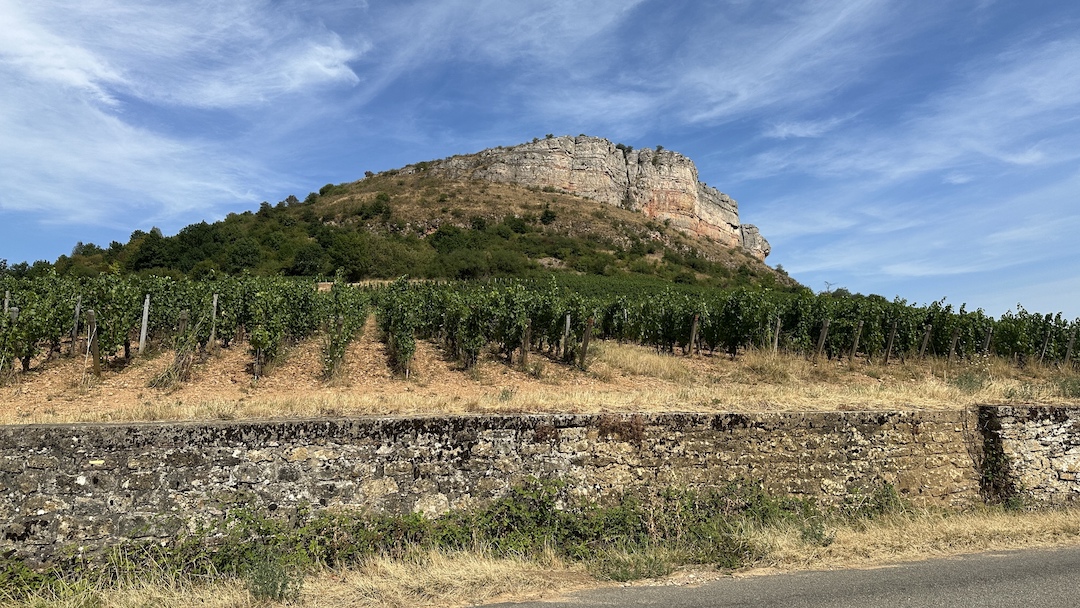
No self-respecting Mâconnais report can be seen without a photo of the Roc de Vergisson. Here is this year’s entry.
The Growing Seasons
Received wisdom is that in Burgundy, the rain-soaked and traumatic 2024 was followed by a better vintage in 2025.
It is the opposite in the Mâconnais.
Growers will tell you that, for them, 2024 was far easier than 2025. Olivier Merlin put it succinctly: “In 2024, the further south you were from the Côte d’Or, the less rain you had. It was the other way around in 2025, when there was more rain as you went south.” It is as if Mother Nature was trying to distribute her malevolence evenly across appellations.
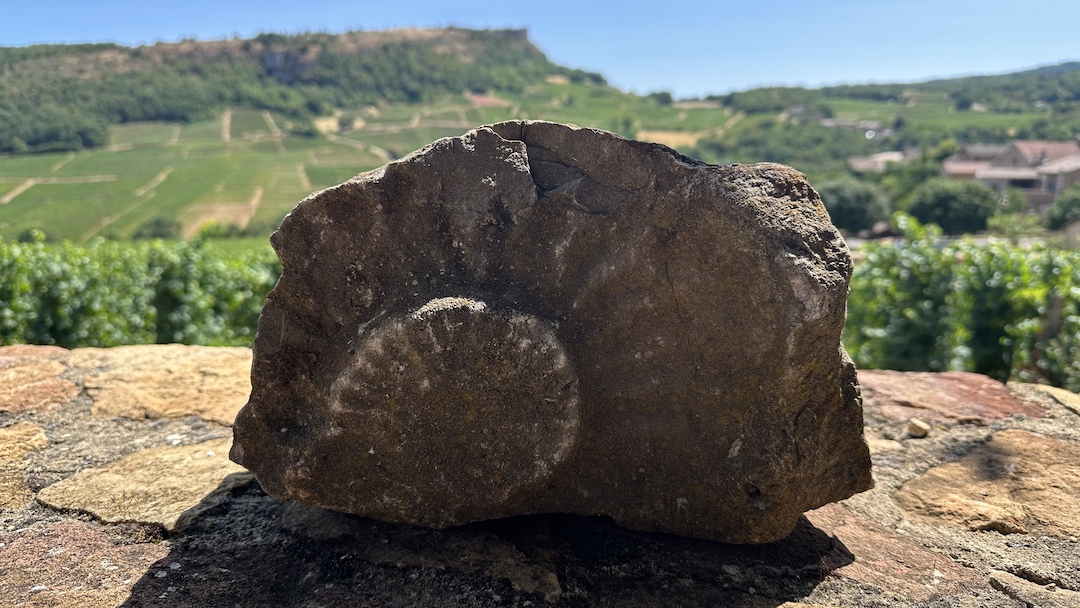
A fossil from the Mâconnais’ ancient limestone soils, a reminder of the marine origins that continue to shape the region’s vineyards today.
As I mentioned in last year’s report, the Mâconnais was not quite as detrimentally impacted in 2024 as the Côte d’Or or Chablis; it avoided the severest hail damage and temperatures were not as low. The figure that most differentiates the Mâconnais from the Côte d’Or is August precipitation: 30 mm compared to 87 mm, respectively. Mâcon also enjoyed 328 sunlight hours, more than either the Côte d’Or or Chablis. A week of rain arrived in early September, with many pickers entering the vineyards around September 12 in cooler conditions than recent years. Yields were not as severely impacted as in other regions; Château de Fuissé, for example, reported a generous 52 hl/ha.
As for 2025, a cursory glance at rainfall figures immediately reveals the differences between appellations. The first divergence came in April, which saw 93 mm in Mâcon compared to 32 mm in Chablis, then 62 mm versus 38 mm the following month. An unseasonal 86 mm fell in June, the Côte d’Or similarly affected by storms that month. August was also rainy at 104 mm, not quite as much as Chablis, but far more than Beaune’s 89 mm. Temperatures throughout the growth cycle were more in line with the rest of Burgundy, with a cooler July averaging 21.7°C followed by a warmer August. Overall, vine growth began in a similar fashion to the 20-year average before starting to lag by August, when véraison was ten days behind normal. Yields were low due to poor flowering, mildew pressure and hail damage. Frédéric Burrier of Château du Beauregard mentioned figures as low as 10 hl/ha, more synonymous with Sauternes than Burgundy.
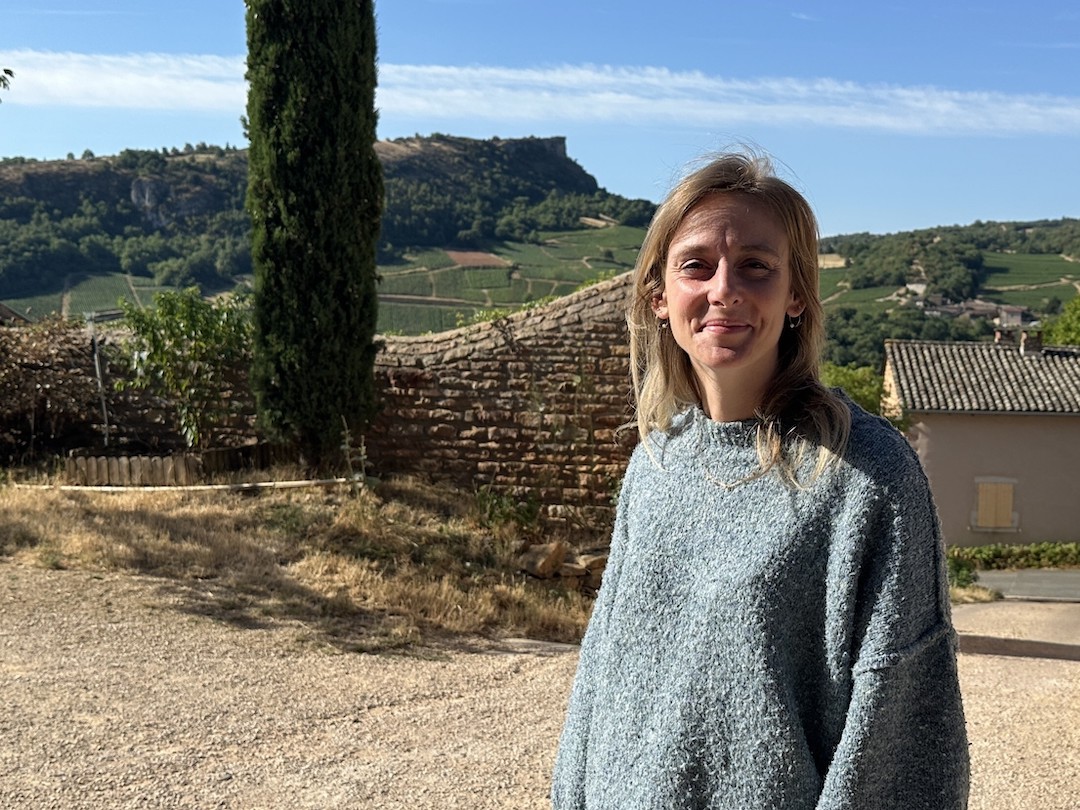
Winemaker Lisa Saumaize-Michelin at her namesake domaine, Domaine Saumaize-Michelin. She started working with her family in 2020 alongside her brother, Vivien, and produces a quintessentially Mâconnais range with Pouilly-Fuissé at its heart.
How I Tasted The Wines
I made two trips to the Mâconnais this year, in June and July. Unlike in other regions, I focused on producers I chose to include rather than conducting a broad regional tasting. There are a handful of Beaujolais stowaways in this report, since some Mâconnais producers (such as Bret Brothers and Château de Beauregard) have a foot in each adjacent region. It is more efficient to include these wines here, and doing so allowed me to sneak in recently bottled Moulin-à-Vents from Richard Rottiers.
The Wines
Tasting the Mâconnais wines reconfirmed my conviction that quality in this region is better than ever. I asked a few winemakers what they considered to be the stylistic difference between the Mâconnais and the Côte de Beaune, and the general consensus was a slight bitterness on the finish. This is a trait I genuinely prize. While it can feel less seductive than the polished, creamier finish of a Meursault or Chassagne-Montrachet, that bitterness imparts a vital freshness at the dinner table.
The 2024 vintage is studded with gems from across the entire region, not just Pouilly-Fuissé but Saint-Véran, various Mâcon-Villages, Viré-Clessé and beyond. The inclement weather may have nixed the reds up in the Côte de Nuits, but the whites fared considerably better in the Côte de Beaune, and Mâconnais producers had an easier ride. The best wines are imbued with fabulous nervosité and tension, qualities thrown into sharp relief when juxtaposed against the 2025s. The 2024s hark back to the Chardonnays of the 1980s and 1990s in the most positive sense. Several winemakers trotted out the word “classical,” and in this instance, it is entirely justified.
A northerly breeze during picking played a key role in shaping the wines, not only drying out the vines but enhancing concentration, which may explain why the density and ripeness surprised me in some cases. At the most extreme, these wines dupe you into believing that 2024 was a hot growing season. Elevation is beginning to play an important role in the Mâconnais, perhaps more so than in the Côte de Beaune, where the contour lines are more widely spaced and elevations are not as high. Aside from the cooler conditions that extend the growth cycle, later flowering in 2024 coincided with more stable weather, giving higher-elevation sites a potential advantage. The irony is that the INAO capped vineyard elevation at 400 meters because higher elevations were perceived as disadvantageous for ripening. In reality, higher elevations are beneficial, not detrimental.
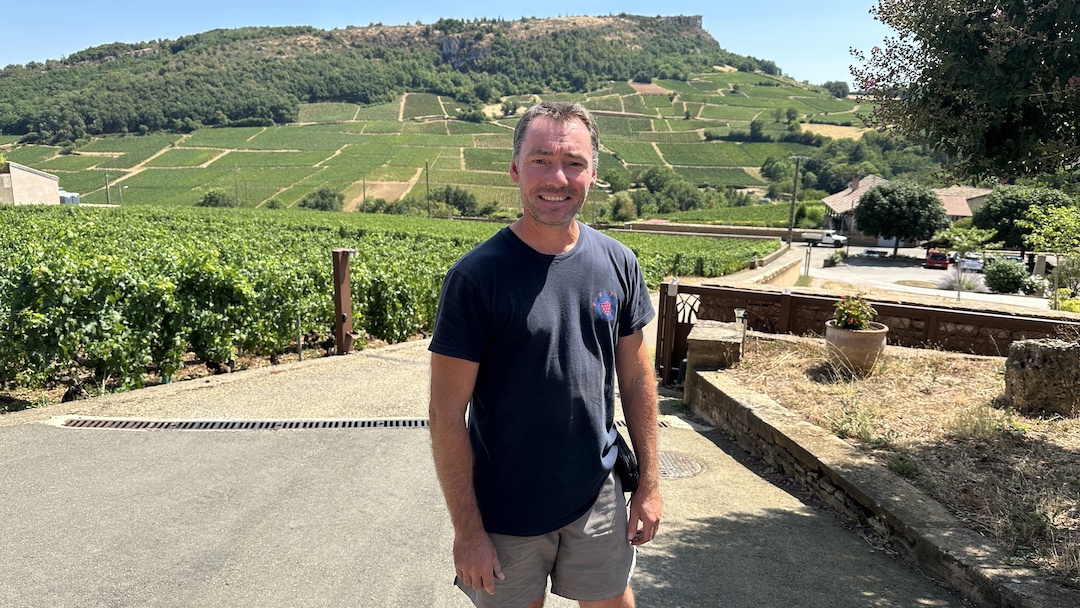
Winemaker Julien Barraud oversees an impressive range that stylistically borrows from the Côte d’Or but retains Mâconnais DNA.
It bears repeating: 2025 was to the Mâconnais what 2024 was to winemakers in the Côte d’Or and Chablis. This inversion is a pertinent reminder that there can be enormous weather differences between Burgundy’s subregions. Winemakers’ anguish over 2025 was still palpable when the subject arose, as if I had stepped on a topic they would rather forget. Incessant rain and the kind of unrelenting mildew pressure that particularly affects more humid climats decimated yields. Ex-cellar prices remain modest for Mâconnais producers, so shortfalls in quantity can seriously impact the bottom line for family-owned operations. Factor in the knock-on effect of how 2025 sapped vines’ energy and the prospects for decent volume in 2026 are not great (though, as they say, don’t count your chickens ‘til they hatch).
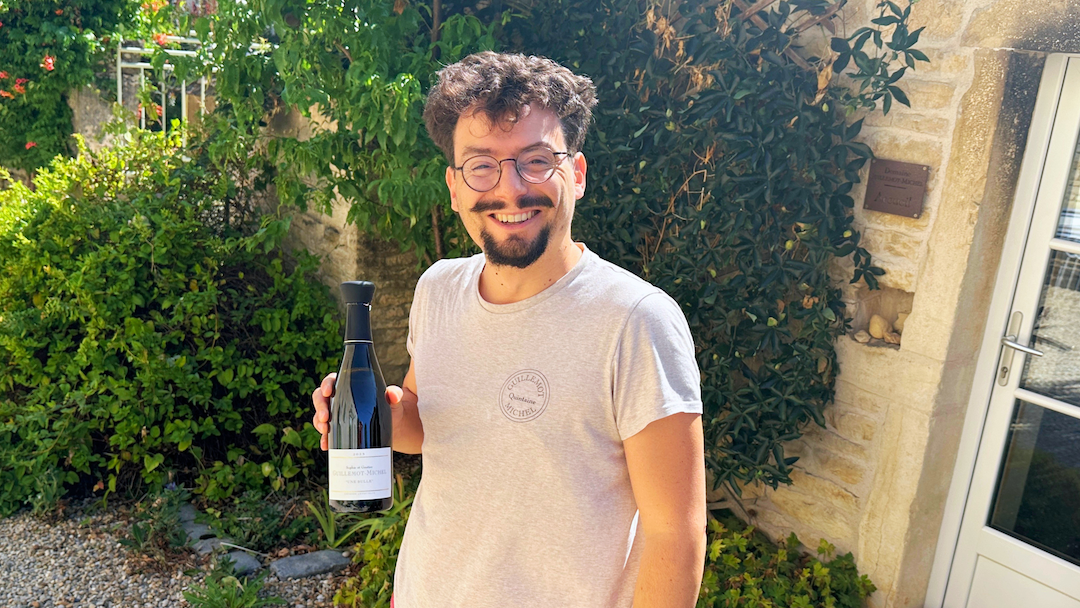
Winemaker Gauthier Roussille farms biodynamically and produces low-intervention Viré-Clessés at Domaine Guillemot-Michel in the village of Quintaine. Roussille is also very knowledgeable about Japanese sake.
Final Thoughts
The Mâconnais is a treasure trove awaiting discovery. I have driven its winding serpentine lanes for many years and always find something new. Few would argue against Pouilly-Fuissé being home to its finest terroirs, but that is no reason to ignore the raft of outstanding wines hailing from other appellations. That said, cooperatives continue to hold sway, supplying high volumes of low-priced wines for supermarkets and large distributors. Nothing is wrong with that if the wines reach a base level of quality and serve as an affordable gateway. On the other hand, the preponderance of inexpensive, lower-quality wines cannot help but taint Mâconnais’ reputation. These factors prevent the likes of Saint-Véran from gaining Premier Cru status despite the appellation’s finest exponents unequivocally meeting the required standard.
It is refreshing to visit a wine region unburdened by stratospheric prices and all the expectations that come with them. There is an authenticity to the Mâconnais that should be cherished and preserved, the driving motivator for quality being intrinsic rather than commercial. That even the finest Mâconnais wines are less expensive than those of the Côte d’Or is no reflection of their pedigree, but simply a result of distorted market forces.
So, returning to the question posed at the outset — should said Burgundy expert consider a trip to the Mâconnais? I did, in fact, answer…
“It is definitely worth your time.”
© 2026, Vinous. No portion of this article may be copied, shared or redistributed without prior consent from Vinous. Doing so is not only a violation of our copyright but also threatens the survival of independent wine criticism.
You Might Also Enjoy
Tail Fin Delights: Mâconnais 2023/2024, Neal Martin, August 2025
Mâconnais 2022/2023: Don’t Pass Me By, Neal Martin, August 2024
Moving On Up: Mâconnais 2021 & 2022, Neal Martin, August 2023
The Inflection Point: Mâconnais 2020 & 2021, Neal Martin, August 2022
Don’t Rain on My Parade: Mâconnais 2019/2020, Neal Martin, November 2021
Show all the wines (sorted by score)
- Bret Brothers
- Château de Beauregard
- Château de Fuissé
- Château des Quarts
- Château des Rontets
- Château du Clos
- Domaine Barraud
- Domaine Christophe Thibert
- Domaine Corsin
- Domaine de la Chapelle (Catherine & Pascal Rollet)
- Domaine de la Croix Senaillet
- Domaine de la Rochette
- Domaine Dominique Cornin
- Domaine du Mont Épin
- Domaine Eric Forest
- Domaine Frantz Chagnoleau
- Domaine Guffens-Heynen
- Domaine Guillemot-Michel
- Domaine J-A Ferret
- Domaine Jean-Claude Ramonet
- Domaine La Soufrandière
- Domaine Leflaive
- Domaine Lorenzo Palermo
- Domaine Michel
- Domaine Nicolas Maillet
- Domaine Olivier Merlin
- Domaine Pierre Vessigaud
- Domaine Richard Rottiers
- Domaine Robert Denogent
- Domaine Roc des Boutires
- Domaine Saumaize-Michelin
- Famille Paquet
- Famille Vincent
- Jessica Litaud
- Maison Joseph Burrier
- Maison Verget