
Browse using the new Vinous website now. Launch →
Printed by, and for the sole use of . All rights reserved © 2015 Vinous Media
Gigondas 2025: A Warm, Rain-Divided Vintage
BY NICOLAS GREINACHER | SEPTEMBER 29, 2026
Few recent vintages in Gigondas have hinged so decisively on harvest timing as 2025. After a hot, dry summer left small berries and occasionally blocked maturity, record rainfall from late August onward transformed both the vineyards and the choices growers faced. The results are inevitably heterogeneous, yet more compelling than the challenging harvest period might suggest, with serious reds and some particularly successful whites.
The 2025 Growing Season
The autumn that followed the 2024 vinifications was notably dry and mild, and winter continued in the same vein. March broke the pattern decisively, with 120 millimetres (mm) of rainfall, more than double the monthly average. April and May rainfall totals also came in slightly above normal. Downy mildew pressure was present from the very start of vegetation growth, but bud counts looked promising.
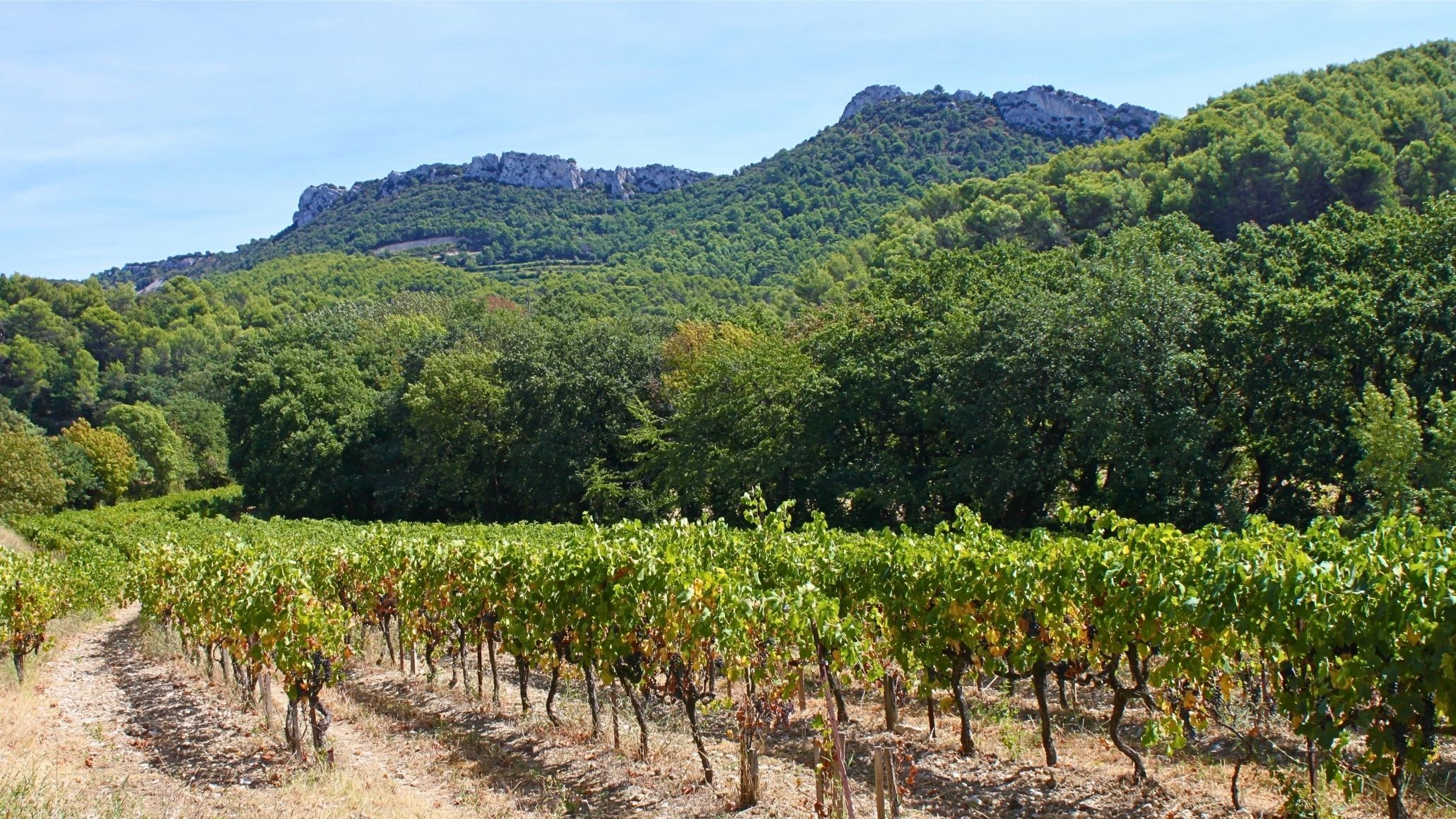
The rugged limestone ridges of the Dentelles de Montmirail frame a sunlit Gigondas vineyard.
The last significant rainfall before summer arrived early: 40 mm on June 4, followed by virtually nothing until the end of August. Flowering began around June 10. Coulure was often present, but moderate. Still, several growers, such as Julien Bréchet of Domaine des Bosquets, noted that flowering had gone poorly for Grenache, which resulted in considerable yield losses.
Summer remained hot and dry, although Maéva Gauci of Domaine La Bouïssiere described the heat as reasonable rather than extreme. June’s warmth proved decisive — bunches did not develop much, and individual berries stayed small. The main heat wave came around August 15 and shrivelled berries in certain sectors, particularly Syrah, Viognier and Roussanne. By late August, blocked maturity was visible in clusters across Gigondas.
Then the weather turned on its head. A total of 130 mm of rain fell during the last five days of August, restarting ripening after the prolonged summer drought. Between August 28 and September 28, a staggering 295 mm fell. On top of this, September passed without a single day of Mistral wind. Dilution was immediately measurable in analysis and in sampling grapes. Ripening blockages disappeared and growers had to maintain a careful watch on sanitary conditions in the vineyards.
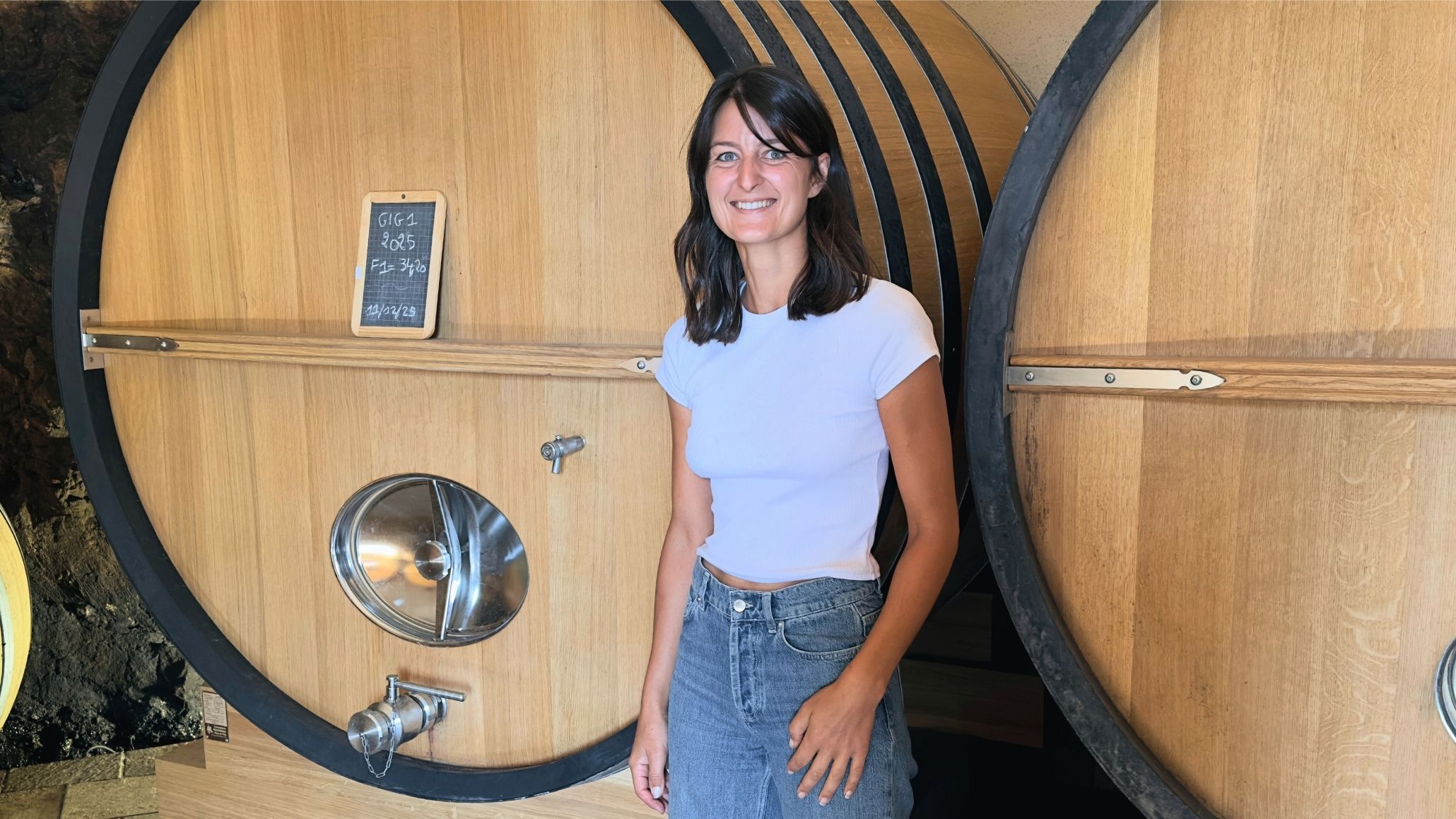
Maéva Gauci of Domaine La Bouïssiere.
By common consensus, harvest was exhausting. “It never really started and never really stopped,” Gauci recalled. There would often be three days of picking because something was ripe, then a pause, then a fresh start, and so on. Ripening was extremely heterogeneous, with heat-shrivelled berries hanging alongside thick-skinned fruit that was not fully ripe. Gigondas’ diverse terroirs and exposures exacerbated very marked differences in both maturity and fruit hygiene from site to site. Botrytis became an issue for grapes picked after multiple rains, and producers had to sort rigorously in the vineyard and the winery.
Paul Fumoso of Gour de Chaulé summed up the trade-off that defined the year: “I harvested everything after the big rain and lost 25% of my volume, but what I picked was ripe and very well balanced at around 14% potential alcohol. Before the rain, the grapes were simply not ready.” Broadly speaking, there are two vintage profiles in Gigondas depending on when a grower chose to pick in 2025. Harvest choices, soil types and exposures all left a particularly distinct imprint.
That said, most Grenache — by far the most important variety for red Gigondas — was picked during the last two weeks of September, while Julien Bréchet collected the last Mourvèdre grapes on October 8. By contrast, the white Clairette performed very well and came in mostly between September 5 and 15. Yields across the region were modest, as the late rains could not compensate for the hot, dry summer. Losses of around 20% to drought damage and sorting were common, with eventual yields settling around an average of 25 hl/ha.
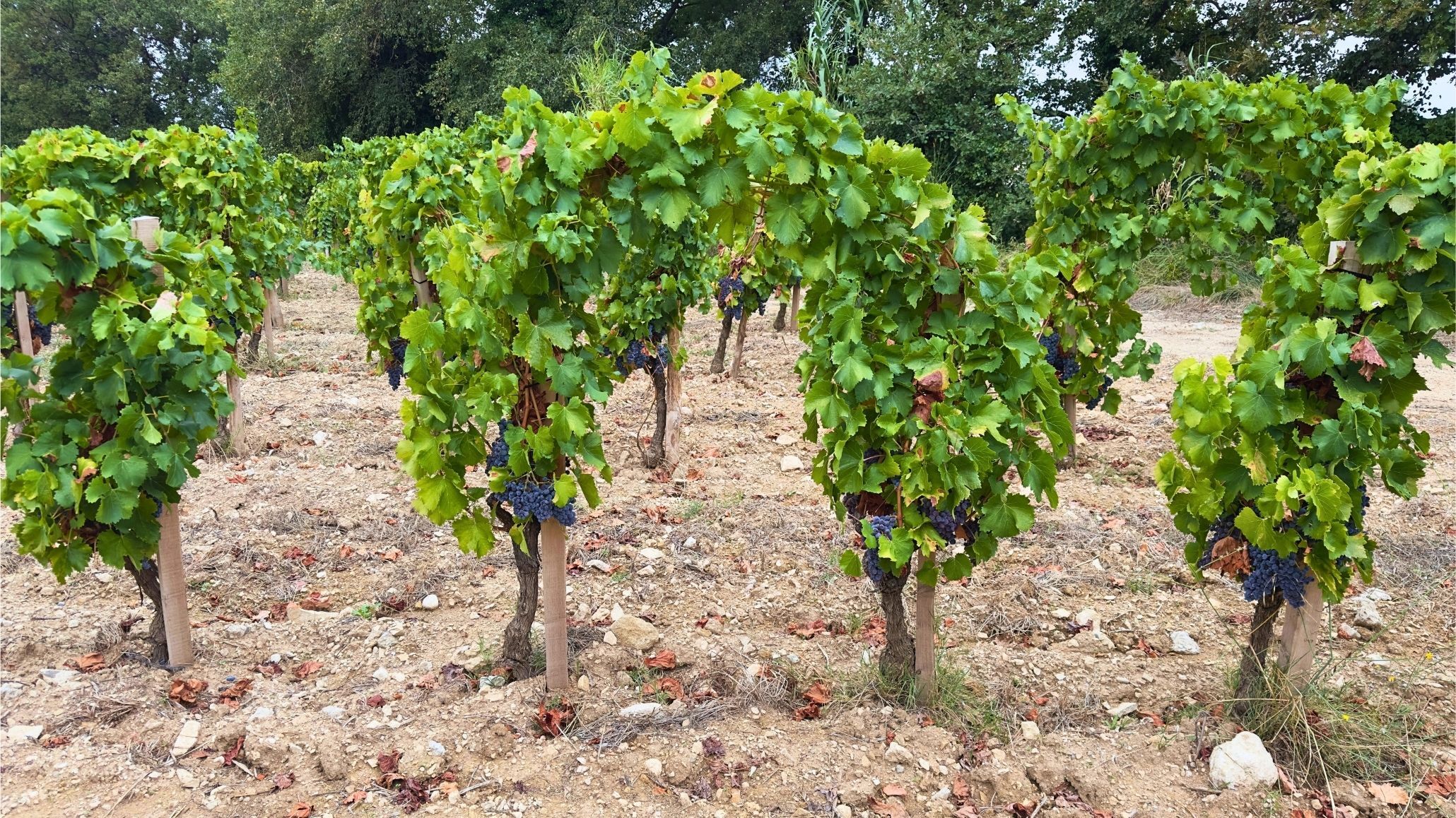
At Domaine des Bosquets, adjacent Grenache shoots are braided together to form arches above the rows, retaining the full canopy rather than hedging the growing tips. This trial aims to maximise functional leaf area while shading the bunches from direct sunlight, helping to protect the fruit from summer heat.
In the cellar, nitrogen levels in the fruit remained robust and temperature management demanded attention, but measured potential alcohols made fermentations relatively straightforward. Color and tannin came easily, even where the fruit was heterogeneous. The risk of over-extraction seemed to be low, and malolactic fermentations followed quickly. Even so, growers who picked late in September needed to work with great restraint; some 2025s carry a risk of oxidative instability, potentially linked to botrytis-affected fruit and the associated oxidative enzymes. Careful producer selection is therefore advisable.
All in all, the best 2025 reds are serious wines built for long aging, but they will need time. Tight tannins in many of the wines reflect the drought conditions on naturally well-drained soils. Alcohol levels are typically around 14.5%, similar to the prior year. At this early stage, Château de Saint Cosme, Domaine de la Combe de Mars, Domaine des Bosquets, Domaine du Gour de Chaulé, Domaine Les Pallières and Domaine Santa Duc compete for the finest red wine of the vintage. The whites are among the vintage’s genuine pleasures, with notably robust Clairette expressions. Château de Saint Cosme continues to set the appellation benchmark with both the Gigondas Blanc Le Poste and Gigondas Blanc Hominis Fides.
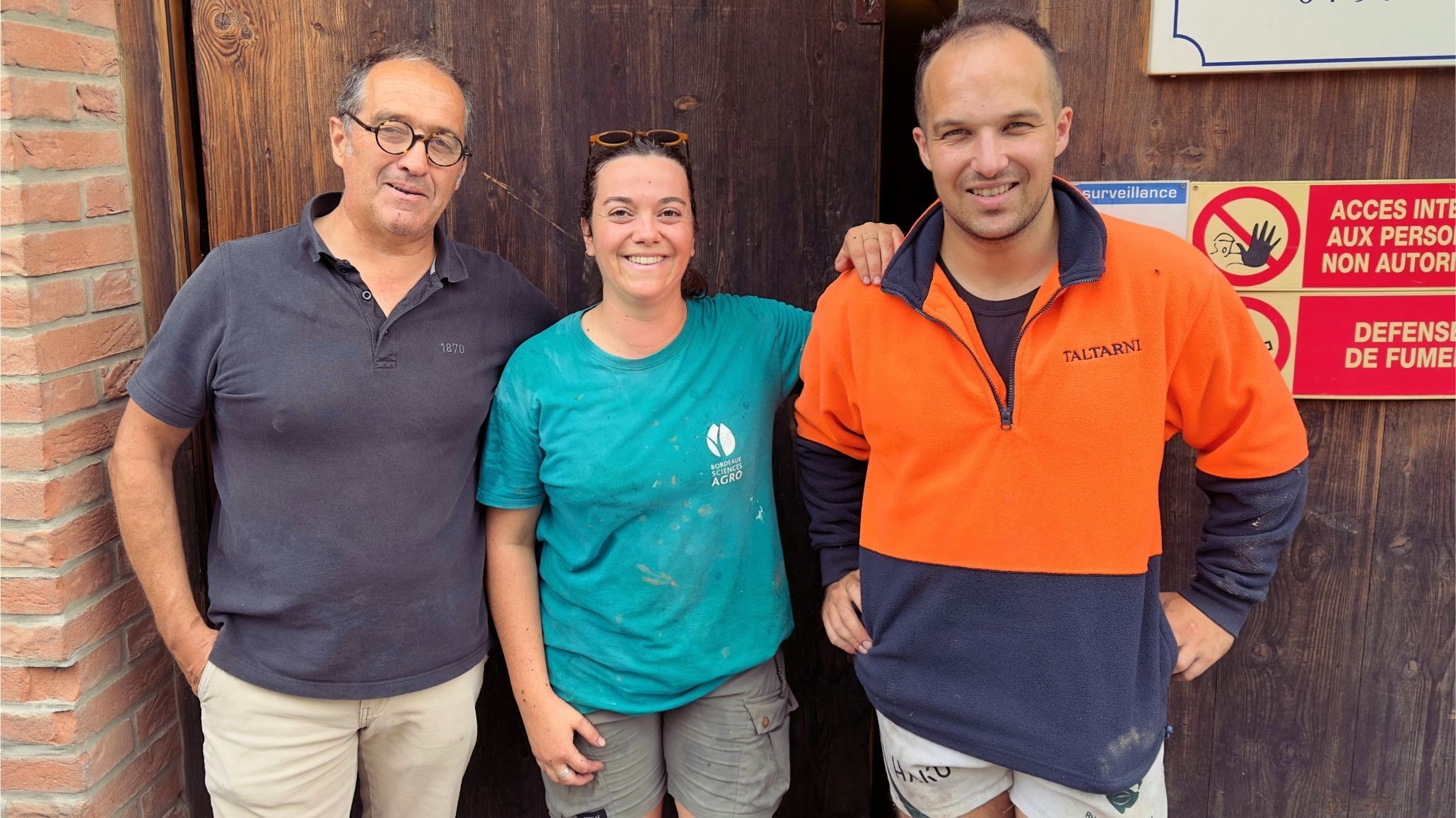
Louis Barruol (left) with his son James Barruol and Winemaker Clarisse Borau at Château de Saint-Cosme, taking a brief break during the 2026 harvest.
2024 from Bottle
There was no significant heat wave in in Gigondas 2024, but coulure reduced yields in many sites, particularly for Grenache after poor fruit set. Mildew caused notable losses in other varieties. Now tasted from bottle, the resulting reds are variable. Some are austere and marked by grippy tannins, but the finest combine concentration and structure with balance, finesse and secure aging potential. These wines make a strong case for 2024, not least because growers could extract relatively firmly without sacrificing refinement. If 2025 is the riper and more solar vintage, the best 2024s are more classical and balanced in feel. Julien Bréchet crafted the wine of the vintage at Domaine des Bosquets, the stellar 2024 Gigondas Le Regard Loin.
I tasted all of the wines in this report in Gigondas in late August 2026.
© 2026, Vinous. No portion of this article may be copied, shared or redistributed without prior consent from Vinous. Doing so is not only a violation of our copyright but also threatens the survival of independent wine criticism.
You Might Also Enjoy
Gigondas 2024: Birth of a Modern Classic, Nicolas Greinacher, November 2025
Gigondas: Triumphs, Challenges and New Beginnings, Nicolas Greinacher, October 2024
Gigondas: The Southern Rhône Jewel Shines and Adapts, Nicolas Greinacher, January 2024
The Deep Bench of Gigondas, Josh Raynolds, January 2023
Gigondas Maintains Its Tempo, Josh Raynolds, February 2020
Show all the wines (sorted by score)
- Alain Jaume
- Bonpas
- Brotte
- Camille Cayran
- Cellier des Princes
- Charles Tort
- Château de Saint Cosme
- Château du Trignon
- Clos du Joncuas
- Crous St. Martin
- Domaine Brunely
- Domaine Brusset
- Domaine Cécile Chassagne
- Domaine de Clos de Tourelle
- Domaine de Coyeux
- Domaine de Font-Sane
- Domaine de Goumarre
- Domaine de la Combe de Mars
- Domaine de la Mavette
- Domaine de la Tête Noire
- Domaine de Longue Toque
- Domaine de Piéblanc
- Domaine de Saint Cosme
- Domaine des Bosquets
- Domaine des Espiers
- Domaine des Florets
- Domaine des Fontnobles
- Domaine des Pasquiers
- Domaine de Verquière
- Domaine d'Ouréa
- Domaine du Cayron
- Domaine du Gour de Chaulé
- Domaine du Grand Montmirail
- Domaine du Grapillon d'Or
- Domaine du Pesquier
- Domaine du Terme
- Domaine Font Sarade
- Domaine Julien Delhomme
- Domaine La Bouïssiere
- Domaine La Font de Notre Dame
- Domaine La Fourmone
- Domaine La Garrigue
- Domaine La Ligière
- Domaine la Roubine
- Domaine La Soumade
- Domaine le Clos des Cazaux
- Domaine Les Goubert
- Domaine Les Pallières
- Domaine Les Sibu
- Domaine Les Teyssonnieres
- Domaine Raspail-Ay
- Domaine Saint-Damien
- Domaine Saint-Roch
- Domaine Santa Duc
- Famille Perrin
- Famille Ravoire
- Ferraton Père & Fils
- François Xavier Lambert
- Gigondas La Cave
- Grandes Serres
- La Ferme du Mont
- La Grand Comtadine
- Lavau
- Le Mas des Flauzières
- Marrenon
- Mas des Restanques
- M. Chapoutier
- Moulin de la Gardette
- Ogier
- Pierre Amadieu
- Pierre de Fontval
- Pierre Henri Morel
- Réserve Saint-Dominique
- Saint-Cosme
- Terranéa
- Xavier Vignon