
Browse using the new Vinous website now. Launch →
Printed by, and for the sole use of . All rights reserved © 2015 Vinous Media
2025 Rheingau & Pfalz: Energy, Ripeness, Brilliance and Speed
BY ANNE KREBIEHL MW | SEPTEMBER 2, 2026
With its combination of warmth and sufficient moisture, the 2025 growing season yielded brilliant and juicy Rieslings full of energy and ripeness. Dryness in spring spelled low yields across the board — 18% less than the long-term average in the Pfalz, and 17% less in the Rheingau — prompting fast-advancing ripening and turbo harvests. The Pfalz almost universally delivered juicy, brilliant wines. The Rheingau is a little patchier but holds many sweet (and dry) surprises. In particular, entry-level Rieslings shine with fruit and liveliness and generally overdeliver with their burst of energy and freshness. The 2024 Pinot Noirs are a revelation and a new paradigm.
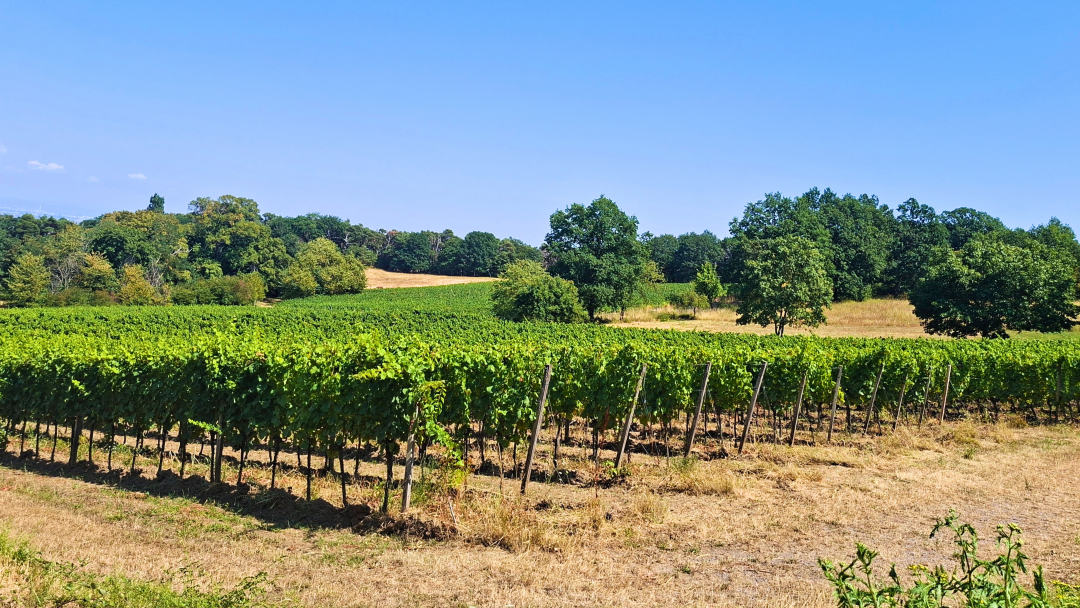
The Odinstal vineyards sits at an elevation of 350 meters in the Pfälzer Wald.
Another Warm Year Where Timing Mattered
Two thousand twenty-five was another warm year. The German Weather Service, DWD, summarized 2025 as “a solar year with unusual warmth and a significant precipitation deficit.” It counts among the ten warmest years since DWD records began in 1881, and among the five sunniest since 1951, but given this summer of near-continuous heatwaves across Europe, that is not surprising. What is more telling is the timing of rain. While the statistics show just 17% less rain than average, Germany had a dry phase from February to May, which was later made up by a wet July and September. As there had been sufficient moisture in winter, vines developed well, but by the time it came to fruit set, this dryness affected yields by impacting cell division. This meant small berries, even when fruit set was good. Simone Rings in the Pfalz remembered, “Tubs of grapes came in, but once the bunches were destemmed, little fruit remained. It was much less than it initially looked.” Many others noted that there was just less juice than usual.
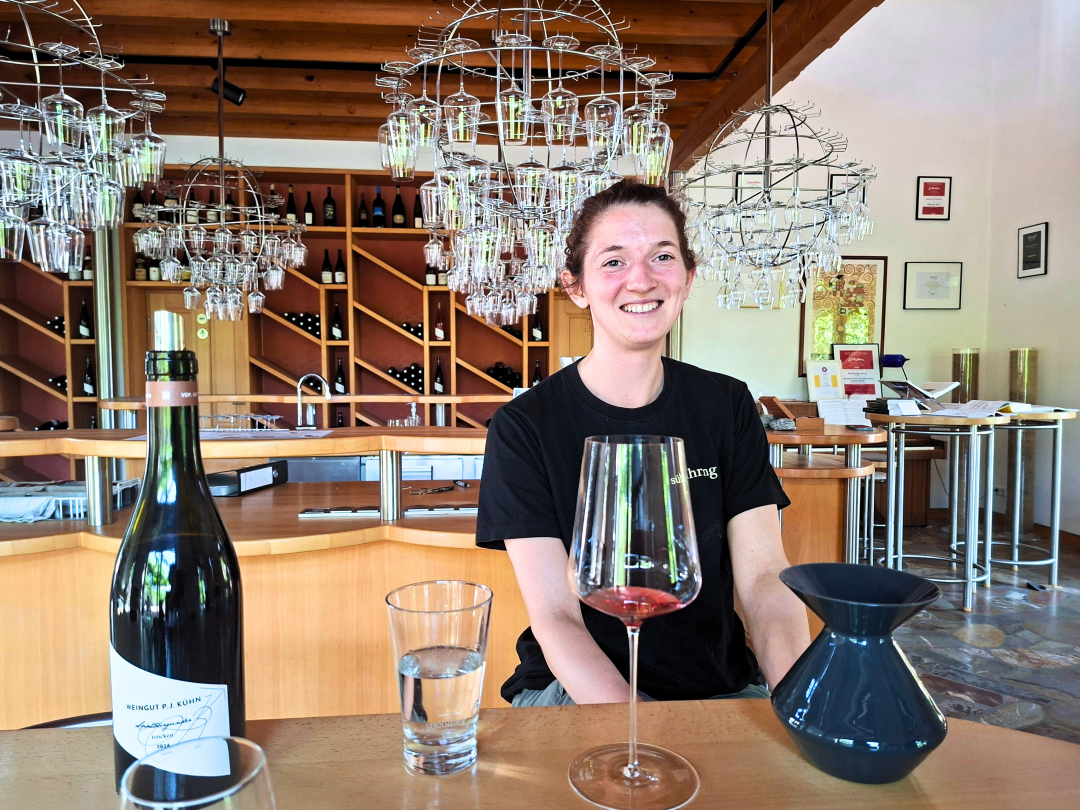
Viktoria Kühn of Peter Jakob Kühn presented a stunning Riesling collection, but she is pictured here with exquisite Pinot Noir.
However, for producers, this dry period meant little disease pressure and even fruit ripening. July started warm with a short heat spike early in the month, but then turned wet. This rain spurred ripening, giving a boost to the vines and posing no threat to the still-hard berries. I remember the deluge in Deidesheim in the Pfalz on July 25, 2025 — rain washed soil down from the vineyards into the streets, even flooding some cellars. That rain, less violent elsewhere, gave a boost to all vegetation, vines included. September was also wet. In the Pfalz, heavy rain was forecast for the weekend of September 20-21. That same rain front reached the Rheingau a little later, and rain made regular appearances from early September onwards. But from there, the picture became much more localized. Stefan Doktor of Schloss Johannisberg, however, stated something that was true everywhere: “The decisive thing was not to measure just the state of ripeness, but to realize the speed of ripening. Anticipation and drawing the right conclusion were key.”
Rheingau
In the Rheingau, September was punctuated by showers. This rain affected grapes that were ripe and close to picking, causing rot and inducing a sense of urgency. This prompted some to machine-harvest sites destined for village wines to gain time. Theresa Breuer in Rüdesheim said, “Rain came reliably every week. For the first two weeks of September this was okay, as the soils could absorb it, but by the third week this led to split grapes in the water-retentive sites.” She started picking in late August. Stefan Doktor at Schloss Johannisberg noted the advantage of cooler August nights for acid retention. Eva Fricke in Eltville cited an “extraordinary” window after rainfall on September 15 that allowed her to harvest exceptional Spätlesen, Auslesen and even TBA before lasting, heavy rain arrived on September 22. Many estates had started harvest in late August or very early September, and most had their quickest harvests ever. Press and cellar capacity were key logistical assets in 2025. For the first time ever, Kloster Eberbach finished harvest well before the end of September. While some estates made their usual Kabinett wines, the natural balance in 2025 favored higher Prädikate, presenting the very opposite of 2024. Some specialists harvested everything up to TBA, with or without botrytis. Lovers of sweet Riesling are in for treats. Overall, there are some very good and pristine wines — I hardly tasted a dud at the estates I visited. But not everyone had the capacity to hand-harvest and sort, so my Rheingau verdict comes with a caveat. I heard horror stories of rot. The wines I tasted charm with the full fruit and solar energy of 2025, even if they possibly have a little less stuffing, a little less longevity from the short vegetative period. Wilhelm Weil encapsulated it perfectly: “Perhaps it was not a grandiose year — even if there are grandiose wines.”
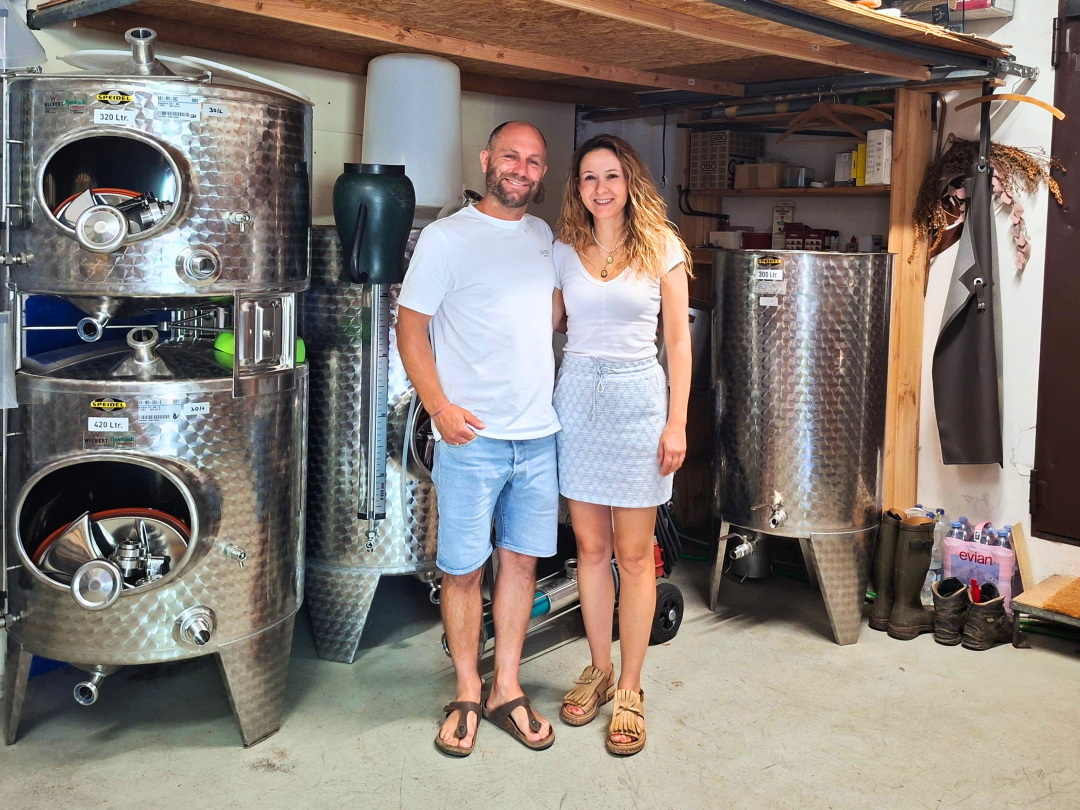
Martin and Annette Fusser in their garage in Niederkirchen, which lends its name to their boutique wine production, Garage Caveau.
Pfalz
The Pfalz really delivered in 2025. The wines benefit from natural concentration and juicy ripeness across the board. As Georg Fusser noted, this concentration also translated into “stable if moderate acid levels, and low pH with hardly any malic acid.” These wines are so easy to like, so bouncy, and even the entry-level Rieslings are filled with exuberance and joy. In an area as big as the Pfalz, experiences at individual estates differed; the only common theme was turbo harvests. Some, like the Rebholz family in Siebeldingen, picked in dry weather throughout, while the Jülgs in Schweigen, even further south, had a drenched harvest. In Kallstadt, Dominik Sona of Koehler-Ruprecht was caught in a September deluge mid-harvest, costing him a lot of yield due to sorting in an already low-yielding year. Rain also caught Karsten Peter in Bad Dürkheim during picking. That said, the estates I visited managed these circumstances by sorting very well. The Pfalz really rocks in 2025.
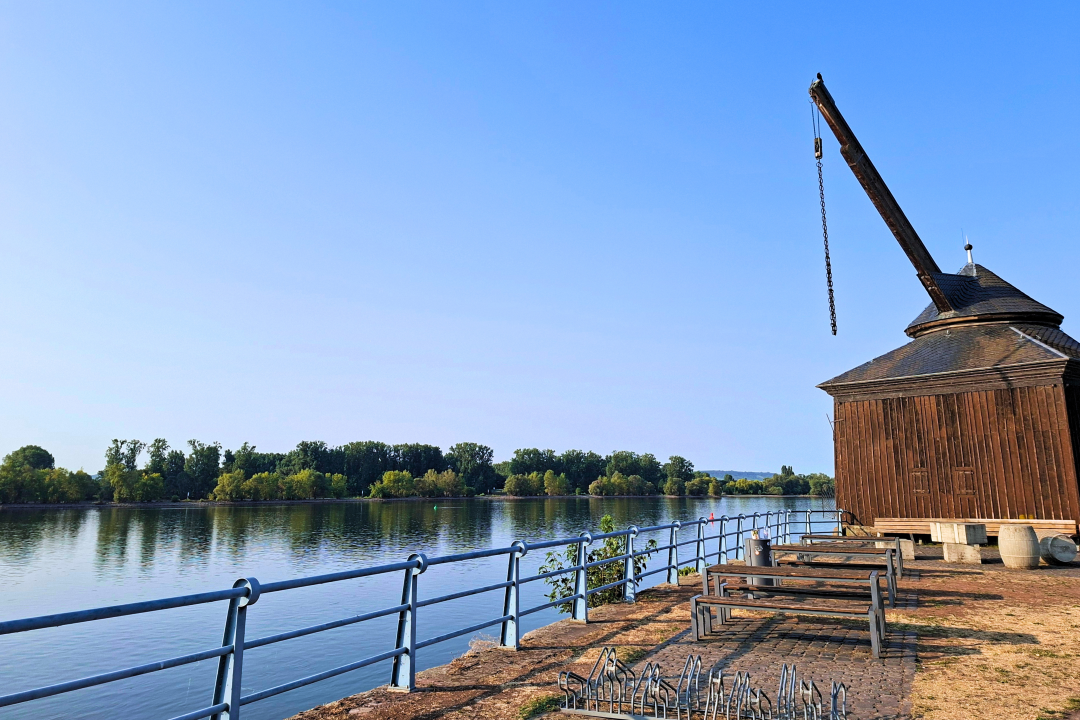
The famous Oestricher Weinkran, or wine-loading crane, dates back to 1744. It is a reminder that wine has always been central to the Rheingau.
A Word on Chardonnay and Pinot Noir
Across the Pfalz, I tasted Chardonnays that are as ambitious as they are excellent, a theme I also observed in Rheinhessen during my preceding trip. These wines are made by estates that have long farmed on limestone sites and began planting and producing Chardonnay when they already had awareness and expertise, choosing excellent genetic material and aging the wines in exquisite oak. This explains the relatively high level of quality, which comes, without fail, with proper and bright acidity. Unlike Chardonnay, which is a late arrival, Pinot Noir has a long history in Germany. Winemakers crafted stupendous Pinot Noirs in 2024. Last year, I reported how some winemakers had spoken of a “year of two vintages, one for Riesling, one for Pinot,” with the Pinot Noirs ripening well before the Rieslings in excellent sanitary condition before any rain. This is borne out by the beautiful 2024 Pinot Noirs tasted. The wines are elegant and pristine.
I tasted the wines for this report during estate visits in late July and early August 2026.
© 2026, Vinous. No portion of this article may be copied, shared or redistributed without prior consent from Vinous. Doing so is not only a violation of our copyright but also threatens the survival of independent wine criticism.
You Might Also Enjoy
2025 Rheinhessen-Nahe and Mittelrhein: Opulence, Clarity and Sweet Marvels, Anne Krebiehl MW, August 2026
Rheinhessen, Pfalz & Mittelrhein: A Game of Patience, Anne Krebiehl MW, September 2025
Rheingau and Nahe 2024: Rain, Frost and Unexpected Brilliance, Anne Krebiehl MW, September 2025
Rheinhessen & Rheingau: Riesling Triumphs After Rain, Anne Krebiehl MW, October 2024
Nahe, Pfalz & Mittelrhein–Of Wheat, Chaff and Thrill, Anne Krebiehl MW, September 2024
Show all the wines (sorted by score)
- Andres
- August Eser
- August Kesseler
- Bassermann-Jordan
- Bibo Runge
- Christmann
- Corvers-Kauter
- Dr. Bürklin-Wolf
- Dr Wehrheim
- Eva Fricke
- Fürst von Metternich
- Garage Caveau
- Georg Breuer
- Georg Fusser
- Heinrich Spindler
- Josef Spreitzer
- Jülg
- Karsten Peter
- Kloster Eberbach
- Knipser
- Koehler-Ruprecht
- Krone Assmannshausen
- Künstler
- Leitz
- Markus Schneider
- Odinstal
- Ökonomierat Rebholz
- Oliver Zeter
- Peter Jakob Kuehn
- Peter Jakob Kühn
- Pflüger
- Philipp Kuhn
- Reichsrat von Buhl
- Rings
- Robert Weil
- Schloss Johannisberg
- von Winning
- Wegeler
- Weingut George
- Weingut Kaufmann
- Weingut Meier
- Weingut Prinz
- Wein- und Sektgut Barth