
Browse using the new Vinous website now. Launch →
Printed by, and for the sole use of . All rights reserved © 2015 Vinous Media
Alsace 2024: A Rainy Year of Svelte Beauties
BY ANNE KREBIEHL MW | MARCH 24, 2026
I began last year’s report covering the 2023 vintage with the words dry, dry, dry. Another triple invocation aptly serves for 2024: wet, wet, wet. Winemakers described a spring of “persistent,” even “incessant” rain. The public news service FranceInfo reported May as a particular outlier. with “no less than 185 millimeters of cumulative rainfall, four times the average and five times more than during the same period in 2023.” Rainfall was well above average from June to October, and sunshine hours only briefly exceeded long-term averages between July and August, dropping sharply in September.
While the abundant rain came as a relief for nature and was a boon for newly planted vines, disease pressure was high. However, several winemakers noted that they had learned lessons in 2021 and went out to spray whenever there was a brief dry window. Occasionally, that meant spraying by hand, as the teams at Albert Mann and Domaine Weinbach did in some sites, or mobilizing staff to head out on weekends and holidays, as Thomas Boeckel, JB Adam and Trimbach did.
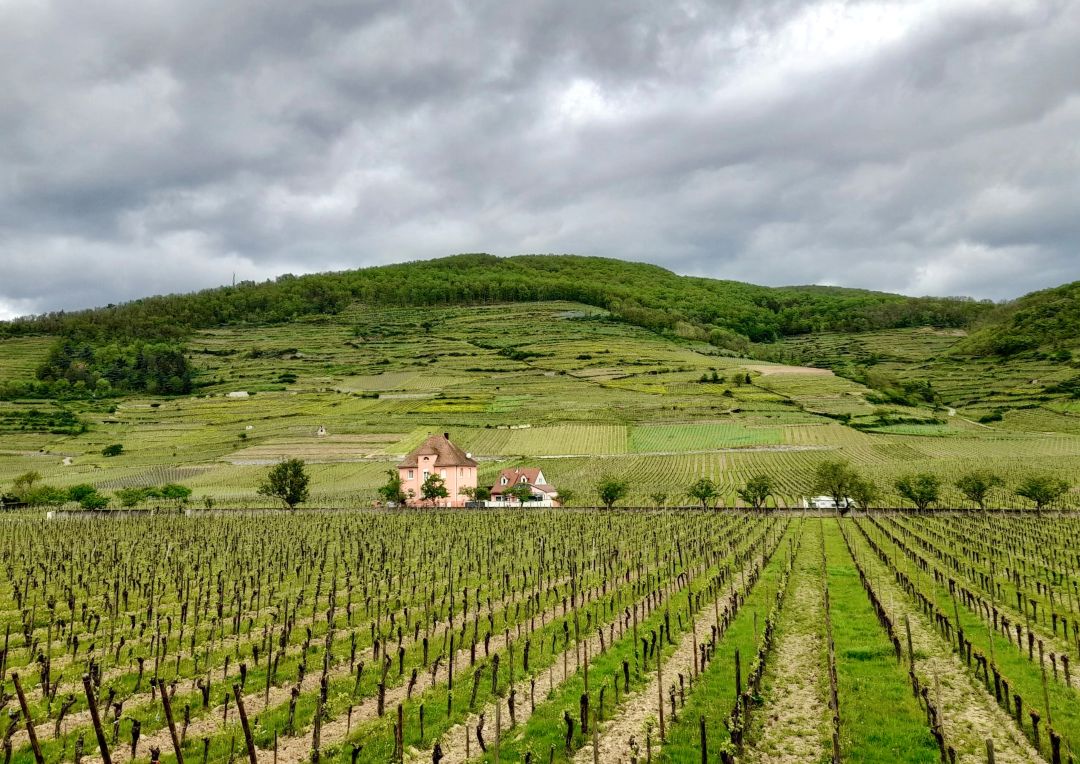
The various terraces and plots across the south-facing Grand Cru Schlossberg, as seen from the balcony at Domaine Weinbach.
More Challenges
Some winemakers described 2024 as their hardest year ever—several used the word “fight,” and one even called 2024 “traumatizing.” But rain was not the only difficulty. Budburst occurred in late March in the south and early April further north. Cold nights in late April posed a frost risk and some were hit, like Remy Gresser in Andlau and Alexandre Schoffit in his sites on the Colmar plain. Variable weather meant mixed flowering, and some winemakers reported poor fruit-set. Summer was punctuated by storms and local showers, and while nobody reported hail damage, ripening was slow. A warmer, sunnier and drier August helped everyone. The Meyer sisters at Josmeyer in Wintzenheim noted that September daytime temperatures rarely rose above the mid-teen Celsius mark. Nobody started picking until September, and harvest often lasted well into October. Some also had to contend with rain during harvest, fighting against grey, black and sour rot, which required careful sorting. Few winemakers chaptalized, and those who did only did so minimally. On the contrary, many welcomed the moderate alcohol levels as being right on trend with consumer preferences.
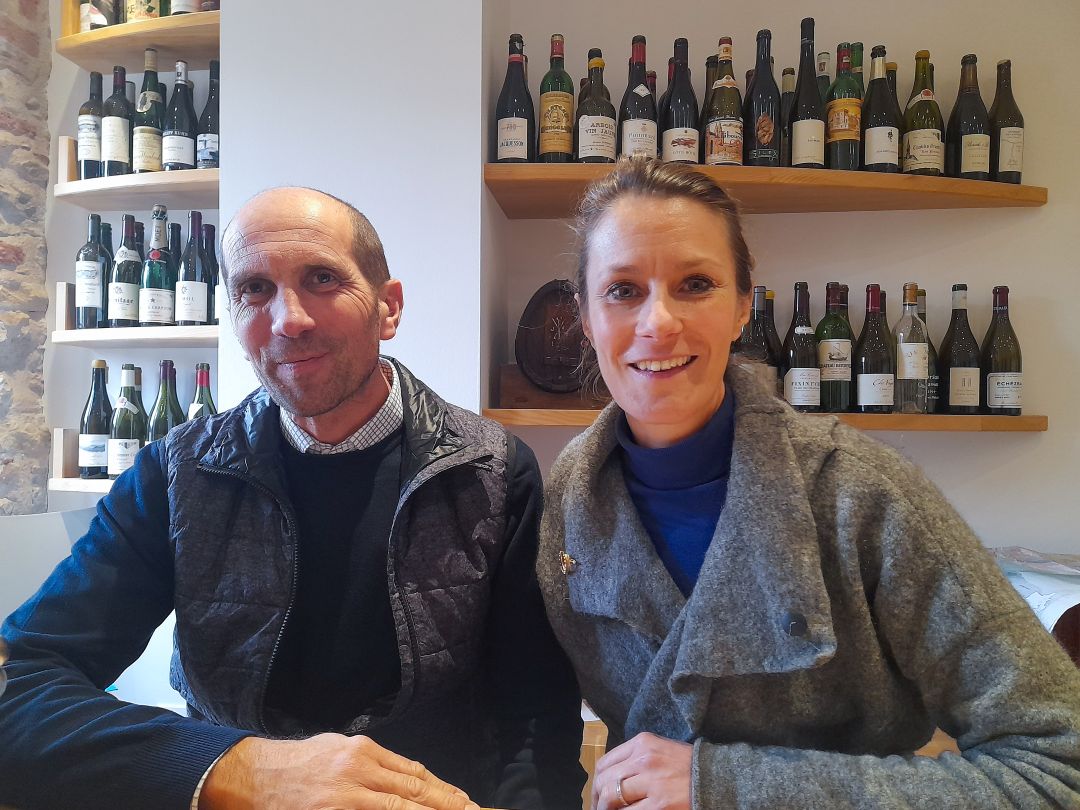
Christian and Valérie Beyer of Domaine Emile Beyer in Eguisheim.
Low Yields
Of course, the challenges of the 2024 growing season resulted in reduced yields. Frost damage was minimal, but mildew damage was considerable for some during May and June. Others managed to preserve all their fruit through the rain, but losses then came via sorting at harvest. Mélanie Pfister in Dahlenheim, close to Strasbourg, reported 30-40% losses for the thin-skinned Pinot varieties. Deiss in Bergheim and Trimbach in Ribeauvillé lost up to 30% of their average yields. Pierre Gassmann of Rolly Gassmann only brought in one-fifth of his long-term average, as did Kirrenbourg in Kaysersberg.
The combination of less ripeness and low yields led many to declassify fruit. This move was not necessarily motivated by qualitative concern but by the desire to make up volumes of the faster-moving entry-level wines, as was the case for Maison Moritz-Prado in Albé and Domaine Trapet in Riquewihr. These producers did not make some of their usual single-parcel bottlings, instead using that wine to bolster volumes elsewhere. Others, like Schlumberger in Guebwiller, Muré in Rouffach or Dirler-Cadé in Bergholtz, sold substandard fruit in bulk or for distillation, preferring zero profit or even losses to compromising their wine quality.
Jean-Michel Deiss in Bergheim, who had last seen such rainy days in the 1980s, said, “Over the past 20 years, whenever you worked well in your vineyards, with low yields, you were guaranteed to harvest good grapes. This is no longer the case. Doing good work is no longer enough.” Producers who did all the work still absorbed heavy losses with the increasing vagaries and caprices of the weather. There was a lot of input for often little yield. However, despite the diminished quantities, Alsatian wines remain remarkably well priced compared to other classic French regions.
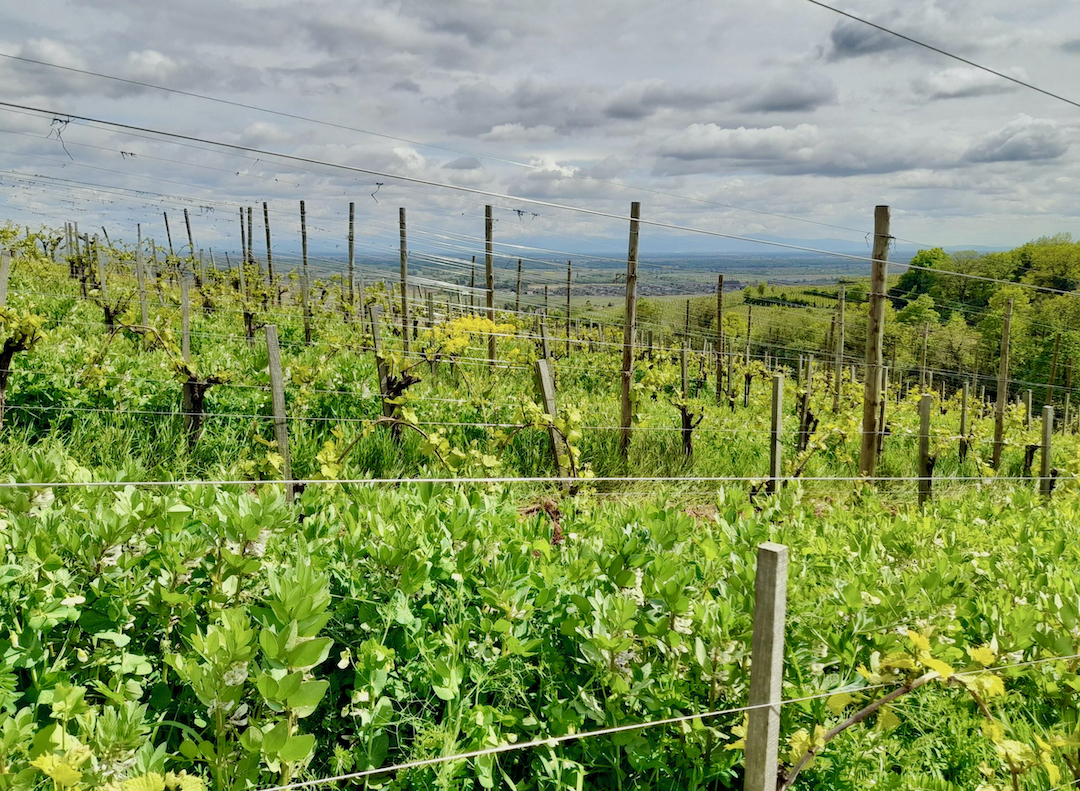
Spring cover crops have become an integral part of vineyard and soil management in Alsace.
Svelte Styles and Unusual Gewurztraminers
Across the board, the 2024s are lighter in alcohol, bright and fresh. In pre-climate-change days, this could have been described as “classic”—a kind of classic that no longer exists. But low yields also spell concentration, so the wines possess depth of flavor, just not necessarily power. This is particularly true of Rieslings in excellent and well-drained sites. The Schlossberg Rieslings, for instance, are brilliant examples of this.
In 2024, Pinot Gris often comes with less muscle and bulk, something that suits the variety well. The real surprise is Gewurztraminer, which occasionally had difficulty ripening, not clocking up its usual high sugar levels or heady rose oil aromatics. This meant that much Gewurztraminer was declassified due to “a certain lack of richness,” as one winemaker put it. But for me, these wines hit a nerve. Though I usually reserve my highest praise in Alsace for Riesling and Pinot Noir, the 2024 Gewurztraminers show a side I’ve rarely encountered before: alluring aromas, unusually thrilling brightness and captivating scentedness rather than full-blown perfume.
We will have to wait for the 2024 Pinot Noirs until next year, of course. Only absolute die-hards like Pierre Gassmann of Rolly Gassmann consistently made vendanges tardives and sélections de grains nobles, but he was only able to accomplish that because he has a specialized team and was willing to sacrifice a significant portion of his yields.
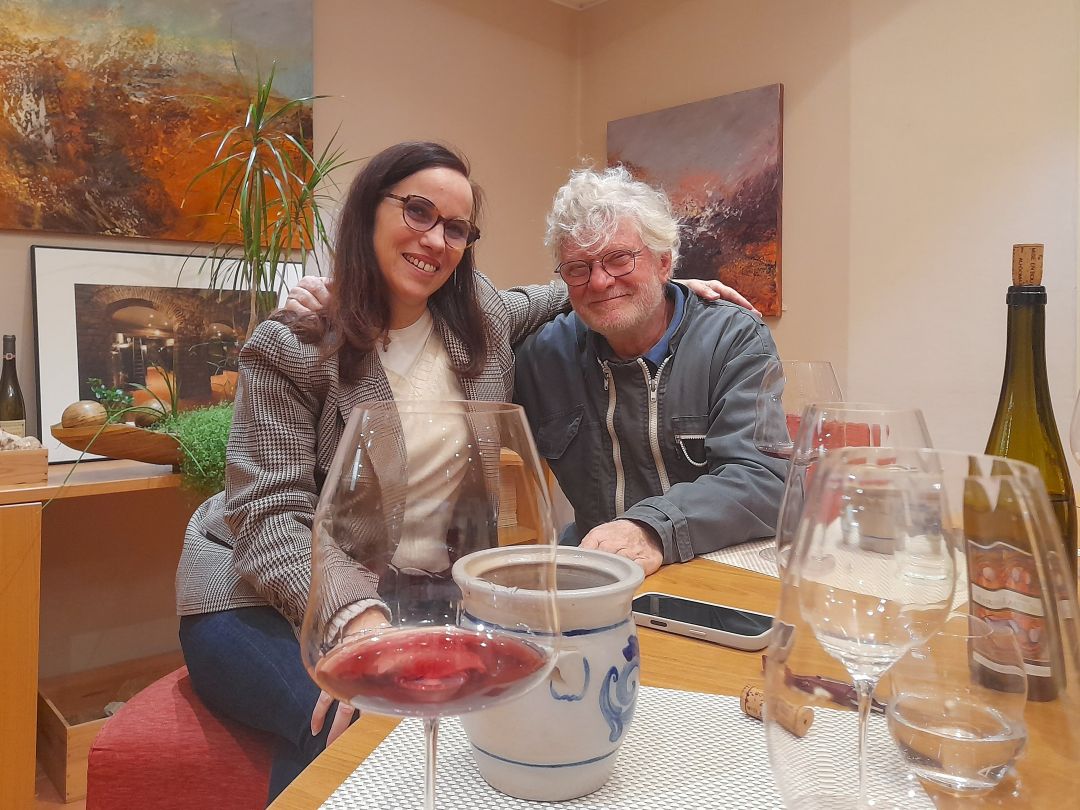
Marie-Hélène and Jean-Michel Deiss presented a stunning collection of wines in their Bergheim tasting room.
Crémant: A Notable 50th Anniversary
Two thousand twenty-six marks the 50th birthday of the Crémant appellation, granted in 1976. Over the past decade, Crémant has become the motor behind the entire region. According to the Comité Interprofessionnel des Vins d'Alsace (CIVA), Crémant accounted for only 25% of the total Alsace output in 2005, but by 2025, that number had risen to 40%. That is entirely in line with market trends, a function of the specialisation of various cooperatives that are able to push out considerable volumes of perfectly correct but somewhat uninspiring fizz. However, the impending mega-merger of two large cooperatives—Wolfberger and Bestheim—that I reported on in 2024 was cancelled due to a lack of support from members.
Be that as it may, Alsace is still France’s second sparkling powerhouse—well behind Champagne in both volume and quality, with the vast majority of sparkling wines sold in supermarkets at cheap prices. But here and there, quality is catching up. Hugel presented another ambitious Crémant and reported that the first batch presented last year sold out within a week. Zind-Humbrecht debuted their very first Crémant, an ambitious Blanc de Blancs. Schlumberger is also in the trial stage, looking to diversify and use their considerable Pinot Blanc holdings to good advantage. Various estates I visited for this report have a long history of producing a more artisanal style of Crémant, such as Boeckel, JB Adam, Dirler-Cadé and Muré. Given the ambition, approach and patience of these estates, we will likely begin to see real gems in another decade.
In that respect, I can only say S'gelt! (which means cheers in the Alsatian dialect).
I tasted all the wines for this report during estate visits in Alsace in January 2026.
© 2026, Vinous. No portion of this article may be copied, shared or redistributed without prior consent from Vinous. Doing so is not only a violation of our copyright but also threatens the survival of independent wine criticism.
You Might Also Enjoy
Alsace 2023: Astonishing Whites and Splendid Reds from a Complex Year, Anne Krebiehl MW, April 2025
Alsace 2022 Reds: Continuing Their Trajectory, Anne Krebiehl MW, May 2024
Alsace 2022 Whites: A Lucky Escape, Anne Krebiehl MW, April 2024
Alsace 2020s and 2021s: Just like Janus, Anne Krebiehl MW, April 2023
Show all the wines (sorted by score)
- Albert Boxler
- Albert Mann
- Barmès-Buecher
- Dirler-Cadé
- Domaine Amélie & Charles Sparr
- Domaine Bott-Geyl
- Domaine Charles Baur
- Domaine Emile Beyer
- Domaine Hunter-McKirdy
- Domaine Kirrenbourg
- Domaine Léon Beyer
- Domaine Mélanie Pfister
- Domaine Rémy Gresser
- Domaines Schlumberger
- Domaine Trapet
- Domaine Weinbach
- Dopff au Moulin
- Emile Boeckel
- Etienne Loew
- Famille Hugel
- Henry Fuchs
- Jean-Baptiste Adam
- Josmeyer
- Julien Schaal
- Kuentz-Bas
- Maison Moritz Prado
- Marcel Deiss
- Ostertag
- Rolly Gassmann
- Schoffit
- Sophie Schaal
- Trimbach
- ValentinZusslin
- Véronique & Thomas Muré - Clos Saint Landelin
- Zeyssolff
- Zind Humbrecht