
Browse using the new Vinous website now. Launch →
Printed by, and for the sole use of . All rights reserved © 2015 Vinous Media
A Landmark Vintage: 2023 Margaret River Cabernet Sauvignon
BY ANGUS HUGHSON | JANUARY 15, 2026
The serenity of Margaret River is always striking for first-time visitors, as it must have been for the early vignerons who explored the region in the 1960s. There’s natural beauty in spades, with more than a hint of surf culture, but also a nostalgic appeal. Vineyards and farms are dotted between vast tracts of tall forests, bordered by white sands and aquamarine waves. The occasional appearance of great white sharks reminds us that this part of the world remains untamed and a little wild, which is an important part of its charm. You can find biodiversity at every turn in Margaret River, as the environment is brimming with life. Vineyards take up only a small part of the overall region, with national parks, untouched bushland and farmland breaking up the viticultural patchwork.
Natural energy and fruit brightness are hallmarks of Margaret River’s wines. Whether a function of said biodiversity, the unspoiled natural environment or its seaside location, there is a tangible and very special quality about wines from this corner of Australia. Similarly, the local winemakers carry a unique flair and can-do attitude that has served them well over recent decades.
At the time of my most recent Margaret River report in 2024, it was the excellent 2022 Chardonnays and 2020 Cabernet Sauvignons that stole the show. The weather in subsequent vintages has been out of the ordinary, with a string of dry summers. The key question is how these conditions impacted fruit quality and winemaking styles. What do these changes tell us about the future of wines from this isolated corner of Australia?
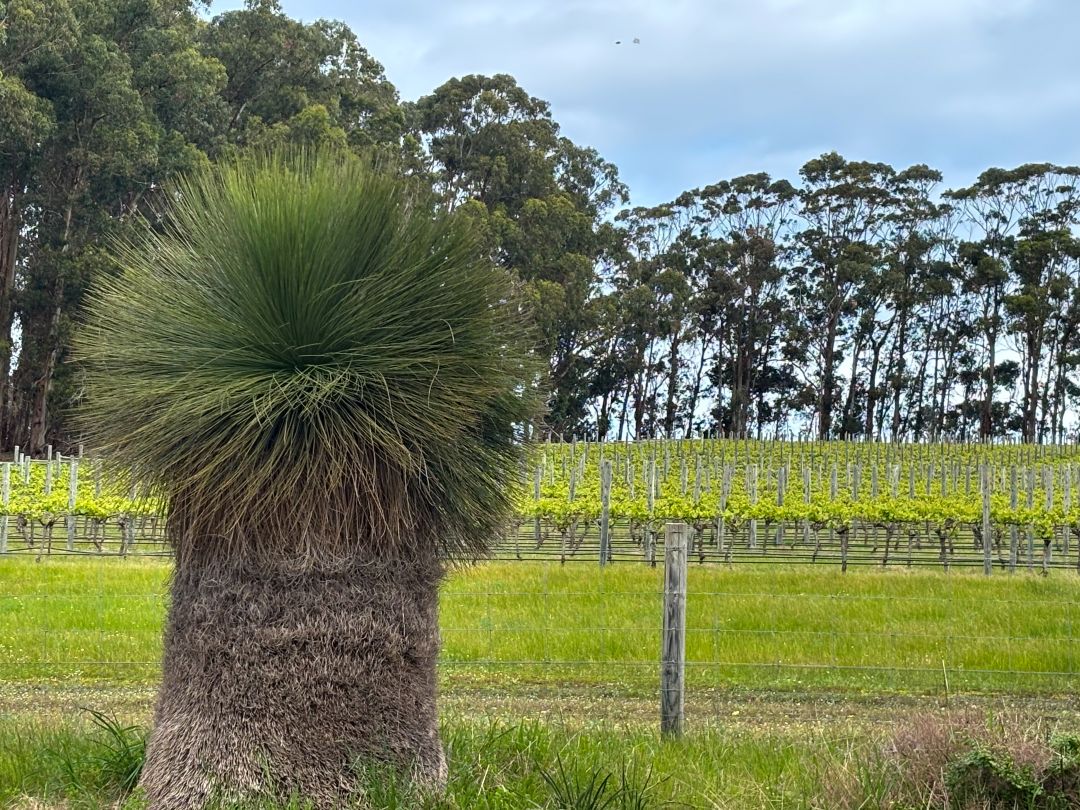
Margaret River's natural landscape is dotted with local grass trees, some of which are up to 2,000 years old.
Shifting Sands
In some ways, Margaret River is perplexing. On the one hand is the region’s well-deserved reputation for outstanding Chardonnay, renowned for purity and brightness of powerful fruit in a modern, mid-weight, acid-driven style. Many of the plantings here are the local Gingin clone, which is typically affected by millerandage and originates from historic Californian vine stock. Burgundian clones are becoming increasingly common, notably the Montrachet-sourced P58.
On the other hand are Margaret River’s stylish Cabernet Sauvignons, historically known as fine, perfumed expressions of the variety. These wines are highly unique due to the region’s maritime climate on the Australian mainland. Here, the local and historic Houghton clones reign supreme and underpin most of the region’s top red wines.
These two marquee varieties share the spoils, aided by metronomic seasonal patterns (the last truly challenging vintage was in 2006). But while the climate is generally quite dependable, the story is, of course, much more complex. For example, tropical storms originating from northwestern Australia will occasionally barrel down the coast and drop significant rainfall, as occurred in 2021 more than once. But whatever the growing season brings, this remains one of Australia’s most aspirational wine regions, with its eyes firmly (and reasonably) set upon the global stage.
While the vintages of recent decades have been relatively placid for vignerons, there are certainly signs of change. Margaret River has occasionally been home to leafier expressions of Cabernet Sauvignon and Chardonnays with dominant acidity. Over time, local winemakers have embraced these styles and honed their skills to create highly individual wines, although what were typical seasons are now becoming much less common.
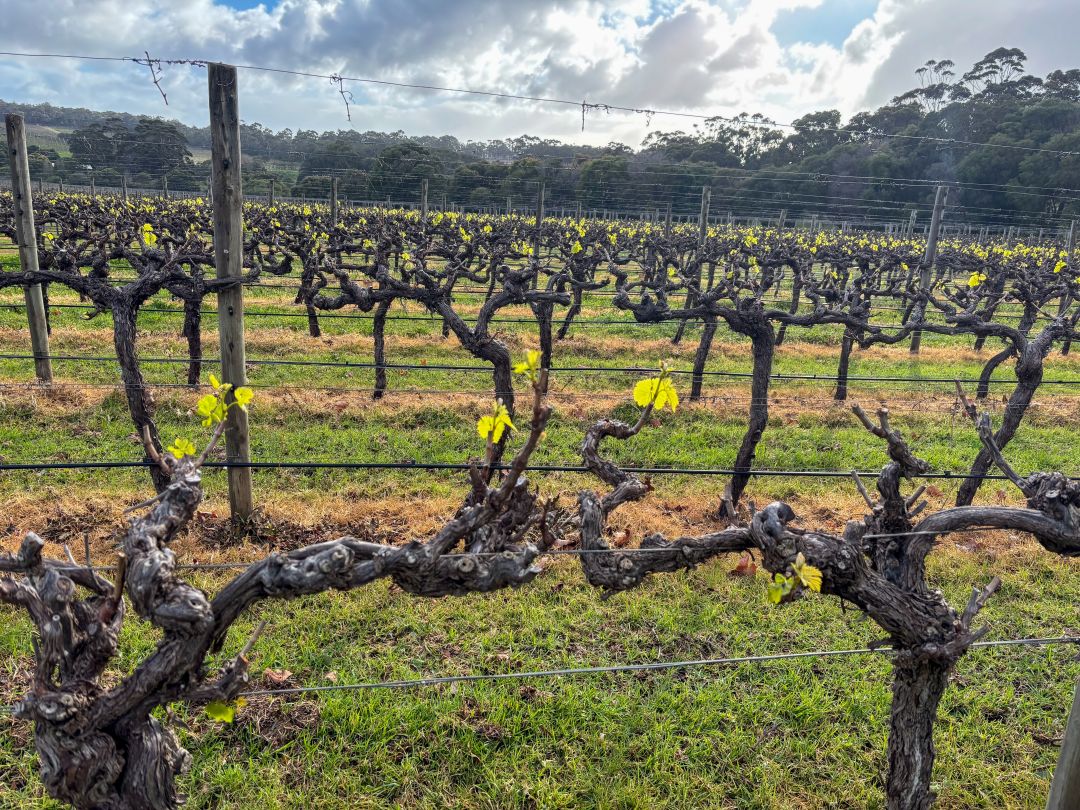
Budburst at the historic Brookland Valley vineyard, which overlooks Wilyabrup Brook.
Statistics from recent years show a remarkable stretch of dry conditions from 2023 to 2025, in particular 2024 and 2025, where below-average rainfall was matched with above-average mid-summer temperatures. Lower-than-average rainfall has increasingly become the norm, as has the absence of frosty seasons—some winters have not been cold enough for Chardonnay to go into full dormancy. That said, we are not talking about desert-like conditions, as Margaret River has historically been a temperate region. For example, the mean mid-summer temperature in 2024 and 2025 was 21.9 °C, similar to Bordeaux. So, the question is whether these drier and warmer conditions are a challenge, an opportunity or both?
The first answers can be found in 2023, which is a hallmark vintage across the board. The year started well, with a genuinely cold winter that saw the best dormancy period in years. This was particularly useful for Chardonnay, which requires lower temperatures to fully rest between vintages. Spring rainfall was lower than average but adequate, although the cold weather delayed budburst and flowering by up to three weeks. However, the rain was more than adequate, and spring brought a fairly uneventful flowering, with only scattered light showers in November. This resulted in yields a little above average, as well as good canopy development. The summer was temperate and, most importantly, very dry. Only 2 millimetres of rain fell, so there was minimal disease pressure. Crucially, there were no extreme heat spikes, allowing the fruit to march towards harvest in pristine conditions. Old vines were particularly advantageous in 2023, as their deep root systems ensured a lack of dry stress.
For Jacopo Dalli Cani, Chief Winemaker at McHenry Hohnen, there was another powerful factor at play: “Excellent diurnal temperature variations were a constant feature across January, February and March. I believe that was one of the key factors for highly aromatic, powerful Chardonnays that retained great natural acidity and site-specific flavours.” White wines were picked at will under dry conditions in February and into March. For the red wines, a few isolated showers fell in March, which energised the vines toward the end of the growing season.
Consistent with long-term patterns, heavier rain returned in the second week of April, followed by a couple of weeks of warm weather and patchy showers. For most quality-conscious growers, this rainfall was not a problem. Some, such as Cullen Wines, had chosen to pick their fruit early. For others, the fruit had already developed thick, tannin-rich skins to protect themselves from precipitation. The rain did negatively affect some cooler sites and high-yielding Cabernet Sauvignon vineyards. According to well-known local winemaker Larry Cherubino of Cherubino Wines, “Sites that ripened early came in extraordinarily well. Those that had to push into late April or early May just didn’t make it.” For Bruce Dukes, local consultant and Chief Winemaker at Domaine Naturaliste, riding out the rainfall was risky but yielded great outcomes: “It was certainly a fortune-favours-the-brave scenario,” Dukes told me. “By waiting and risking the crop, we achieved some of the most amazing Cabernet I have worked with in the last 35 years.”
For the red wines from Margaret River, including Shiraz, Merlot and local stalwart Cabernet Sauvignon, 2023 is a vintage of rare synergy. The moderate conditions helped to retain pristine, effortless aromatics with fabulous purity, while the lack of rainfall provided fruit density, tannic structure, and the characteristic local energy and fruit vibrancy. That little touch of rain at the end of the season may have been a blessing rather than a curse, imbuing the wines with a lovely, even flow and a sense of balance. After all, bigger is not always better. For producers not tripped up by the final weeks of the growing season, 2023 is a year of the highest quality, a once-in-a-decade vintage that is sure to thrive in the cellar. Both Chardonnay and Cabernet Sauvignon are beautiful, but the reds just shade the whites.
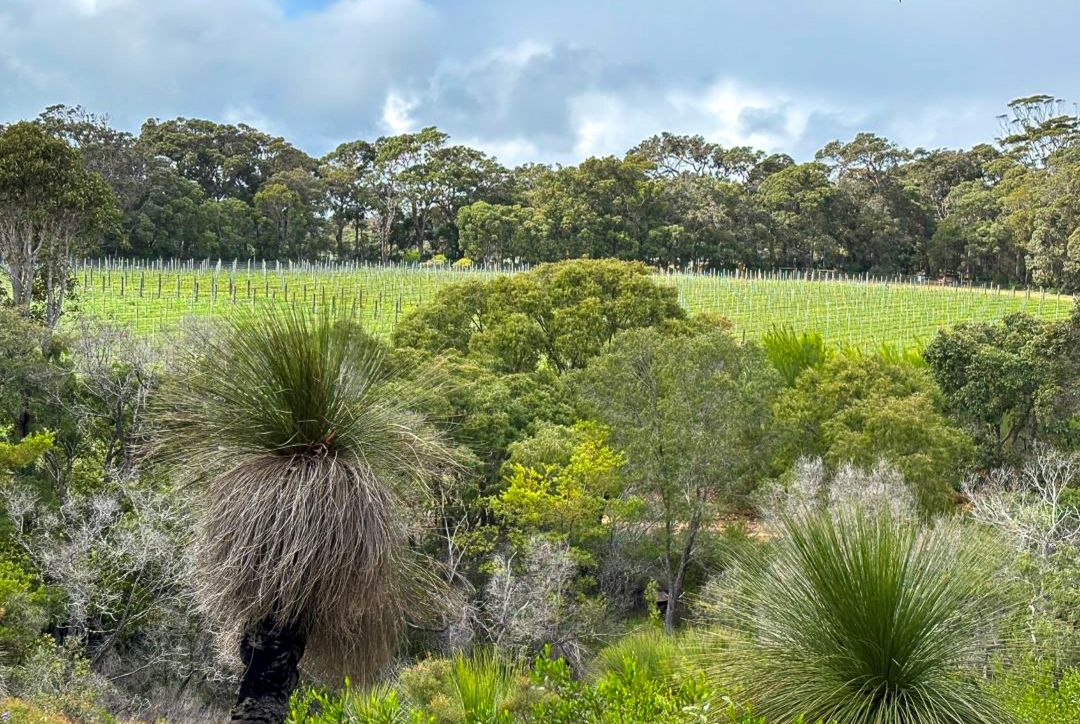
The Corymbia vineyard, bordered by natural bushland and the Calgardup Brook.
In some ways, 2024 was similar to 2023. A cool, wet winter helped to replenish groundwater supplies. Rain remained plentiful until early October, when the growing season hit the ground running with above-average temperatures. The bone-dry weather continued for all the way through harvest, leading to smaller bunches and below-average yields. Temperatures remained above average through the spring and summer, with numerous heat spikes, the worst of which were in February. The warm spring brought an earlier-than-normal budburst, which thankfully saw picking begin in mid-January. Much of the white harvest was done prior to the February heat spell, and red grapes were picked soon thereafter. In the end, 2024 was the warmest and driest vintage in Margaret River’s history, and a tough one for winemakers in terms of choosing when to pick. Processing fruit and fermenting juice also presented timing challenges in a highly compacted vintage, with the usual ten-week harvest compressed into five weeks. However, there was one significant silver lining, and that was the abundance of the Marri blossom, which only occurs around every four years. For dry vintages in particular, the native silvereye birds can be a menace, causing significant damage to fruit. Thanks to the Marri blossom, which kept the attention of silvereye away from the rapidly ripening fruit, this was not an issue in 2024.
As most of the 2024 red wines are yet to be released, it is difficult to fully assess how quality will play out but suffice it to say that the 2024s will be very different from the 2023s. Barrel tastings showed many wines with excellent power and colour, but they are a little muscular and lack the finesse of 2023. Perhaps the 2024s will settle down with some more time in barrel and bottle.
Given the season, it would be easy to deem 2024 a write-off for Chardonnay, but nothing could be further from the truth. Despite challenging conditions, the vines showed excellent resilience, and winemakers who embraced the full-flavoured vintage rather than trying to tame it were highly successful. The advantages of the Gingin clone and its adaptability to warmer conditions are again on display, with many of the top wines significantly or wholly reliant on this unique genetic material. The wines are certainly more broad-shouldered than the modern, streamlined Margaret River style, but they are no less delicious. Perhaps this is a snapshot of Margaret River’s future.
I tasted the vast majority of these wines in Margaret River during my visit in September 2025, with follow-up tastings in Sydney.
© 2026, Vinous. No portion of this article may be copied, shared or redistributed without prior consent from Vinous. Doing so is not only a violation of our copyright but also threatens the survival of independent wine criticism.
You Might Also Enjoy
Australian Syrah: The Quest for Refinement, Angus Hughson, January 2026
Barossa and Clare Valley: The Champion and the Contender, Angus Hughson, August 2025
The Second Coming of Australian Chardonnay, Angus Hughson, June 2025
McLaren Vale: Pushing the Envelope of Refinement, Angus Hughson, April 2025
The Yin and the Yang of Western Australia, Angus Hughson, May 2024
Show all the wines (sorted by score)
- Apricus Hill
- Brookland Valley
- Brown Hill Estate
- Cape Mentelle
- Castle Rock Estate
- Cherubino
- Corymbia Wines
- Cullen Wines
- Deep Woods Estate
- Devil's Lair
- Domaine Naturaliste
- Duke's Vineyard
- Evoi Wines
- Flametree
- Forest Hill Vineyard
- Frankland Estate
- Gralyn Estate
- Harewood Estate
- Higher Plane
- Houghton Wines
- Howard Park Wines
- Juniper
- LAS Vino
- Leeuwin Estate
- Lenton Brae
- McHenry Hohnen Vintners
- Moss Wood
- Oates Ends
- Passel Estate
- Peccavi Estate
- Rosily Vineyard
- Singlefile Wines
- Stella Bella
- Swinney
- Trait
- Vasse Felix
- Voyager Estate
- Wayfinder
- Woodlands
- Xanadu
- Yaari-Karri