
Browse using the new Vinous website now. Launch →
Printed by, and for the sole use of . All rights reserved © 2015 Vinous Media
Jura: France's Mysterious Outsider
BY NICOLAS GREINACHER | AUGUST 6, 2026
From the dramatic limestone escarpments of Château-Chalon to the rolling vineyards of Arbois, Jura continues to enjoy near-mythical status in the world of wine. Spending a few days in this eastern French region is invariably stimulating, not only because of the singular wines, but because nowhere else have I encountered such a remarkable diversity of wine styles, viticultural approaches and cellar philosophies within such a compact area. This year's report opens with an assessment of the 2025 growing season before reviewing the newly bottled 2024s. This coverage includes over 300 wines from 50 producers spanning every major Jura wine style, including Crémant and Vin de Paille.
In recognition of the Château-Chalon AOC’s 90th anniversary, I have dedicated a special section to the appellation, exploring its terroir, history and unique winemaking traditions. The report concludes with an appraisal of the newly released 2019 Vin Jaunes and Château-Chalons, together with an early look at the 2026 growing season, which, at the time of writing, is on course to become the earliest on record. Jura may no longer be France’s best-kept secret, but it remains its most mysterious outsider.
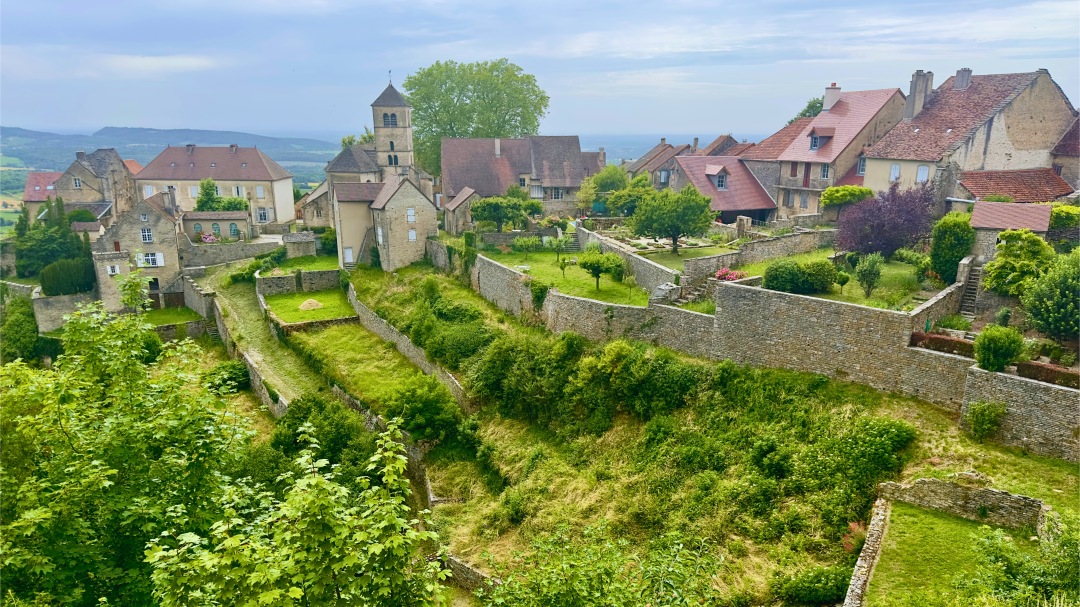
The historic village of Château-Chalon in June 2026.
The 2025 Growing Season
Two thousand twenty-five was marked by precocity from budbreak through to harvest. February and March were warm and fairly dry, with temperatures up to 2.4°C (4.3°F) above the 1991-2020 mean. Rainfall remained limited until April, when precipitation rose to 30-40% above long-term averages. May brought temperatures closer to seasonal norms, while throughout spring, sunshine consistently exceeded long-term recordings.
June ushered in the year’s first heat wave, with temperatures up to 4°C (7.2°F) above average and exceptionally high sunshine hours. Heavy rainfall early in the month was followed by an extended spell of hot, dry weather. Occasional poor fruit set (coulure) was observed, with many affected producers noting that Trousseau was more susceptible than other varieties. July proved more variable — southern Jura remained comparatively dry, while northern sectors received frequent and abundant rain. Thunderstorms on July 20 caused localised hail damage, particularly in the northern areas.
A second heat wave in early August reduced berry size, with water stress most evident in sites with young vines, free-draining soils and parcels with significant grass competition. Conditions changed abruptly on August 19 as the onset of regular rainfall and cooler temperatures brought summer to an end. Unsettled weather continued into harvest. Hélène Berthet-Bondet of Domaine Berthet-Bondet in Château-Chalon recalled, "It felt as though every week brought a different season. I even cut my summer holidays short to begin harvest earlier, expecting rapid ripening. Instead, temperatures fell, rain arrived and ripening slowed. We ended up harvesting in three stages, which made logistics particularly challenging." Most producers began picking grapes for Crémant du Jura at the end of August.
September remained close to average for both temperature and rainfall, although sunshine was well below the norm. While cooler conditions ultimately favoured slow and even ripening, Trousseau — Jura's latest-ripening red variety — proved the most challenging to harvest, with pre-harvest rainfall occasionally damaging bunches and necessitating rigorous sorting. “For the red varieties, the goal was to obtain phenolic ripeness early to avoid exposing the grapes to uneven autumn weather,” said Benjamin Benoit of Cellier Saint Benoit.
Overall, 2025 combined an unusually early vegetative cycle with a highly changeable summer. Repeated heat spikes were tempered by regular rainfall from late August onwards, resulting in moderate yields (generally between 30 and 35 hectolitres per hectare) that exceeded the low-yielding, frost-affected 2021 and 2024 vintages yet remained below the more generous 2023 crop. Mildew pressure was low throughout the 2025 season, with growers requiring only around half as many treatments as in 2024.
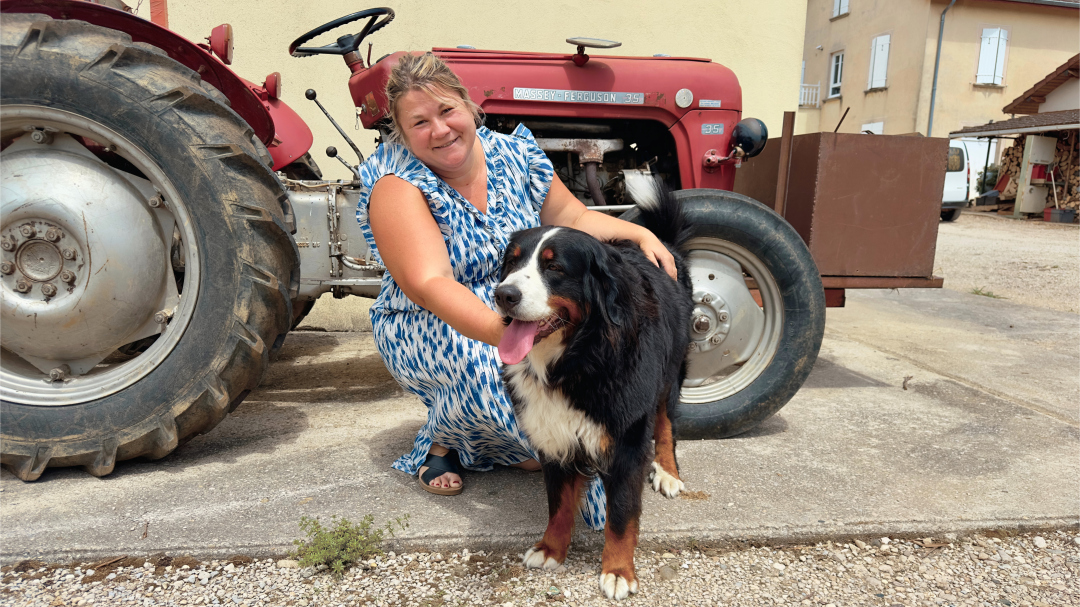
Alexandra Mossu is one of the brightest talents of Jura’s new generation of vignerons.
At this early stage, the 2025 reds strike a fine balance between the generosity of a warmer season and the freshness of a cooler one. Lower yields delivered ample flavour concentration, while the wines avoid the fruit richness and elevated alcohol levels of the hot, dry 2022 season. Instead, the 2025s show fresh, well-defined fruit, moderate alcohol and great balance. Among the reds I tasted, Poulsard is particularly compelling, combining fragrant aromatics with notable purity. My assessment of the topped-up (ouillé) whites will follow in next year's report.
2024s In Bottle
Many 2024 whites turned out very well, at times reaching outstanding quality levels. Chardonnay, in particular, excelled, delivering fresh fruit, vibrant acidity and a sleek mineral edge. The vintage yielded whites of clarity and aging potential, making 2024 a very good year pour les blancs. Among the wines I tasted from barrel, Bénédicte & Stéphane Tissot's Arbois Chardonnay Clos de la Tour de Curon shines brightest. Across the bottled whites, Domaine du Pélican's Arbois Chardonnay En Barbi and Arbois Savagnin Grand Curoulet Ouillé are both exceptional.
The reds are defined by equally fresh fruit profiles, moderate alcohol and a cool-toned character. Their naturally vibrant acidity accentuates the perception of freshness, though some wines possess unripe tannins. Nevertheless, estates that succeeded in harvesting clean, phenolically ripe grapes and exercised restraint during maceration were able to produce wines of impressive finesse, making 2024 an acceptable to good red wine vintage that delivered more positive surprises than might have been expected. Kudos to Cellier Saint Benoit and Lucien Aviet & Fils for delivering some of the finest reds of the vintage.
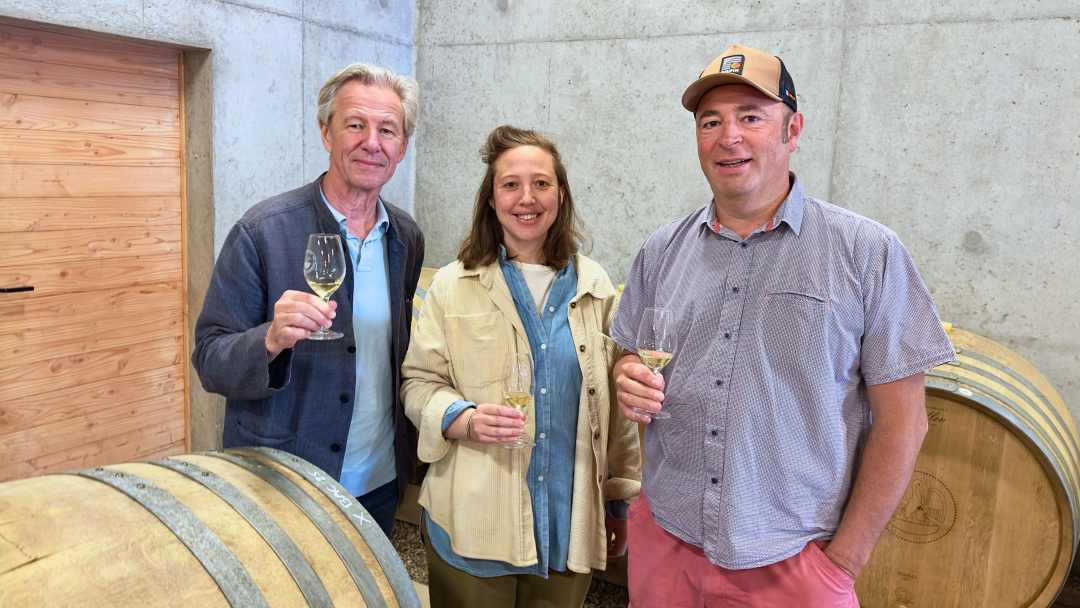
From left to right: Guillaume d'Angerville, his daughter Margot d’Angerville, and François Duvivier at Domaine du Pélican, whose 2024 whites rank among the estate's finest to date.
Château-Chalon: Terroir and Winemaking
Ninety years after its creation in 1936, Château-Chalon remains one of France's most distinctive appellations. Today, roughly 50 hectares of vineyards are dedicated to the production of Château-Chalon, although the AOC covers roughly 90 hectares, leaving potential for future expansion. The village of Château-Chalon sits atop a stunning limestone escarpment and the vineyards occupy the gentler slopes below, where softer Jurassic marls form the geological foundation of the appellation. Atop these marls rests a variable layer of fine silts and clay produced through the weathering of limestone and centuries of downslope erosion. The depth and composition of this superficial layer vary across the hillside: sites closer to the escarpment generally contain more limestone fragments, while lower positions have deeper accumulations of fine material. Beneath them, grey marl is widespread throughout the region.
In fact, grey marl is the defining substrate of Château-Chalon. Composed predominantly of clay minerals with a smaller proportion of dispersed limestone, grey marl can appear pale grey, dark grey or bluish-grey, giving rise to the local expression “marnes bleues.” According to French geologist Michel Campy, these marls were deposited in a calm, oxygen-poor Jurassic Sea where organic matter only partially decomposed before burial. In certain locations, the marl exists as finely laminated layers known locally as schistes cartonnés. Although comparable grey marls occur elsewhere across Jura, their continuous presence beneath Château-Chalon provides the geological framework upon which the appellation has developed.
Variations in superficial soil thickness create important differences between individual vineyard sites. In Gaillardon, for example, the marl may lie only around 20 centimetres (8 inches) below the surface, limiting soil moisture reserves and making vines more susceptible to drought. Elsewhere, superficial deposits can exceed 80 centimetres (32 inches), providing greater rooting depth and water availability. The wider landscape itself was shaped by Alpine compression, when the Jura mountains were thrust westwards along underlying salt-rich marls, creating the folded geological structure that defines the region today.
Savagnin's affinity for these clay-rich marl soils is central to Château-Chalon's identity. The variety’s thick-skinned berries enable healthy fruit to remain on the vine during Jura's traditionally long growing seasons and late harvests, while Savagnin’s naturally low pH and high acidity allow for the balance required for prolonged aging under the yeast layer known as voile.
Yet geology alone does not explain Château-Chalon's distinctiveness. As Michel Campy argues, the appellation's distinction lies not in possessing a unique soil, but in centuries of human understanding of that soil. Generations of growers recognised Savagnin's compatibility with grey marl and refined the art of aging the wines under voile. At the same time, the Benedictine abbesses of Château-Chalon helped establish the wine's reputation throughout the Middle Ages, laying the foundations for its enduring prestige. Château-Chalon's identity therefore rests on the convergence of an exceptional geological setting, a grape variety uniquely adapted to it and a centuries-old viticultural tradition dedicated to producing one of the world's most singular and ageworthy wines.
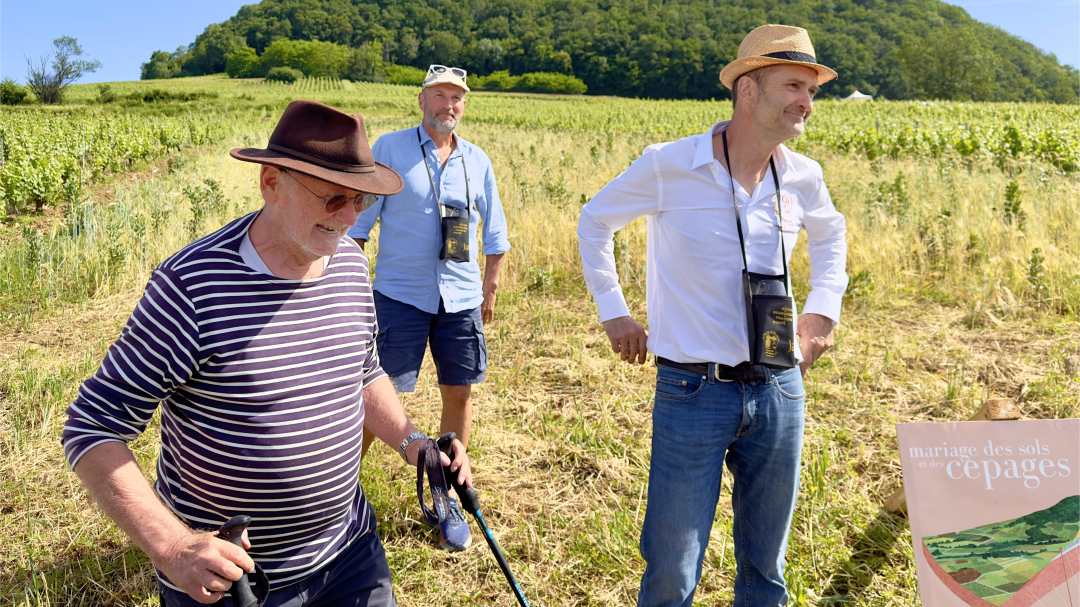
Geologist Michel Campy (left) explaining Château-Chalon's unique terroir during the AOC's 90th anniversary celebrations, with Stéphane Tissot (centre) and Laurent Macle (right).
In the cellar, the production of Château-Chalon begins with ripe Savagnin grapes, harvested with the aim of producing a base wine of at least 13% potential alcohol while preserving the variety's naturally high acidity. This balance of ripeness and freshness is essential for a wine intended for extended aging sous voile. Harvest may be carried out either by hand or machine, as the appellation imposes no requirement for one method over the other. Likewise, producers remain free to choose between indigenous or selected yeasts for fermentation. After pressing, the must undergoes alcoholic fermentation with the overriding objective of achieving a complete fermentation in which all fermentable sugars are converted into alcohol.
Malolactic fermentation is optional but generally carried out. Together with alcoholic fermentation, it helps stabilise the wine microbiologically before its prolonged period of biological aging. Alcoholic fermentation takes place immediately after harvest, while malolactic fermentation is usually completed before winter, although some fermentations continue into the following spring as cellar temperatures rise. Once malolactic fermentation is complete, many producers add a modest dose of sulphur dioxide (SO2) to protect the wine. The dose is kept low, as excessive SO2 would inhibit the development of the voile. When the wine is transferred to cask — typically in the spring or summer following harvest — the barrels are left partially unfilled, creating the ullage needed for the voile to develop. By then, much of the added SO2 has been bound or consumed, and little or no free SO2 remains to impede the growth of the yeast layer.
Regulations require Château-Chalon to be aged until December 15 of the sixth year following harvest, including a minimum of five years in barrel under voile without topping up, which is why 2019 is the most recent available vintage.
2019 Vin Jaune and Château-Chalon
Lovers of Jura's most distinctive wine category can look forward to a very good vintage of biologically and oxidatively aged wines. Although the 2019s clearly reflect their warm-vintage origins through elevated alcohol levels (generally above 15%) and generous fruit, I find them noticeably tighter and more finessed than the equally flamboyant 2018s.
Beyond the growing season itself, one of the defining differences between the two vintages lies in the conditions for biological aging. The warmer 2018 growing season frequently resulted in very high potential alcohol, often contributing to slower fermentations and, in many cellars, a less persistent voile during élevage. By contrast, while still warm, 2019 generally produced wines with slightly lower alcohol levels, allowing for more straightforward fermentations and, in many cases, a more stable voile.
Both vintages display the interplay of biological and oxidative aging that defines the style, but most 2019s achieve a more harmonious balance between the two. The 2018s, by comparison, tend to lean further towards oxidative development, sacrificing a degree of precision and energy that gives the 2019s their greater nuance and verve.
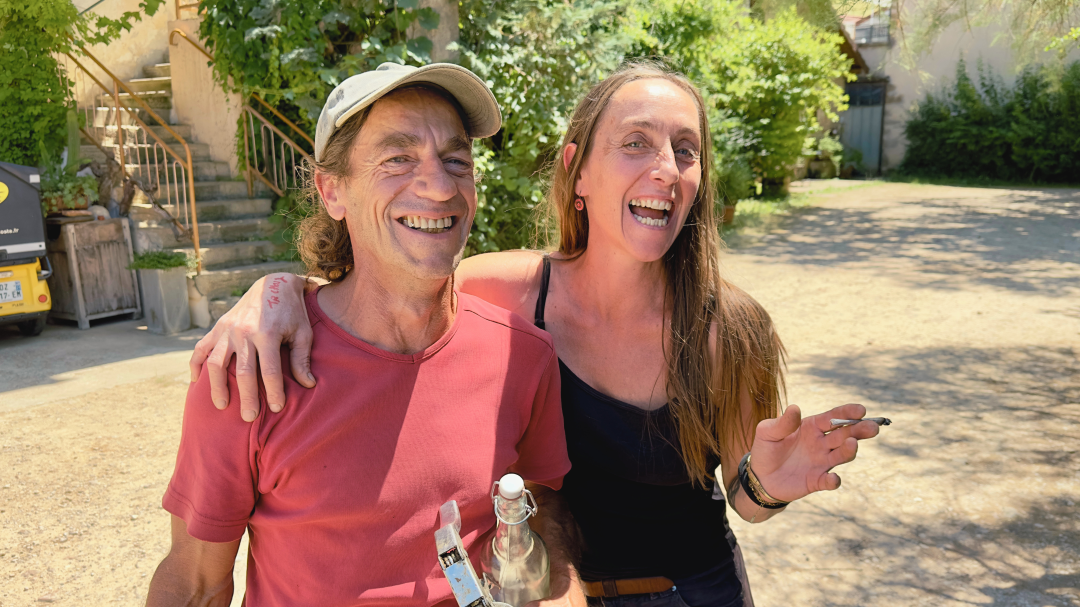
Siblings Romain and Charline Labet, ahead of what proved to be a spectacular 18-wine tasting at Domaine Labet, one of Jura's hot-ticket wineries.
An Early Look at 2026
As of early August 2026, Jura's growing season was advancing even faster than in 2025, running roughly two weeks ahead of an already precocious vintage. Many growers are anticipating a harvest beginning around August 20, potentially the earliest on record. But, as 2025 demonstrated, a shift to cooler, wetter conditions at the end of August could markedly slow ripening and ultimately reshape the character of the vintage.
I tasted the majority of the wines for this report in Jura during March and June 2026, with follow-up tastings at my office in Switzerland.
© 2026, Vinous. No portion of this article may be copied, shared or redistributed without prior consent from Vinous. Doing so is not only a violation of our copyright but also threatens the survival of independent wine criticism.
You Might Also Enjoy
Jura: Nature Hits Hard, but the Wines Fight Back, Nicolas Greinacher, September 2025
Bonjour Jura!, Nicolas Greinacher, August 2024
Northern Rhône 2023: The Art of Perseverance, Nicolas Greinacher, January 2025
Châteauneuf-du-Pape: Alluring 2023s and Benchmark 2010s, Nicolas Greinacher, November 2024
Focus on Vacqueyras: Latest Vintages and Top Producers, Nicolas Greinacher, October 2024
Show all the wines (sorted by score)
- Alexandra Mossu
- Bénédicte & Stéphane Tissot
- Camille Loye
- Cellier Saint Benoit
- Chateau d'Arlay
- Château de Verreux
- Claude Charbonnier
- Domaine Baud Génération 9
- Domaine Benoit Badoz
- Domaine Berthet-Bondet
- Domaine Bourdy
- Domaine Butin
- Domaine Courbet
- Domaine de la Pinte
- Domaine de la Renardière
- Domaine de Montbourgeau
- Domaine de Savagny
- Domaine des Marnes Blanches
- Domaine des Miroirs (Kenjiro Kagami)
- Domaine Dugois
- Domaine du Pélican
- Domaine Fumey Chatelain
- Domaine Geneletti
- Domaine Grand
- Domaine Jacques Tissot
- Domaine Jean-Claude & Valentin Credoz
- Domaine Labet
- Domaine Lornet
- Domaine Maire et Fils
- Domaine Noir Frères
- Domaine Philippe Chatillon
- Domaine Philippe Vandelle
- Domaine Pignier
- Domaine Rijckaert
- Domaine Rolet
- François Mossu
- François Rousset-Martin
- Fruitière Vinicole d'Arbois
- Fruitière Vinicole de Voiteur
- Jean-François Ganevat
- Jean-Marc Brignot
- Kevin Bouillet
- Lucien Aviet & Fils
- Maison Bonnot
- Maison des Saules
- Maison du Vigneron
- Maison Pierre Overnoy
- Michel Tissot et Fils
- Nicolas Jacob
- Pierre Girardin
- Renaud Bruyère & Adeline Houillon